
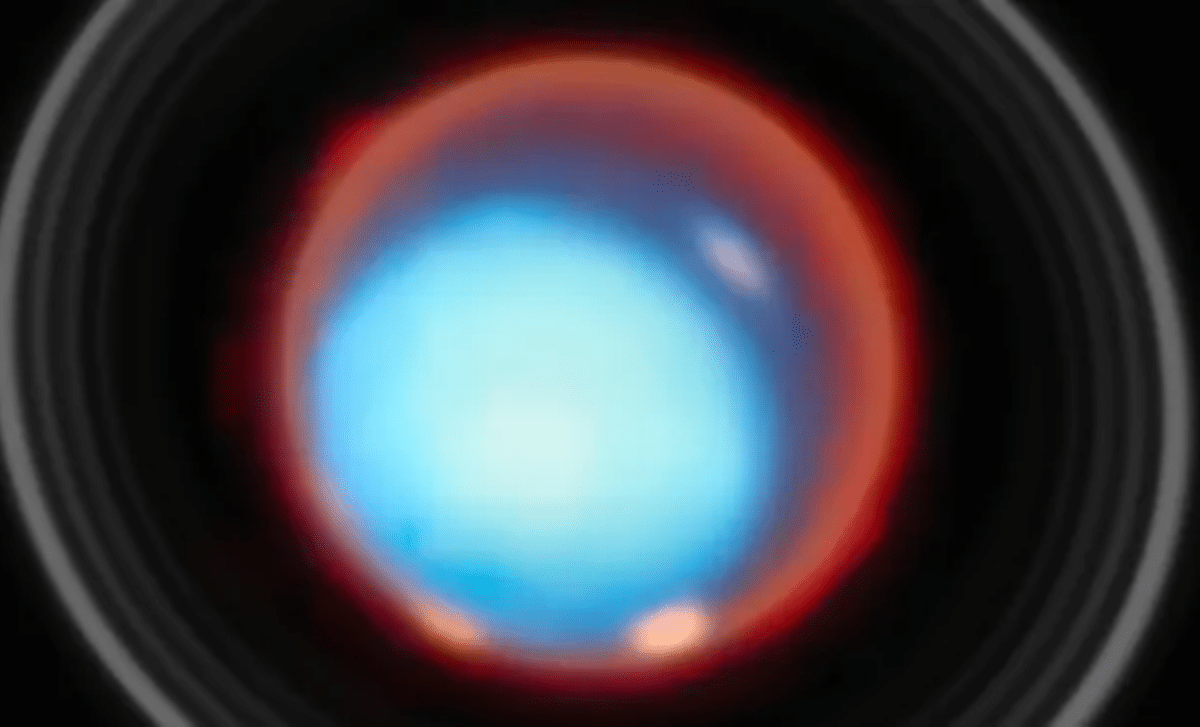
Uranus, with its strange magnetic field and mysterious auroras, has long baffled scientists. Now, thanks to the James Webb Space Telescope (JWST), researchers have mapped the planet’s auroras in 3D for the first time. This new study, published in Geophysical Research Letters, reveals new insights into Uranus’s unique atmosphere and magnetic field, paving the way for future exploration of distant planets beyond our solar system.
Uranus’s Magnetosphere: The Strangest in the Solar System
Uranus has long puzzled astronomers due to its unusual magnetosphere, which differs drastically from those of other planets in the solar system. “Uranus’s magnetosphere is one of the strangest in the solar system,” said Paola Tiranti, a researcher at Northumbria University in the U.K. The unique characteristics of Uranus’s magnetic field include its tilt and offset from the planet’s rotation axis. Unlike the orderly magnetic field of Earth, Uranus’s is skewed, causing its auroras to behave in complex and unpredictable ways. This has made studying the planet’s atmosphere and its interaction with solar wind a challenging task for astronomers.
Thanks to the sensitivity of the JWST, scientists have been able to study Uranus’s auroras in unprecedented detail, providing a clearer understanding of how its magnetosphere influences the planet’s atmospheric dynamics. By mapping these auroras in 3D, researchers were able to visualize how energy moves through Uranus’s upper atmosphere in ways never before possible. These findings not only shed light on Uranus’s unique magnetosphere but also provide valuable information about the processes that shape auroras on other planets, especially those outside our solar system.
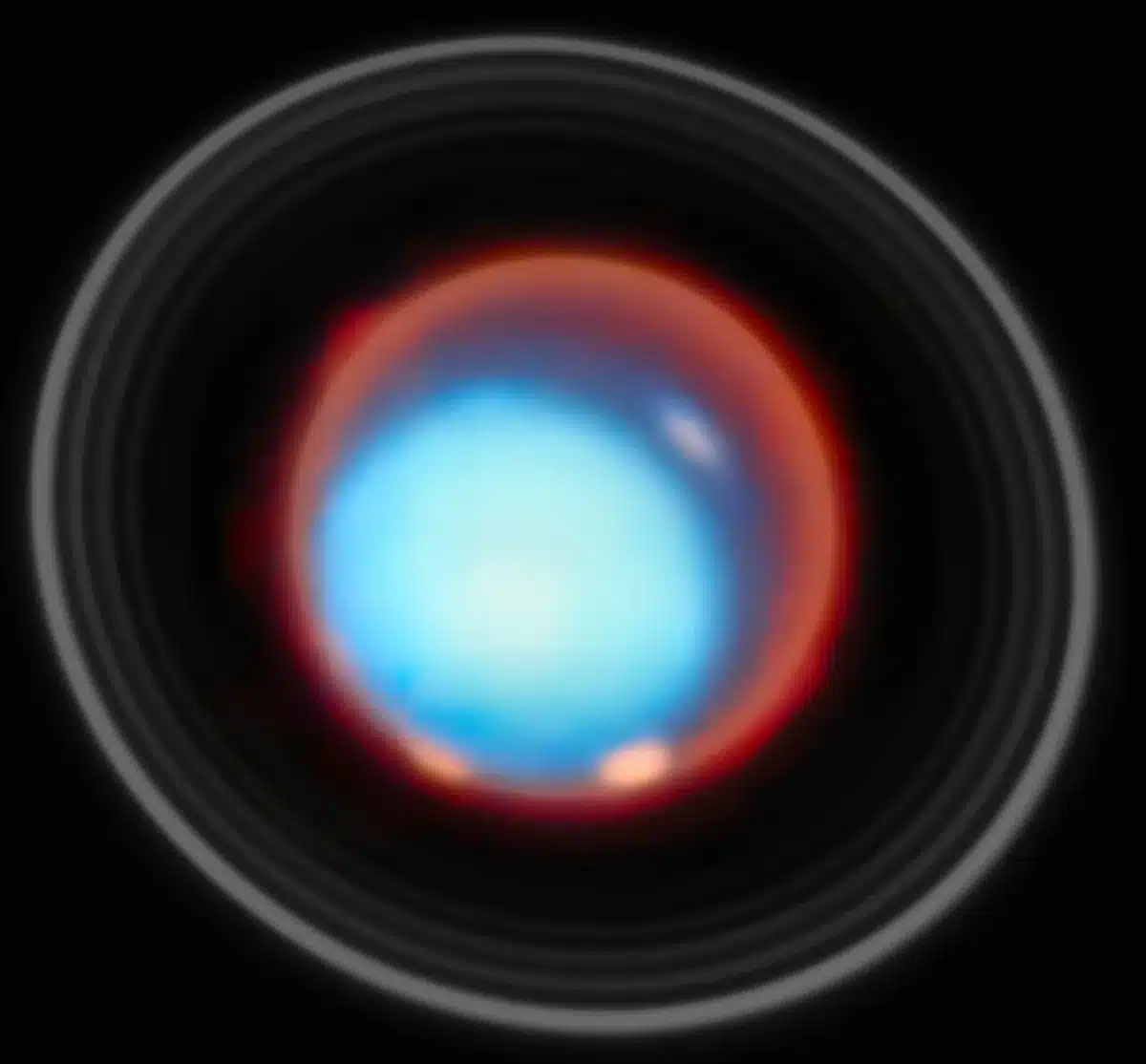 A view of Uranus captured by the James Webb Space Telescope, 19 January 2025.
Credit: ESA/Webb, NASA, CSA, STScI, P. Tiranti, H. Melin, M. Zamani (ESA/Webb)
A Three-Dimensional View of Uranus’s Upper Atmosphere
The ability to observe Uranus’s upper atmosphere in three dimensions is a major milestone in planetary science. “This is the first time we’ve been able to see Uranus’s upper atmosphere in three dimensions,” Paola Tiranti noted. Prior to this, astronomers were limited to two-dimensional observations, which only provided partial views of the planet’s atmospheric layers. With Webb’s advanced imaging capabilities, scientists can now trace how energy moves upward through Uranus’s atmosphere, a phenomenon that was difficult to study with earlier telescopes.
The 3D maps also reveal the influence of Uranus’s lopsided magnetic field, which causes energy to transfer in uneven patterns. This insight into the atmospheric dynamics of Uranus is invaluable for understanding not only the planet itself but also other ice giants and gas giants across the universe. The data gathered from Webb’s observations are expected to play a key role in future studies of distant exoplanets, particularly those with similar magnetic and atmospheric characteristics.
The Cooling Atmosphere of Uranus
One of the most intriguing discoveries from the JWST observations is that Uranus’s upper atmosphere is still cooling, extending a trend that began in the early 1990s. “Webb’s data confirm that Uranus’s upper atmosphere is still cooling, extending a trend that began in the early 1990s,” said Tiranti. This cooling trend suggests that the planet’s energy output is decreasing over time, which could have implications for its long-term climatic patterns.
The team measured an average temperature of around 426 kelvins (about 150 degrees Celsius), a significantly lower value than previous measurements taken by ground-based telescopes or past spacecraft, including the Voyager 2 mission. This cooler temperature indicates that Uranus may be experiencing a prolonged period of cooling, which could affect the behavior of its atmosphere, magnetosphere, and even its weather systems. The findings, published in published in Geophysical Research Letters, provide important clues about the planet’s past and its evolution over time.