
A new artificial intelligence system has outperformed experienced physicians in diagnosing rare diseases, according to a study published in Nature, marking a pivotal moment in the use of advanced AI for complex clinical decision-making.
A New Approach To One Of Medicine’s Hardest Problems
Rare diseases affect an estimated 300 million people worldwide, yet each individual condition is so uncommon that physicians may encounter only a handful of cases in their careers. The result is often a diagnostic odyssey that stretches across years, filled with referrals, inconclusive tests, and repeated misdiagnoses. In response to this long-standing challenge, researchers developed DeepRare, an AI-driven system designed specifically to tackle the complexity of rare-disease phenotyping and diagnosis.
Unlike conventional AI tools that rely on a single predictive model, DeepRare integrates 40 specialized digital tools capable of analyzing genetic sequences, medical databases, clinical notes, and even handwritten physician observations. At the center of the architecture sits a coordinating AI “host” that orchestrates these tools into a unified reasoning process. The findings, detailed in the journal Nature, suggest that this multi-agent system can synthesize vast and fragmented medical data more effectively than traditional diagnostic workflows. By combining genomic insights with symptom-level pattern recognition, DeepRare attempts to mirror, and extend, the reasoning steps of human specialists.
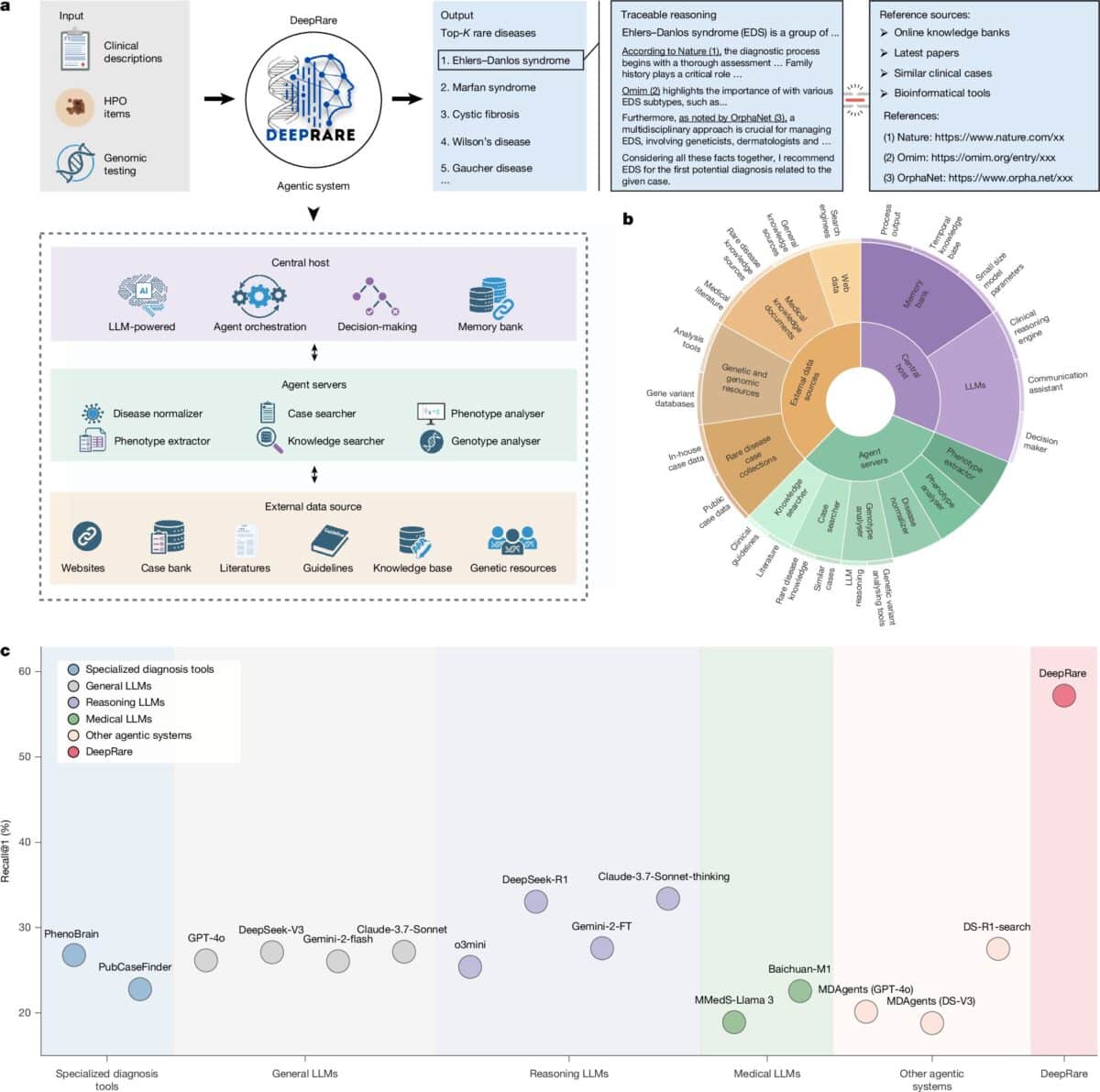 DeepRare: an agentic framework for rare disease prioritization. Credit: Nature (2026). DOI: 10.1038/s41586-025-10097-9
Head-To-Head With Experienced Physicians
The system was first evaluated using 6,401 historical clinical cases where the correct diagnoses were already known. Researchers fed DeepRare the same clinical symptoms and DNA information that physicians originally had at the time of diagnosis. The AI demonstrated that it could have identified many of the diseases earlier in the diagnostic timeline, outperforming 15 other existing computational diagnostic tools. The decisive test came in a smaller but more demanding cohort of 163 difficult cases. Five physicians, each with more than a decade of clinical experience, were asked to review the same data provided to the AI. DeepRare correctly identified the disease on its first attempt in 64.4% of cases, compared with 54.6% for the physicians. The research team stated,
“DeepRare is one of the first computational models to surpass the diagnostic performance of expert physicians in the complex task of rare-disease phenotyping and diagnosis.”
Even when the AI’s first guess was not correct, the right diagnosis was frequently included among its top three suggestions, reflected in a strong Recall@3 score. This indicates not only accuracy but also practical clinical usefulness, where differential diagnosis lists matter.
Transparency, Agreement, And Clinical Implications
One of the major concerns surrounding advanced AI systems is interpretability. To address this, the researchers invited ten rare disease specialists to evaluate DeepRare’s step-by-step reasoning. They agreed with the AI’s logic in 95.4% of cases, suggesting that the system’s conclusions were not only accurate but medically coherent. This alignment between machine reasoning and human expertise strengthens the case for real-world clinical adoption. The study’s authors emphasized the broader implications of their findings, writing, “Our work not only advances rare disease diagnosis but also demonstrates how the latest powerful large-language-model-driven agentic systems can reshape current clinical workflows.” By structuring the AI as a coordinated network of agents rather than a monolithic model, the researchers created a diagnostic engine capable of cross-referencing genetic data, phenotypic features, and medical literature in parallel. In practice, such systems could reduce years of uncertainty for patients and decrease unnecessary interventions. Hospitals may eventually deploy similar architectures to support physicians, offering ranked diagnostic suggestions grounded in both genomic data and global medical knowledge.
Toward A New Era Of Ai-Assisted Medicine
The success of DeepRare signals a broader transformation underway in healthcare. Rare disease diagnosis has long represented one of medicine’s most complex reasoning challenges, requiring synthesis across genetics, neurology, immunology, and countless subspecialties. An AI capable of coordinating dozens of analytical tools simultaneously introduces a new paradigm for clinical problem-solving. Rather than replacing physicians, such systems may serve as advanced collaborators, augmenting diagnostic precision and reducing cognitive overload. The publication in Nature positions DeepRare at the forefront of AI-driven medicine, demonstrating measurable gains in accuracy against seasoned professionals. As healthcare systems grapple with growing patient complexity and limited specialist availability, multi-agent AI platforms could become embedded within electronic health records and genomic labs. The coming years will determine how regulators, clinicians, and patients respond to this shift, but the data suggest that artificial intelligence is beginning to redefine what is possible in rare disease care.