

Off the coast of Western Australia, the Southern Indian Ocean is becoming significantly less salty, and scientists say it’s happening at a rate never seen before. This rapid freshening has raised alarms about its potential effects on global ocean circulation and marine ecosystems. While this may sound like a distant concern, the changes unfolding in this remote ocean could ultimately ripple out to impact the entire planet.
A recent study published in Nature Climate Change outlines how this dramatic change has unfolded over the last six decades. Global warming has altered key wind patterns across the Indian and Pacific Oceans, pushing more freshwater into the Southern Indian Ocean.
While the region has long been characterized by high salinity due to evaporation, the new influx of freshwater is radically changing the composition of the water, and scientists are worried about what it could mean for ocean currents and marine life far beyond the region.
A Rapid Shift in Salinity
According to the study, published in Nature, salinity levels in the Southern Indian Ocean have dropped by around 30% over the last 60 years. To put that in perspective, the researchers compared it to adding the volume of 60% of Lake Tahoe’s freshwater every year.
“To put that into perspective, the amount of freshwater flowing into this ocean area is enough to supply the entire U.S. population with drinking water for more than 380 years,” clarified the lead author Gengxin Chen, a visiting scholar in the Department of Atmospheric and Oceanic Sciences.
Interestingly, this freshening isn’t due to more rainfall in the area, but rather to changing wind patterns. The winds, which are linked to the warming of the planet, are pushing more freshwater from the Indo-Pacific freshwater pool into the Southern Indian Ocean. Normally, this pool stays fresh due to frequent rainfall, but now that water is finding its way into the ocean, further diluting the salinity.
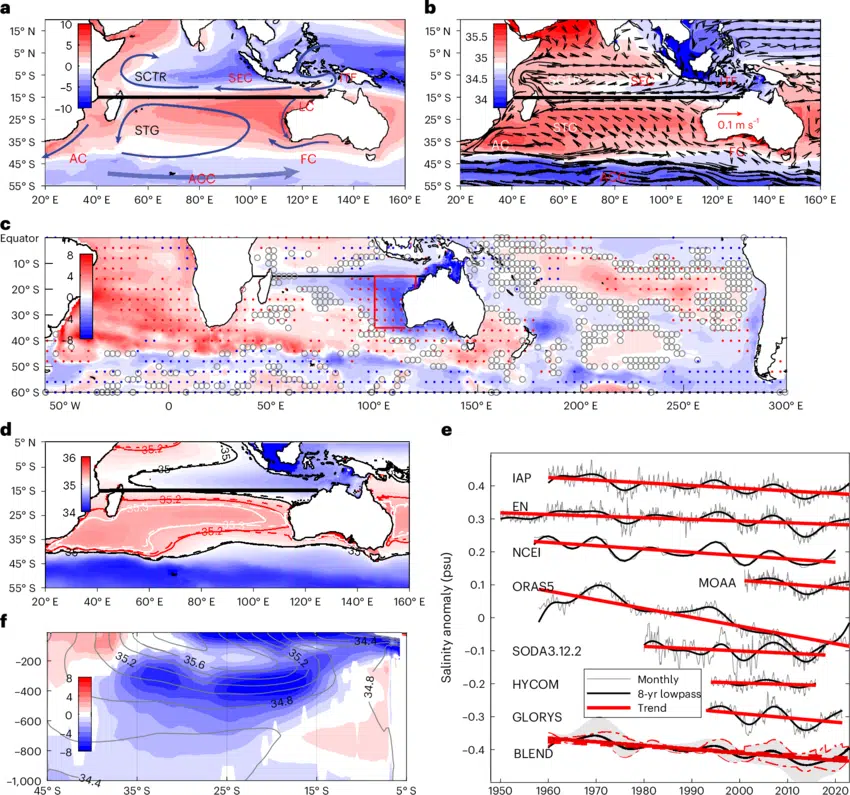 This figure shows salinity patterns and trends in the Southern Indian Ocean, highlighting a decline in salinity over time. Credit: Nature Climate Change
Is Salinity Killing Our Oceans?
Salinity may seem like a minor detail when you’re considering the health of an ocean, but it plays a huge role in the movement of ocean currents. Ocean currents are essential for regulating the Earth’s climate. They help distribute heat and nutrients around the globe. But these currents rely on seawater density, which is heavily influenced by salt levels.
When freshwater dilutes the salt content, the water becomes less dense, and that affects how it moves. Instead of sinking and circulating in deep layers, the lighter, fresher water stays near the surface. This disruption is a big deal because it stops vertical mixing in the ocean. Vertical mixing is vital for bringing nutrients from the deep up to the surface, where marine life can access them. Without it, surface ecosystems might struggle.
“Salinity changes could affect plankton and seagrass. These are the foundation of the marine food web. Changes in them could have far-reaching impacts on the biodiversity in our oceans,” said the study’s lead author.
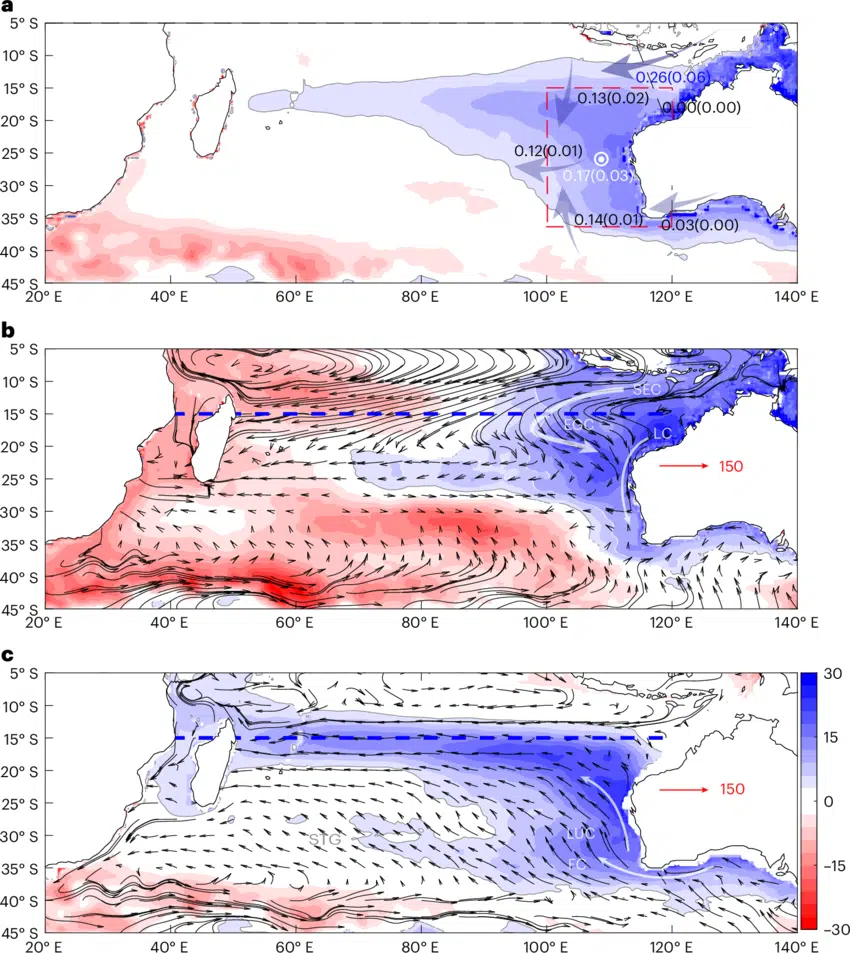 This figure displays salinity anomalies and ocean currents in the Southern Indian Ocean. Credit: Nature Climate Change
A Ripple Effect on Global Climate
The Southern Indian Ocean plays a critical role in the global thermohaline circulation, which regulates the climate by moving heat and nutrients between ocean basins. However, if its salinity continues to drop, it could disrupt this system, affecting ocean currents and climate patterns worldwide.
This freshening could even extend to the Atlantic Ocean, weakening currents that regulate climate in regions like Europe and North America. The interconnectedness of the oceans means that changes in one part can have widespread impacts, influencing both marine life and global weather.