
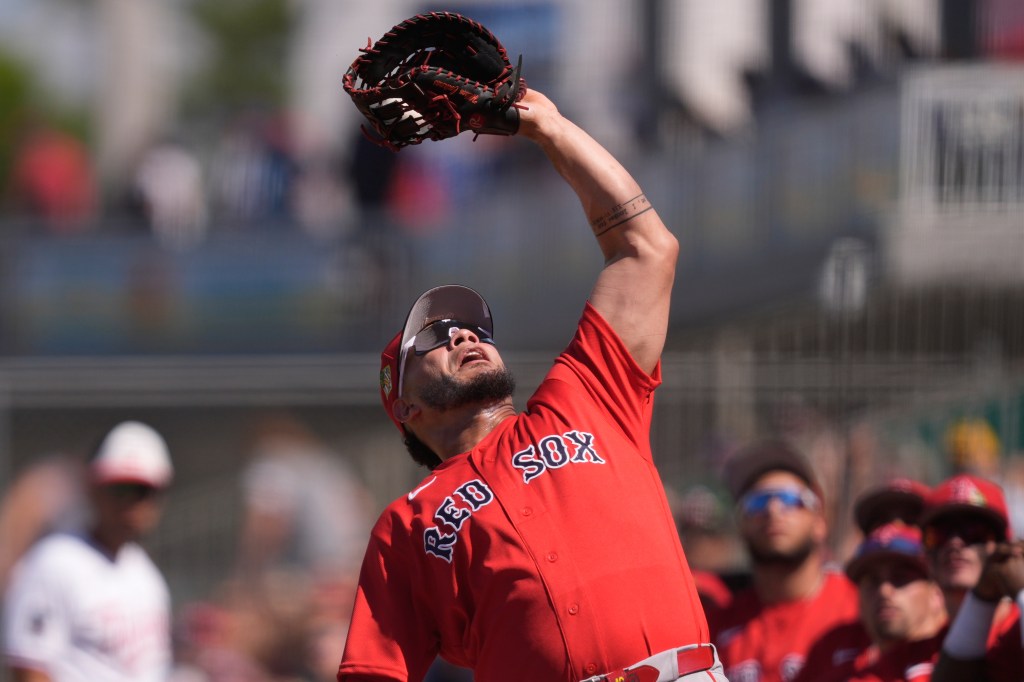
FORT MYERS, Fla. — Willson Contreras will be the answer to a deep-cut Red Sox trivia question some day.
Who made the first ABS challenge in franchise history?
Manager Alex Cora has instructed his players to be aggressive with the new Automatic Ball-Strike challenge system in spring training games, especially with more than a dozen players leaving camp in the coming days for the World Baseball Classic and therefore missing days, if not weeks, of opportunities to familiarize themselves with the technology before Opening Day.
So it was Contreras who requested the first-ever Red Sox challenge with two outs in the top of the first on Saturday. And he was successful.
“It was good to have that reaction, because I was so convinced that it was low,” Contreras told the Herald, “But at the same time, you start doubting a little bit because they delayed the call.”
A longtime catcher before moving to first base last season, Contreras feels he might have an advantage as the league adapts to this new technology.
“It’s different when you’re catching than hitting, but when you’re a first baseman you don’t know the strike zone, the umpire, anything like that,” Contreras said earlier during his postgame media session. “You just know your strike zone, you’ve been playing for so many years that you have an idea of what is (a) ball and strike. But it definitely helps, for sure.”
The ABS challenge system gives teams two challenges per game, to be used only by the pitcher, catcher, or hitter. If a player challenges successfully, their team retains the opportunity to do so again. In extra innings, teams without challenges remaining will receive one per frame.
It’s a new form of entertainment for fans, a long-awaited solution to umpire error and a new layer of education and preparation for players. But it’s certainly going to be an adjustment for everyone. Since camp began, Cora has expressed a wish for more challenges in spring training games multiple times. On Saturday, he revealed MLB managers made such a request, and were rebuffed. Instead, teams are conducting meetings with their players about strategy and impulse control, and learning as they go.
“I think it’s huge, I think it can change the course of a game, especially late in the game,” Roman Anthony said. “I challenged quite a bit (in Triple-A). … It’s great for me. It’s turned a lot of strikeouts into walks, or it’s changed a lot of counts for me where I was able to kind of reset the count and do damage. So I think it should be great for the game.”
“I think it’s good to have the opportunity to challenge yourself and see how good you are with your eyes,” Contreras said, “and it’s also good for the umpires to have an idea that the strike zone changes for different guys.”
The Red Sox aren’t making it explicitly verboten, but they’ve made it clear they don’t want their pitchers challenging.
“Absolutely not,” said Payton Tolle when asked about pitchers challenging as he started Saturday’s 7-2 victory at the Minnesota Twins’ complex across town. “I think everything’s a strike! It could be four balls off and I’d think it’s a strike. So I’m going to leave that to the higher powers of catchers.”
For younger players like Anthony and Tolle, who began learning the challenge system while it was tested in the minor leagues, this spring training is simply a continuation of their education.
“It was something that was new to me right when I got to Triple-A at the end of ‘24,” Anthony said. “Just kind of getting comfortable with it, getting used to it, I feel like sometimes I forget it’s even there until somebody uses it.”
But ABS will be, pun intended, a challenge. Even Anthony, known to be even-keeled and capable of a level of elite plate discipline rarely seen in a 21-year-old with 71 career MLB games under his belt, admitted he got greedy with the system in the minors. That was all well and good on the farm, where the focus is on player development, not winning. But in the majors, the new challenge system can win or lose a game.
“There were times where I got a little greedy for sure,” Anthony said with a grin. “But at the same time, I feel like I have a good feel for the zone.”
“I think the biggest thing, not just for me but for everyone, is just that the situation of the game is huge for challenging,” Anthony continued. “I think when you lose (challenges) too early, I’ve seen it kind of go the other way where you’re late in the game and you don’t have one. … I think they’re going to be a slept-on component of this game, that people are going to realize how much they really matter, I think once the regular season starts.”
Contreras sees situational awareness as the key to ABS success.
“We have to be aware of the situation first,” Contreras told the Herald. “I know this is a game of emotion, ups and downs, and you can get greedy at times, and also you can get picky with the strike zone.
“I think the most important thing is just to know when to challenge. If it’s a good situation, like bases-loaded, and you are convinced that it was a ball that was called a strike, why not? We won’t get it 100% right, but at least we will have the conviction.”
Contreras’ successful challenge was met with gleeful reactions from the Red Sox.
“Everybody in the dugout (was) hooting and hollering about it,” Tolle said.
Contreras, who recently said his new teammates made him feel like a brother as soon as he reported to camp, also saw their reactions to his successful challenge as further evidence that there’s something different about these Red Sox.
“Their reaction was priceless,” the former Cubs and Cardinals star said. “I’ve been playing for three teams. This team for me, it seems like they’re really special.
“Every guy that comes here, that comes up, is trying to do the job. They work with a focus, with a goal, and it’s really hard to see that with a lot of guys. Because a lot of guys might come to the field just to come and do whatever they need to do, but this team is different, because they give goals. And we’re working toward something, which is the World Series.”
To get there, the Red Sox will need to overcome the usual challenges and adapt to this new one. That’s what spring training is for.
“If we get it wrong, this is the right time to challenge,” Contreras said, “and if we get it right, it’s applause.”
Red Sox anticipating ’emotional component’ as ABS system arrives in MLB