
I was too old for this.
That was the thought running through my mind as I took a seat in the leather chair inside Marilyn’s log cabin in Santa Margarita, California. Her office sat on her five-acre horse property—a rustic, unvarnished space that smelled faintly of hay and wood smoke, complete with a battered woodstove and knotty-pine walls held together with visible screws. Marilyn was a horse-and-mule person through and through—jeans, work shirt, short gray hair and a direct gaze that told you she had survived both wild animals and wild minds.
We’d been meeting twice a week for five years. Marilyn was also a psychology professor at Cal Poly and an expert in dissociative disorders. She was calm, grounded, and possessed that rare capacity therapists need to treat complex trauma—an internal stillness that does not waver, even when the person in front of them does.
I have dissociative identity disorder—DID—formerly called multiple personality disorder. Before my diagnosis at 38, I knew only the Hollywood versions: Sybil, The Three Faces of Eve, the crime dramas where “Mr. Hyde did it” was supposed to clear someone of guilt. None of that prepared me for what being a multiple is actually like from the inside.
DID is not theatrical or sensational. It is a brilliant, desperate, adaptive survival strategy that doctors believe is caused by childhood trauma—trauma than a single conscious self could bear. During moments of extended trauma, the mind fragments because it must. The fragments know what the child cannot. And then, sometimes decades later, you meet them—sometimes in a therapist’s cabin, sometimes at the worst possible moment.
Before I came apart at the seams, my life looked solid. I was married to Rikki, and we had a beautiful son. We were building a life. From the outside, nothing signaled that internally I was living in a house with a hundred locked rooms and a troupe of strangers who held the keys. Then 24 alter personalities emerged—young boys and twin girls, an older man of wisdom, a man who liked to joke around and wanted to date Rikki, a guy who got things done that needed doing, one who held anger, one who kept the secret of my abuse by hurting me so nobody would tell, and others. Each had a name, an identity, a job assigned in my childhood to keep me from emotional annihilation. I called them “my guys.”
We got to know each other. Rikki welcomed everyone, explaining to them why they were living in the body of a man. We made pacts about who could drive (me) or shop (me) or take care of my son Kai (me). We told our son as much as he could understand and taught him to “call me back” when I switched in his presence. Rikki read to the children after Kai had gone to bed. She took me to the hospital when someone harmed me. She was my rock and my soft place to fall. The surreal became our normal.
Read MoreMy Turn
Marilyn and I worked with EMDR—eye movement desensitization and reprocessing—to target traumatic memories held by distinct alters. As each alter relived abuse in the safety of the session, I absorbed the aftershocks. The work was emotionally excruciating. After particularly difficult sessions, I would lose days to a fog that felt like the smoke from a fire I didn’t remember lighting.
Rikki navigated all of this beside me: the switches, the exhaustion, the emotional hangovers, the fear. She never demanded explanations I couldn’t give. She treated the process the way one treats a long medical recovery—patiently, steadily, with devotion. She attempted to maintain some sort of a normal life for our son.
But this essay isn’t about marriage or fatherhood. It’s about the day a new part of me introduced himself.
I arrived at Marilyn’s cabin one morning already fragile. The night before, I had been at the hospital—32 stitches. I didn’t remember the logic behind the injury, hadn’t held the knife, but felt the warning that something inside had cracked.
Marilyn was waiting outside when Rikki dropped me off. She glanced at the bandage on my arm, gave a single nod—acknowledgment without alarm—and gestured toward the door. She understood dissociation as fluently as some people understand weather patterns. Before I could say a word, she’d read the atmosphere inside me.
I sank into the leather chair. She opened her notebook. The room felt still, watchful. Then came the internal tremor—the shift in sensation that always precedes a switch.
Wyatt appeared. He’d been around for a while. Wyatt is 10. He likes to count things, to pace along borders. He catalogues patterns to create internal order. He sprang up from the chair and began side-stepping the perimeter of the rug, keeping his feet aligned perfectly on the edge, careful not to step on the tile near the wood stove.
“There’s two in each board,” he said, tapping the wall. “Two screws on each side. On each end.” Counting didn’t soothe him—it organized him. It kept him from slipping into chaos.
“Not good today,” he added. “Big trouble.” He touched my—his—bandaged arm.
“You went to the hospital?” Marilyn asked.
“Hurts,” he said. “Thirty-two stitches. I counted.”
My heart pounded. Something was building inside. Marilyn sensed it. She asked Wyatt to sit. He obeyed immediately.
Then the switch hit.
The right side of my face slumped. My mouth sagged open. My right eye closed. My breathing grew ragged and loud. My torso folded in on itself. I was still conscious—aware—but unable to move. This switching pattern was new, neurologically distinct from the others and physically alarming.
“Hi,” Marilyn said softly. “I’m Marilyn. Who are you?”
The child’s voice that emerged was distorted by the partial facial paralysis. “Roger.”
He didn’t know where he was. His panic was immediate and primal. “I don’t know,” he sobbed. “I don’t know.”
He tried to stand, to flee. The terror of finding yourself in a large adult body when you believe you are a small child is indescribable. Marilyn moved quickly but gently, placing a steady hand on his shoulder.
“You’re safe,” she said. “You’re in my office. I’m a doctor. I’m here to help you.”
He looked at the bandaged arm, studying it as if it belonged to someone else. He touched it. “Why does it hurt?”
“It’s your arm, too,” Marilyn said. “Yours and Cam’s. You and Cam live in the same body. Do you know who Cam is.”
This is one of the bizarre truths of DID: Alters may perceive themselves as physically separate from my body, even while inhabiting it. They arrive with their own age, affect, trauma load, and subjective reality. They have to learn who I am if they don’t already know and that we share corporeal space.
Marilyn asked Roger if he had hurt us.
“Don’t tell,” he whispered, his voice growly and slurring as if he’d had a stroke. “If you tell—I’m gonna cut your arm off.”
It wasn’t his anger. It was trauma reenacting itself. Then he screamed—sharp, terrified—and collapsed on the floor.
That was the end of the session. No EMDR. No memory processing. Just the shock of understanding that someone new had arrived—a child who knew a story no one else in the system could bear. When people think of DID, they imagine drama. But new parts don’t appear for spectacle. In my experience, they come out because the psyche has finally become strong and safe enough to allow another buried truth to surface.
DID is an elegant system. Pain held by an alter is never random. Each part emerged for a reason—with a function, a history, a fragment of truth. Roger had experienced something none of the others had—he was held down so he couldn’t breathe and his body was used in unspeakable ways. His EEG patterns show signs of brain injury. Mine don’t. It had been years since a new alter had appeared. He came out that day because I needed him to and I could bear to know one last secret. But the emergence of a new part destabilizes the system. A new part is like an earthquake—cracking the inner map, shifting emotional weight, demanding reorganization.
That day began a long period of learning who Roger was—what he carried, what he feared, why he existed. Marilyn approached each new part not as a symbol or symptom but as a person, albeit still a part of me. That made all the difference. She taught me to approach them that way too. Rikki just did it naturally.
People often imagine healing from trauma as a linear progress—resilience, breakthroughs, strength. But real healing often looks like this: sitting in a therapist’s cabin while a terrified child realizes he shares a body with a 43-year-old man. Healing looks like exhaustion, confusion, grief. It looks like starting over each time a new part arrives with a piece of the story you didn’t know you were missing. It looks like remembering that the self is not singular but layered, adaptive, fluid.
When Rikki picked me up that day, she didn’t ask which one of us had been in the room. She didn’t ask why I looked disoriented or why my voice was slower. She didn’t ask for a debrief or a warning label. She would get all that later.
She just said, “Hey, honey,” the way she always did.
Every part of me recognized her voice and it calmed us and allowed us to relax and feel, for the moment, the comfort of her solid presence.
People ask whether DID gets better. It’s different for every multiple. The short answer is yes—but not by erasing parts or forcing fusion. It gets better through internal communication and cooperation, through reducing amnesia and increasing trust, through painfully processing the trauma that got us here in the first place. Healing is not necessarily about integrating into one person, though for many multiples that is the goal and the result. But first, healing is about becoming one team and resolving the past to come fully into the present. And if you’re lucky, you have someone in your life who stays steady while you become who you are.
My system is quiet now. Integrated—not in the pop-psych sense of “becoming one,” but in the real clinical sense of stabilization, collaboration, and shared memory. Most of my alters are now, in essence, part of me. Roger is still around, as is Wyatt, but they reside quietly in a corner of my mind. And young Clay, one of the first to appear and a cherished protector, is still here and occasionally comes out to get a cookie that he shares with the others. They did the work I needed them to do. And now we are at peace.
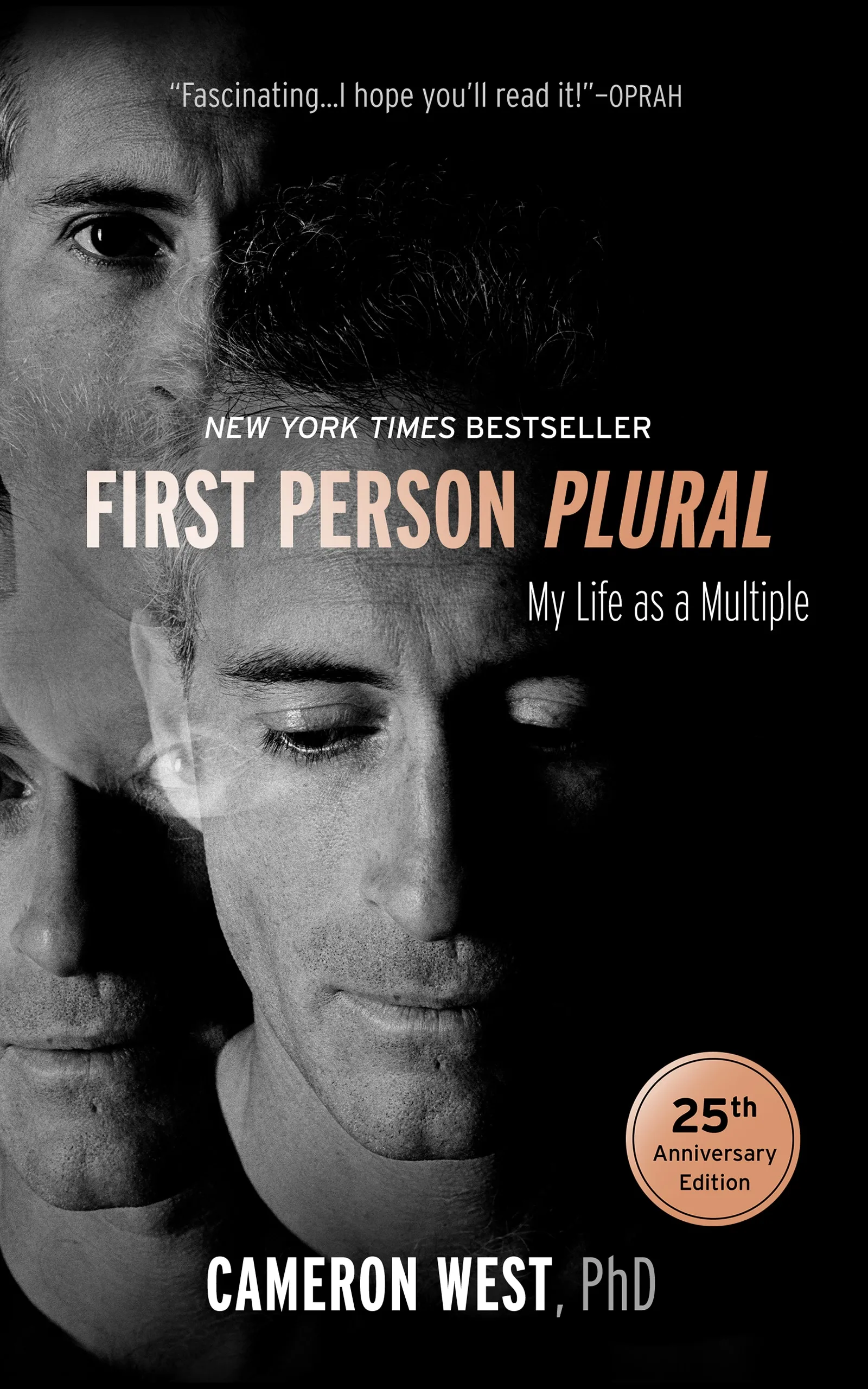
Cameron West is the author of the bestselling memoir, FIRST PERSON PLURAL: My Life as a Multiple, with a 25th anniversary edition coming from Blackstone Publishing on May 26, 2026.
All views expressed in this article are the author’s alone.
Do you have a personal essay you want to share with Newsweek? Send your story to MyTurn@newsweek.com.