
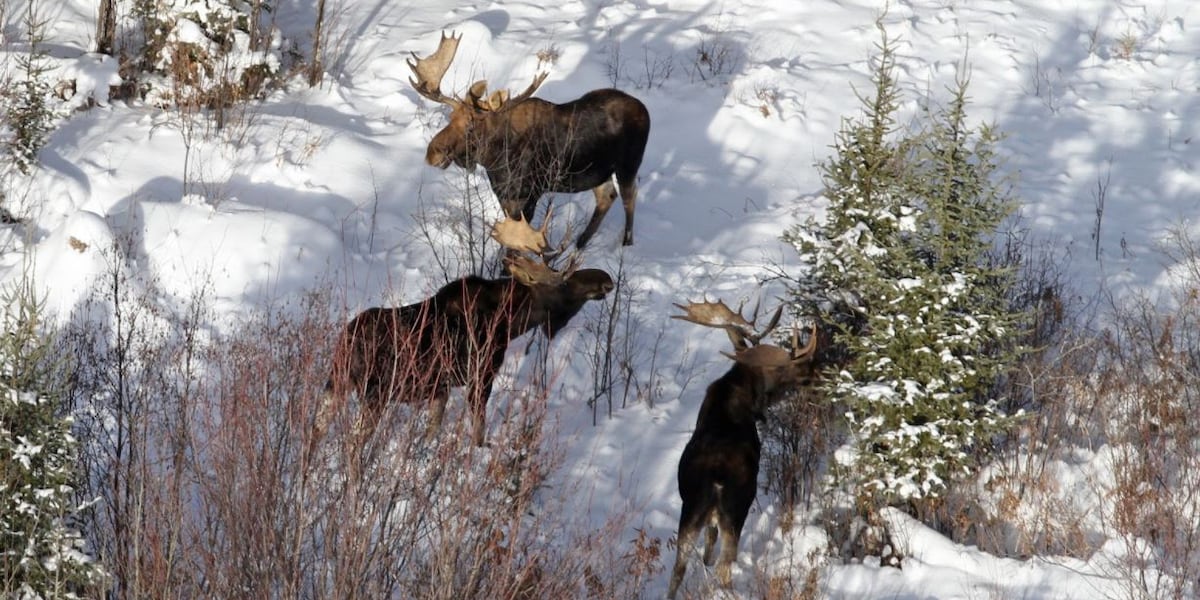
MARQUETTE, Mich. (WLUC) – The Michigan DNR now has data from the first year of a five-year study on moose in Upper Michigan.
One year ago, the DNR began collaring moose from the core moose population in the central and western Upper Peninsula.
This first year, they were able to collar 20 moose, with plans to collar more in the coming years. Now, data shows the moose population has declined to about 300, down from 426 in 2023.
But, the DNR said the numbers are down partly because the moose seem to be moving south and west.
“What we’ve really seen is that over-wintering populations of moose have been shifting quite a bit to the south of US 41, we’re not really sure of the extent of how much south and west those populations are going but, from this capture, from the collaring that we’ve been doing,” Michigan DNR Wildlife Research Specialist, Tyler Petroelje said. “We are seeing moose that are over-wintering further to the west, outside of what we consider to be the core range, and even further to the south outside of what we call the traditional core range.”
Petroelje said they are seeing encouraging news about moose births in the wild, with about 80 percent of observed moose producing calves. But this winter has been very severe, and they may see a decline.
“We were quite surprised to see good calf production and good twinning rates relative to the number of animals we sampled, but, because there can be very good calf years and then subsequently very poor calf years, following something like a severe winter, we are interested to see if our calf production falls this coming year,” Petroelje said.
The study is a partnership between the DNR, the Keweenaw Bay Indian Community and Northern Michigan University. Grant money for the next few years of the study has been secured. In total, the DNR hopes to collar about 60 moose during the study.
Copyright 2026 WLUC. All rights reserved.