
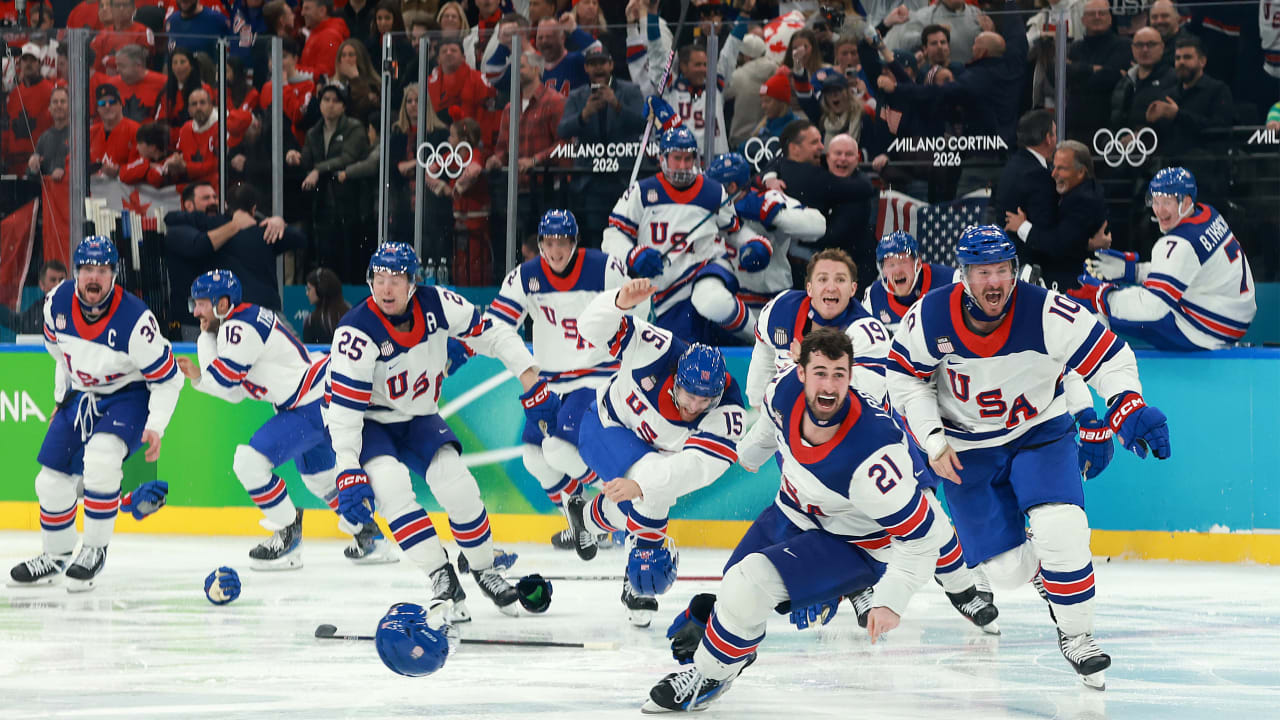
And then he delivered the winning goal. He flashed his broken teeth with a bloody smile.
“It speaks volumes to the type of person he is, the type of player he is,” said U.S. defenseman Quinn Hughes, his brother. “Yeah, just an incredible moment.”
This was validation for U.S. general manager Bill Guerin and his staff too. They were questioned entering the tournament for leaving home some of the top U.S.-born goal-scorers in the NHL. But they valued chemistry, and they slotted players into roles.
Two players some thought shouldn’t have made the team — forwards J.T. Miller and Vincent Trocheck — helped the Americans go 17-for-17 on the penalty kill in the tournament. That included a 5-on-3 PK of 1:33 against Team Canada’s fearsome power play in the second period and another PK of 1:11 late in the third.
“The team was built with personality in mind,” Sullivan said. “We were loaded with personality up and down our lineup. There are whiskey drinkers and milk drinkers, and we’ve got a lot of whiskey drinkers on this team.”
The players carried American flags around the ice, along with the No. 13 jersey of the late Johnny Gaudreau. They received their gold medals, sang the “Star-Spangled Banner” as the American flag rose to the rafters, and spoke to president Donald Trump via videoconference in the locker room.
“This game in a lot of ways was an inspiration to our country,” Sullivan said.
It will inspire the next generation of hockey players in the United States, the way the “Miracle on Ice” team did in 1980, the way the World Cup team did in 1996, leaving a legacy for this group of Americans.
“We’re going to hopefully create some more superstars that want to not just play hockey but want to represent the United States of America,” U.S. forward Brady Tkachuk said. “This is one of the greatest feelings I’ve ever had. Just to do it alongside everybody here, this is so special.”