
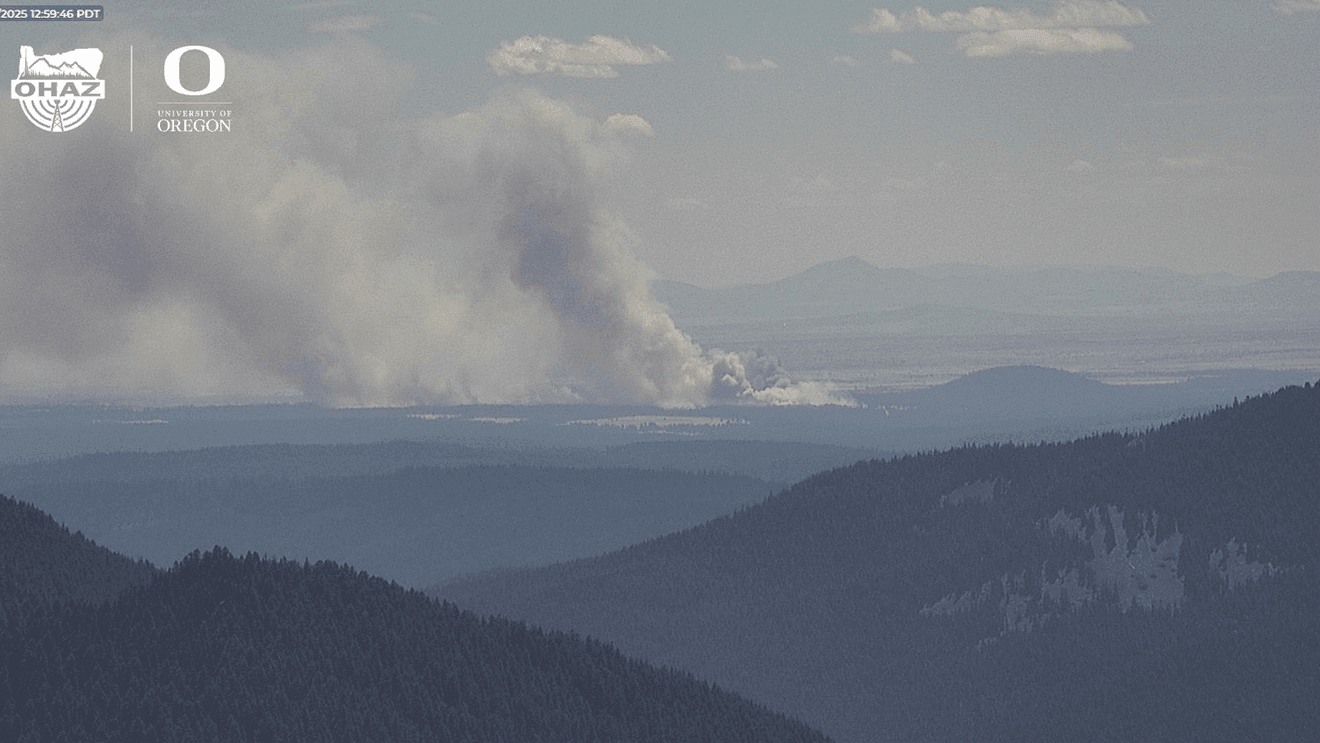
As Oregon heads into what potentially could be another dangerous wildfire season, a key early-warning detection system is facing a budget shortfall. Wildfire cameras operated by the University of Oregon Hazards Lab (OHAZ) help fire crews and the public spot smoke and fires in real time, but researchers warn some of those cameras could soon go dark.
The director of the lab, Leland O’Driscoll, told lawmakers in a committee meeting Friday that the lab is roughly $2 million short, putting staffing and 33 of their cameras at risk.
“We see these [cameras] as tools,” O’Driscoll said. “We use tools and we provide them to the fire professionals. We also present the tools to the public so they can see the landscape and see if there’s anything happening in their region.”
The lab collaborates with the Oregon Department of Forestry (ODF) and other agencies across the state as part of the broader Oregon Wildfire Detection Camera Interoperability Committee (OWDCIC). The group was formed after the Governor’s Office and federal agencies asked for a cross-sector group to be established in detection camera efforts.
“As the university and research entity, we can take the lead on that and assist with the Department of Forestry’s mission and adopting technology,” O’Driscoll said. “And in turn, that allows the Department of Forestry to really focus more on the challenge of fire operations and response.”
The AI-enabled camera network is currently made up of 180 cameras across the state; 70 of those cameras are operated by OHAZ. The cameras provide a round-the-clock, 360-degree view and are typically on top of tall mountains or high-rise buildings.
Levi Hopkins, Deputy Chief Policy and Planning with ODF’s protection division, also told lawmakers the cameras ultimately save agencies a significant amount of funding and resources.
“It the end of the day, that really just resolves to preventing a small fire from becoming large, and then ultimately potentially saving thousands, if not millions, of dollars right there. Just by knowing the adequate response of what’s needed for that detection when we can see it live, and fire managers can see what what is necessary,” Hopkins said. “If we need to call a helicopter, call an airplane, we can see it right there before the firefighters even get on scene.”
O’Driscoll said the goal is to have 250 cameras operational, but for full statewide coverage, more than 500 cameras are needed.
According to O’Driscoll, each camera costs roughly $25,000 to operate annually, and there’s currently not enough consistent funding to keep all of the current cameras operational.
“We currently have a series of cameras at risk of going offline for this fire season and into the next, and so we’re working to mitigate that,” O’Driscoll said. “It is all about preserving staffing, but also preserving the services in those regions. Largely, our cameras are in Western Oregon that are under threat. Those were funded by the state, and they also serve a lot of communities in the wildland urban interface boundaries that are out there. So we’re looking to protect that capital investment.”
O’Driscoll also told lawmakers that investments into fire operations are in dire need, saying the Cascades were below 50% of the snow water equivalent for the 30-year running average.
RELATED | Low snowpack does not necessarily mean extreme wildfire season next summer
Democratic Representative Nancy Nathanson called the situation “alarming,” emphasizing that wildfire response and communications are a large part of the committee’s responsibilities.
There are funds on the table from the previous session, including House Bill 3219, that O’Driscoll urges lawmakers not to reduce in the upcoming budget.
O’Driscoll said $2 million is the immediate shortfall, but said $4 million would be needed in order to meet their expansion goals of getting 250 cameras online.
“The operational cost of a camera or even 10 cameras is a fraction of what it costs to survey, to do a reconnaissance and certainly if we can save even percentages of burn areas, that response time is overwhelming in terms of the cost savings.”