
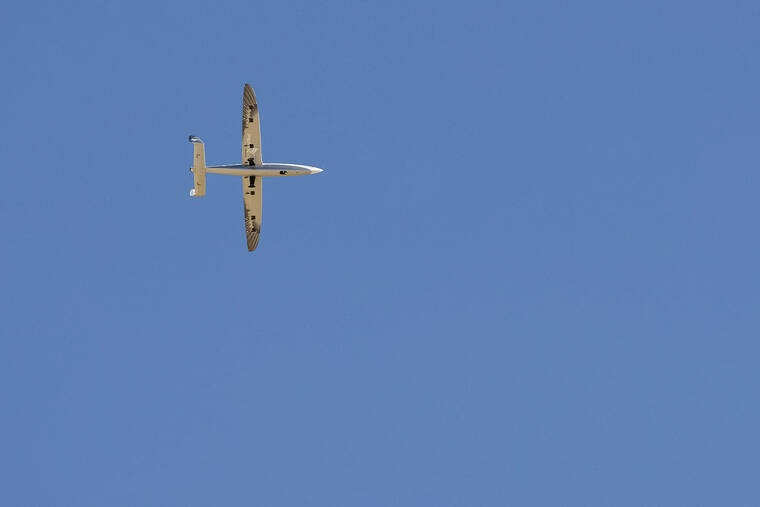
State leaders are considering what could be a leap toward a decades-old goal of making the aerospace industry a big part of Hawaii’s economy.
Two bills pending at the Legislature aim to help a California company launch payloads via rocket into space at low cost from a winged booster ship towed high into the sky by plane.
The measures — one to let the firm sell up to $40 million in low-interest bonds and another to have the state help pay for building a high-tech hangar at Hilo International Airport — recently advanced after initial committee hearings.
Public testimony on the bills was all positive or neutral. Yet even if one or both do become law, it wouldn’t ensure realizing what the company, Fenix Space Inc., said could be part of its entry into a $13 billion “orbital launch” market that it projects will grow to over $40 billion by 2030.
Trung Lam, executive director of the Hawaii Technology Development Corp., a state agency, described the interest by Fenix as an “amazing” opportunity.
“The opportunity for aerospace development is right now,” he told a House committee considering one of the bills. “Hawaii has missed out in the past on many opportunities because we took a long time to make a move.”
Don’t miss out on what’s happening!
Stay in touch with breaking news, as it happens, conveniently in your email inbox. It’s FREE!
Hawaii’s place in space
Hawaii has a long history in the aerospace sector that includes providing vital assistance with training NASA Apollo program astronauts on Mauna Kea for their first landing on the moon in 1969, tracking spacecraft and retrieving returning astronauts who splashed down in the Pacific Ocean.
In 1985, Ellison Onizuka became the first Hawaii-born astronaut to fly into space aboard the Space Shuttle Discovery. Onizuka, a Hawaii island native, died a year later with the crew of the Challenger shuttle that exploded during takeoff from Cape Canaveral, Fla.
Other more recent and ongoing endeavors include a University of Hawaii at Hilo aerospace research and education program called Pacific International Space Center for Exploration Systems, or PISCES, which was established in 2007 and among other things has helped test robotic rovers for planetary exploration.
At the NASA-funded Hawaii Space Exploration Analog and Simulation program established in 2012 and also known as HI-SEAS, astronaut mission conditions on Mars and the moon are simulated in a “biodome” atop Mauna Loa where test subjects live for up to a year.
Yet state leaders also have foregone projects and other efforts to make Hawaii a more significant player in aerospace.
Missions explored
One major failed past effort was to develop a space port in Kau on Hawaii island in the late 1980s and early 1990s.
A more recent setback was the Legislature abolishing the state Office of Aerospace Development in 2021, though some of the office’s work shifted to the HTDC led by Lam.
Since then, some lawmakers have invigorated aerospace development efforts, but without much, if any, success.
Thirteen House and Senate members in 2024 formed the bipartisan Aviation and Space Caucus chaired by Rep. Kanani Souza (R, Kapolei-Makakilo) and have introduced one or two bills in each of the last three years in addition to aerospace-related measures from other lawmakers.
Souza, an attorney with a master’s degree in air and space law from the University of Mississippi School of Law, said the caucus is in its infancy but aims to help Hawaii compete with other states that have plans or projects to improve infrastructure for aerospace industry growth.
“We have no plan in place,” she said. “This is a very lucrative industry. I feel we have a ways to go, but we have to start somewhere.”
One of the first bills from the caucus in 2024 proposed to reopen the Ellison S. Onizuka Space Center, an educational facility established at Kona International Airport in 1991 that featured a space travel simulator, personal belongings of Onizuka, interactive displays, a lunar sample, an Apollo 13 spacesuit and other space-related exhibits.
The center, built by the state Department of Transportation in coordination with the Onizuka family and a memorial committee, was closed in 2016 during airport renovations. The airport was renamed for Onizuka in 2017 but the center wasn’t restored. The bill to reopen the center didn’t receive a hearing.
Another caucus bill from 2024 proposed to establish an air and space law program at UH’s William S. Richardson School Law. That bill was deferred after an initial committee hearing.
A more ambitious bill introduced in 2024 by Souza and three Republican colleagues proposed creating a public corporation to develop a spaceport for launching vehicles and cargo into space. The bill wasn’t taken up for action.
One aerospace bill that did advance significantly in 2024 was introduced by a bipartisan group of six senators led by Sen. Glenn Wakai (D, Kalihi-Salt Lake-Pearl Harbor) to establish an aerospace and aeronautics development program within the state Department of Business, Economic Development and Tourism.
The measure passed the full Senate on a 25-0 vote after two committee hearings but stalled in the House.
Last year, one caucus bill that stalled without a hearing proposed to establish a Hawaii Space Commission within DBEDT to promote innovation in space exploration and commercial aerospace.
This year, another space commission bill, House Bill 1903, stalled without a hearing. But one caucus bill advancing after an initial committee hearing, HB 1904, proposes to establish a board within DBEDT to track and manage orbital traffic with authority to award research, education and workforce development grants.
Unique enterprise
The more attention-grabbing legislation currently pending before lawmakers involves potential Fenix operations.
HB 1608, introduced by six House members led by Rep. Greggor Ilagan (D, Hawaiian Paradise Park-Hawaiian Beaches-Leilani Estates), would authorize Fenix to sell up to $40 million in special-purpose revenue bonds to finance an operating base at the Hilo airport.
Such tax-exempt financing is something that private entities can seek through the state for projects that have a public benefit and are within several industries that include industrial enterprises along with agriculture, health care, utilities and education. The state incurs no financial obligation for the bonds.
Fenix founder and CEO Jason Lee in written testimony said the company would use proceeds “to create the world’s first orbital launch-on-demand site and service.”
The operation, he said, would include three autonomous, fully reusable winged booster vehicles, one modified Gulfstream G‑IV tow aircraft and a number of payload-carrying rocket launch vehicles to offer regular and affordable service to orbit from Hawaii for a global customer base.
“Fenix launch operations will drive industry cluster growth and encourage launch customers and partners to establish a permanent presence to take full advantage of our unique launch-on-demand service,” Lee said, adding that a current wait of two years exists for low-cost launches to a fixed orbital destination.
Lee also said the San Bernardino, Calif.-based company expects to generate revenue topping $400 million by 2030.
According to the San Bernardino Economic Development Agency, Fenix is an offshoot of Kelly Space & Technology Inc., an aerospace and defense technology firm founded in 1993 and based with Fenix at the San Bernardino International Airport.
The agency, in a November 2024 report, said the company’s approach, which Lee said is based on a NASA towed-glider air launch system, is to tow a winged booster by plane to 40,000 feet, followed by the booster rising to 60,000 feet where a launch vehicle atop the booster deploys to space.
The agency quoted Lee as saying Fenix anticipated its first full-scale test flight in 2026.
Fenix in 2023 and 2024 received $1.5 million from the U.S. Small Business Administration, which said the company’s plan is to establish the first commercial service for deploying space vehicles from the top of air-launch vehicles instead of below.
In September, Alaska-based investment firm Alaska Capital LLC announced that it signed a letter of intent to invest $30 million in Fenix in conjunction with accessing airports and launch facilities in Kodiak, Anchorage, Fairbanks and the Aleutian Islands.
Hilo focus
Lee told Hawaii lawmakers that Hilo also is being considered for Fenix operations due to its combination of geography, airspace, infrastructure and workforce potential.
In a statement, Lee explained that Hawaii’s latitude on the globe significantly boosts payload performance to low inclination orbits compared to mainland sites. He also said other important factors include uncongested airspace and flights over the ocean that eliminate risks to populated areas.
Senate Bill 2693 was introduced to help facilitate a Fenix operation in Hilo and proposes that the state Department of Transportation invest $15 million to help develop an aerospace hangar at the airport if an equal investment is committed by the federal government, a private entity or both.
Lee testified the envisioned 50,000-square-foot facility would suit Fenix’s needs and wouldn’t displace any existing airport users.
Lee also said the tow-launch procedure is based on a proven, FAA-regulated aviation technique similar to sailplane operations that have safely operated worldwide for decades, and that NASA describes the company’s technology as having the potential to “revolutionize the commercial space launch market.”
Lam at HTDC told a House committee considering the bond financing bill that the state DOT and Hawaii island Mayor Kimo Alameda support the Fenix project.
Lam also endorsed the hangar legislation, saying in written testimony on SB 2693 advanced by two Senate committees earlier this month that development of aerospace infrastructure can generate positive ripple effects across related industries, including advanced manufacturing, that help diversify Hawaii’s economy.
“The proposed project at Hilo International Airport has the potential to attract new ventures, support existing companies, and create high-quality jobs, clustered strategically in a concentrated geographic area,” he said. “We appreciate the Legislature’s attention to this opportunity and look forward to supporting its successful execution.”