
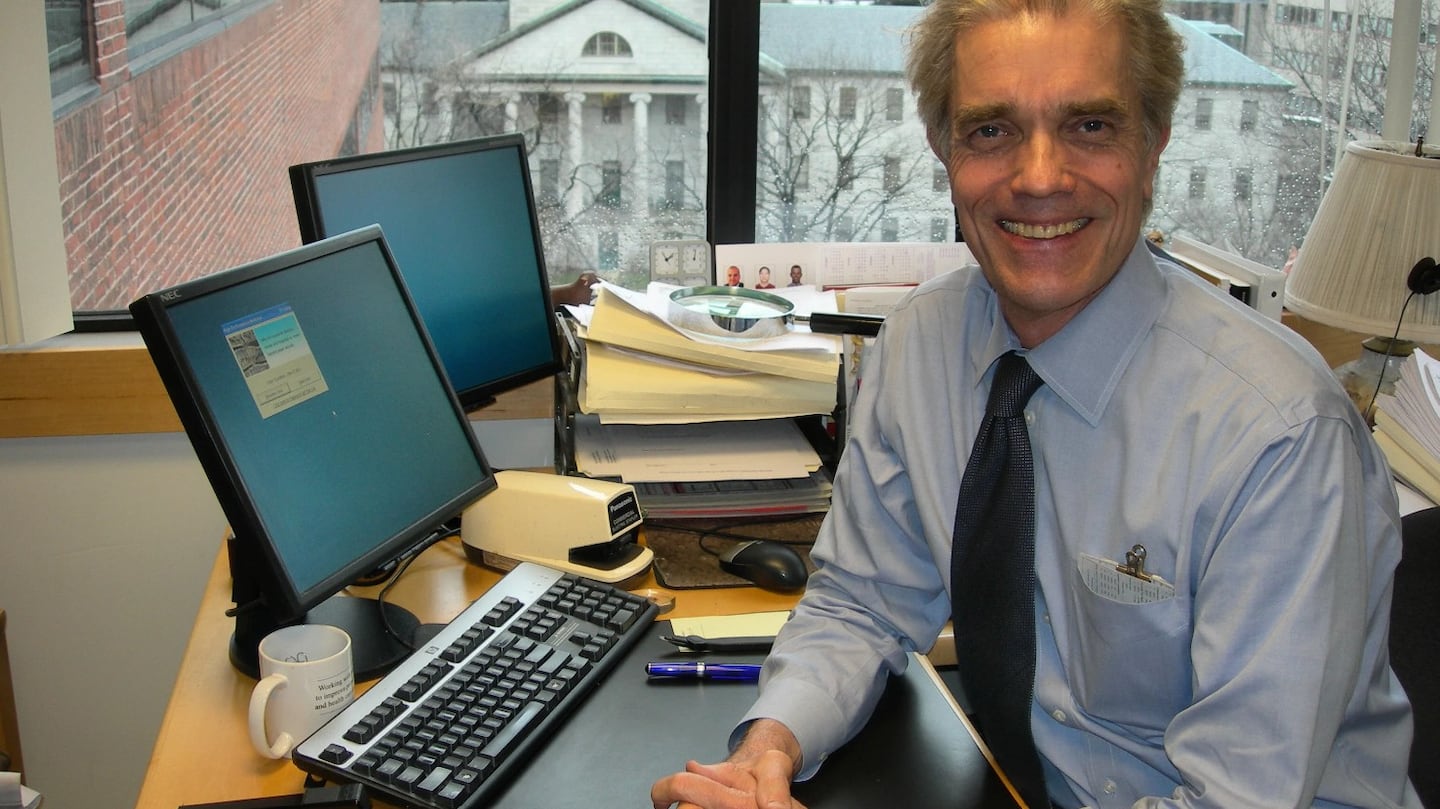
Of one patient, he wrote about the startling way death suddenly arrives: “And then you vanished / only ten short days from when you first walked in.” A few lines later, turning inward to give thanks for the gift of his own life, he added: “Reflecting, comparing fates / I breathe.”
Get Starting Point
A guide through the most important stories of the morning, delivered Monday through Friday.
Dr. Goodson, who spent his entire career at Massachusetts General Hospital and taught general internal medicine to generations of physicians, was 76 when he died Feb. 7 in his Cambridge home of complications from amyotrophic lateral sclerosis.
After being diagnosed with ALS, often known as Lou Gehrig’s disease, he added research subject to the medical roles he had filled. “He took every drug trial that he could,” said his wife, Pat Willard.
“He believed in the miracle of medicine until the very end,” said Dr. Goodson’s daughter, Molly, who lives in Mill Valley, Calif. “It was, I think, a guiding light for him.”
The son and grandson of general practitioners, Dr. Goodson also believed everyone should have access to health care, and he brought his advocacy to the State House and the nation’s capital.
“It is not an exaggeration to state that our Massachusetts universal health care access policy, and indeed our national Affordable Care Act, have their origins in work that Dr. Goodson championed in the late 1990s drafting a ballot initiative to establish state-based universal health access in Massachusetts,” Dr. Joshua P. Metlay, chief of the Division of General Internal Medicine, and Dr. Jose C. Florez, physician-in-chief and chair of the Department of Medicine, wrote to their MGH colleagues after Dr. Goodson died.
In a 2000 Globe interview about his efforts to expand health care access, Dr. Goodson noted that his “grandfather was a doctor who made house calls. My father was a doctor, too, and he cared for poor Blacks in St. Louis when no one else would. I want patient care to drive the system, not money.”
Two years later, he said: “You’re never going to change things unless you’re willing to start looking at how to do it.”
Born in Kansas City, Mo., on March 16, 1949, John David Goodson was the youngest of four siblings.
His father was Dr. William H. Goodson Jr., and his mother, Violet Sperling Goodson, was active in women’s organizations.
Dr. John D. Goodson received a bachelor’s degree from Columbia University and graduated in 1975 from Stanford University School of Medicine. He then went to MGH as an internal medicine resident and remained with the hospital for the rest of his career.
“He was totally devoted to his patients,” said Camille Madden, a nurse practitioner who worked with him for 26 years. “I swear he was there seven days a week. Even when he wasn’t on call on the weekend, he’d go in. Patients would tell me, ‘I saw him at 6 in the morning.’”
His persistence was such, she said, that “everybody wanted him because they knew if he was their doctor, they would absolutely get the best care in the hospital.”
Along with teaching at Harvard Medical School, where he was a professor, Dr. Goodson was a mainstay of MGH’s Division of General Internal Medicine.
He launched a continuing medical education course in the principles and practice of primary care internal medicine and helped found the “general internal medicine for specialists” program.
“A true giant in our field, he helped create and develop the academic discipline of primary care internal medicine as it exists today,” Metlay and Florez wrote.
Dr. Goodson also pushed for years to narrow the pay gap between primary care physicians and what specialists earn in other areas.
“John was extremely dedicated to making sure that primary care would be an appealing option for medical students and residents coming out of training,” said Dr. Zirui Song, a practicing general internist at MGH and an associate professor of health care policy and medicine at Harvard Medical School.
“He was a role model for all of us in how he approached patients, his bedside manner, his approach to clinical thinking, and clinical decision-making, which comprises a lot of the art of medicine,” Song said. “John was a master at the artistry of delivering high-quality, effective primary care.”
In addition to mentoring generations of primary care physicians, Dr. Goodson cofounded MGH’s John D. Stoeckle Center for Primary Care Innovation.
Dr. Goodson’s marriage to Barbara Dillon Goodson, who now lives in Joshua Tree, Calif., ended in divorce.
He reconnected with Pat Willard, whom he had known since they were children. “His father was our family’s doctor, and my father was his family’s minister,” she recalled.
They married in 2010 and traveled extensively across the country and abroad. He created photo presentations of their travels, crafted pottery, and was an enthusiastic Red Sox fan.
Dr. Goodson had “this ability for fun,” his daughter said. “He was belting out songs at Fenway louder than anyone else.’”
A prolific writer in many realms, he penned a letter a day during a grandson’s first year, “and put them in a book,” said his son John of New York City. “He was an amazingly attentive grandfather.”
Dr. Goodson collected his poetry in “100 Poems: Finding a Moment Every Day” and “Experiences: Reflecting on Certain Fate, I Breathe.” He also published “Longevity,” a book that gathered “his basic recommendations about how to have a good, long life,” his wife said.
He gave “Longevity” away to patients, many of whom mentioned the book and the care he provided, in hundreds of letters of thanks he received throughout his career.
In addition to his wife, daughter, son, and former wife, Dr. Goodson leaves another son, Ethan of Denver; two sisters, Grace Hayes of Centre, Ala., and Liz Verkler of Kansas City, Mo.; a brother, William Goodson III of San Francisco; and three grandchildren.
A celebration of his life and work will be held at 1 p.m. on May 2 in Newton Highlands Congregational Church.
Dr. Goodson approached ALS with “acceptance and grace,” his wife said. “He said to me, ‘I have no right to be angry about this. For years, I have said to patients: You know, life unfolds the way it unfolds, and your body will do what it does.’ And he said, ‘I’m no different.’”
In one poem, Dr. Goodson wrote about the role reversal that can occur as a doctor-patient relationship concludes. That man’s final months “brought an intimacy / that only a doctor can share / with a patient as death comes.”
At the end, he added, “I was in his care / even as he knew / as only the dying know / that there was little time left.”
Using equipment that let his eyes choose letters on a screen, Dr. Goodson kept communicating until a few days before his own death. Then he relied on glances, gazing at his wife as they sat at home on his last day.
“He would have wanted my face to be the last face that he saw, and he did,” she said. “Given who he was, it’s almost like he willed it: This is my time, this is how I’m going to do it. He did it perfectly.”
Bryan Marquard can be reached at bryan.marquard@globe.com.