
The hidden price of height
For centuries, the giraffe’s neck has captured our collective imagination. Yet the animal’s most transformative advantage is carried not in the air, but on the ground—its impossibly long legs. Those towering limbs lift the heart closer to the brain, trimming a brutal tax imposed by gravity. In a tall body, pushing blood uphill is a relentless struggle, and every meter of vertical distance raises the physiological bill.
A giraffe’s heart maintains arterial pressures around 200 mmHg, more than double a typical mammal’s level. That muscular pump burns staggering energy, even at rest. Put simply, the heart is a roaring biological engine, and the cost of keeping the brain perfused is an unforgiving expense. Without strategic design elsewhere in the body, such pressure would be a deadly liability, not a badge of grandeur.
“In biology, what’s ‘invisible’ to the eye often does the heaviest lifting,” as one researcher observed.
The “elaffe” thought experiment
To test how anatomy reshapes energy budgets, scientists built a theoretical hybrid: the “elaffe,” an eland’s sturdy body topped by a giraffe’s long neck. This creature reaches giraffe-like height but stands on much shorter legs. Crucially, its heart sits farther below the head, increasing the column of blood the pump must raise. The model’s circulatory cost soars, with 21% of total energy devoted to the heart, compared with 16% in real giraffes and only 6.7% in humans.
That five-point difference is evolution’s razor-thin margin, shaved by long legs. By elevating the torso—and therefore the heart—closer to the skull, giraffes reclaim roughly 5% of their dietary intake. Over a year, that sums to more than 1.5 metric tons of foliage, an edge that separates survival from starvation when drought grips the savanna.
Credit: Estelle Mayhew/Université de Pretoria — The imaginary “elaffe,” with a short-legged body and a long neck, would spend even more energy pumping blood to the **brain**.
What legs really do
Long legs are not mere stilts; they are circulatory strategy. They:
Shorten the heart-to-head distance, cutting the pressure the heart must generate.
Preserve precious calories that can be spent on growth, movement, and reproduction.
Raise the eyes above the horizon, aiding vigilance against lurking predators.
Expand feeding reach, accessing browse others cannot touch.
Each benefit turns vertical height from a liability into an adaptive asset.
Evolution written backward
The fossil record suggests legs got longer first, with necks lagging behind. That sequence reads like a careful budget, not a flamboyant splurge. By solving the heart’s energy problem via taller limbs, natural selection could later afford the neck’s dramatic extension. Without that preliminary fix, an ultra-long neck would have been physiologically untenable, no matter how many leaves it could reach.
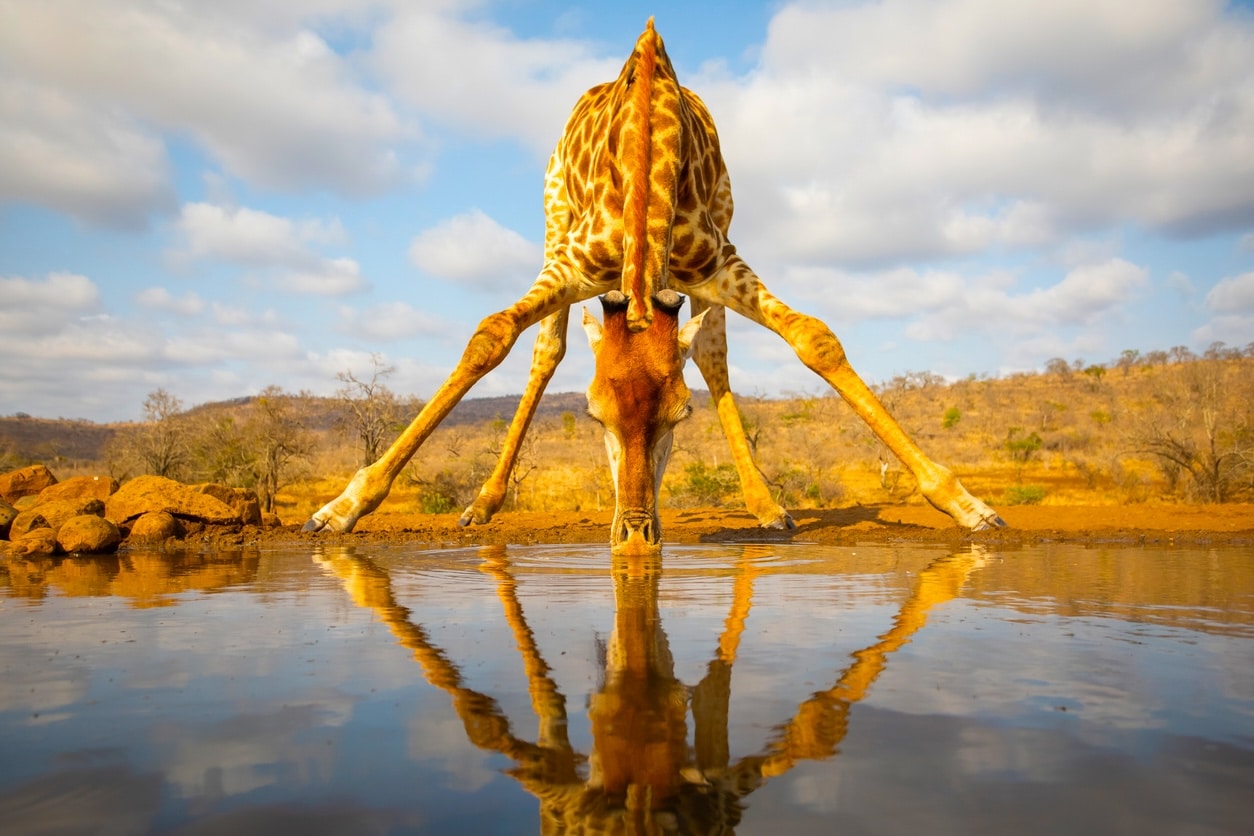
There was, however, a price to pay. To drink, giraffes splay their forelegs in a precarious stance, exposing soft underparts while the head dips low. Waterholes become danger zones, and many individuals retreat without drinking when a threat seems even faintly likely. Elegance at a distance turns into awkward vulnerability up close, a vivid example of evolutionary trade-offs.
The ceiling on terrestrial height
Physics sets a hard limit on how tall a land animal can grow. Consider Giraffatitan, a sauropod displayed at about 13 meters in Berlin. To perfuse a brain some 8.5 meters above the heart, estimates suggest a blood pressure near 770 mmHg. That’s almost eight times a mammal’s norm, a hemodynamic burden so steep the heart’s energy use would have outpaced the rest of the body’s demands.
At those levels, consciousness itself becomes a fragile luxury, not a stable state. By contrast, a male giraffe at roughly six meters appears to skim the workable ceiling. Push higher, and the circulatory math stops adding up. Biology can stretch physics only so far before the numbers snap back.
The overlooked masterpiece
Our gaze drifts to the showy neck, but survival rests on the quiet legs. They recast height from a hydraulic nightmare into a solvable problem, letting the heart do less of the wrong work and more of the right. In the end, true elegance lies where attention rarely falls—in the architecture that makes audacity affordable. Look down, and you’ll see the real secret to a giraffe’s improbable grace.