
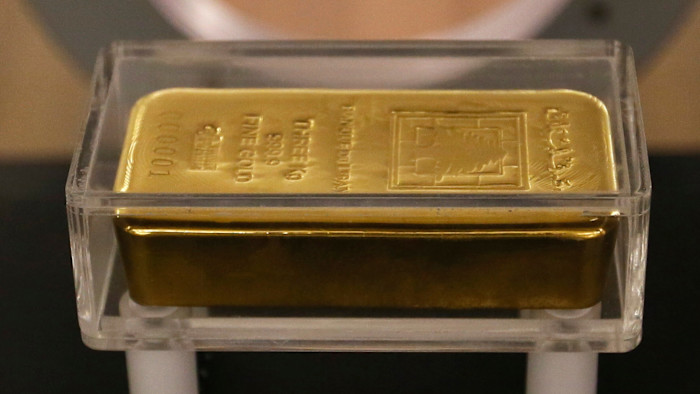
Lebanese bankers and politicians are eyeing the controversial sale or lease of part of the central bank’s large gold reserves — whose value has soared along with the gold price — as a way of rescuing the country from a devastating economic crisis.
Lebanon has struggled to agree on a solution for the economic collapse that has stricken the country since 2019, but the sale of the nation’s accumulated gold reserves is an unpopular solution for citizens who see it as a fix for the few at the expense of the many.
“The country isn’t broken financially — it’s been looted by our leaders,” said Ahmed Zaydan, a shop owner in Beirut who sells bottles of cooking gas. “Don’t sell the gold, bring us the money you stole.”
The crisis — in which banks cut depositors off from their funds, the government defaulted on its debt and the local currency lost more than 90 per cent of its value — was triggered by a severe foreign currency shortfall.
It followed years of what the World Bank described as a ‘Ponzi scheme’ in which banks and in turn bank depositors earned unusually high interest rates on dollar deposits with the central bank, which sought to maintain the currency peg.
For years, banks have resisted paying a large share of the estimated $70bn that is owed to their depositors — while the state has said it does not have the means to shoulder the burden.
But Lebanon now finds itself with the chance of a windfall that could mean avoiding such difficult decisions altogether, analysts say.
Lebanon’s central bank has an unusually large reserve of gold for such a small country — the more than 280 tonnes it holds is second only to Saudi Arabia in the Middle East. The bank began building up gold reserves in the 1940s and 1950s to underpin the value of the Lebanese pound.
That means the recent unprecedented global rise in the price of gold has had an outsized benefit. The price of gold has risen 70 per cent over the past year — to about $5,000 per ounce.
The value of Lebanon’s gold reserves has tripled from the start of the crisis to reach about $45bn in early 2026 — equivalent to more than half the financial losses.
But Lebanese law prohibits the sale or lease of the gold, meaning parliament would need to pass legislation to allow the precious metal to be used.
Meanwhile, politicians and bankers are debating a controversial law that would determine who is responsible for paying back the depositors.
 The central bank began building up gold reserves in the 1940s and 1950s to underpin the value of the Lebanese pound © Hasan Shaaban/Bloomberg
The bill is a key requirement for an IMF deal, which authorities view as crucial for recovering from the disaster. Since 2019 Lebanon has failed to implement reforms demanded by the IMF.
Although the draft law — known as the financial gap law — rules out the use of gold, some analysts say it will eventually end up being part of the solution.
The central bank does not have the liquidity to make the payments promised by the law, unless at least some of the gold is sold or leased, they say. The IMF has not opposed the use of the gold.
Mike Azar, an expert on Lebanon’s financial crisis, said that under the draft law’s proposed payment schedule, the central bank could end up defaulting unless parliament authorises a sale of the gold.
“If your plan is to use the gold, then just say so,” said Azar. “But don’t pass a law that likely doesn’t work if you don’t sell the gold. And hope that in the future whoever is in power will be forced to do it to avoid another default, but today say no, that’s not our plan.”
Few have openly advocated the sale of the gold because the subject is so politically toxic. Instead, the discussions among bankers and policymakers are happening in private.
One banker in favour of selling part of the gold said the banks were not making such proposals publicly because they did not want to further anger the Lebanese public.
Critics say the sale of the gold would bail out banks and wealthy depositors at the expense of the general public.
“These are the assets of the people. So if you’re selling the gold to pay the depositors, it’s like you’re selling the house wealth to bail out one of the children, but you have five children,” said Lamia Moubayad, president of the Basil Fuleihan Institute at the finance ministry.
“Accounting-wise, as a family you have no debt anymore, but basically one of your children got it all, at the expense of his siblings. And not only that, but he will repeat [his mistakes] again.”
 Critics say the sale of the gold would bail out banks and wealthy depositors at the expense of the general public © Bloomberg
Industry minister Joe Issa el-Khoury has been one of the few politicians to publicly suggest selling the gold.
“To improve the gap law, it would be advisable to agree to liquidate about $15bn of the gold to buy investment-grade zero-coupon bonds and give them to depositors whose deposits are greater than $100,000,” he said in a post on X last month. He later clarified that it would not be to benefit the banks.
Mark Daou, an independent member of parliament, said bankers and pro-bank politicians were advocating for the sale of the gold because it would reduce the repayment obligations of commercial banks to depositors.
“The sale of the gold only benefits the banks,” Daou said. “The entire strategy of the banks is the shifting of wealth from the state or the central bank to the banks.”
Ali Noureddeen, an economic researcher at The Tahrir Institute for Middle East Policy, said if the gold was sold in the short term, banks could benefit because “instead of recapitalising, they’ll depend on the gold for the first years of payments”.
But Daou said the proposals remained largely theoretical because few politicians were willing to openly advocate it. “No MPs want to go and tell [the] Lebanese people, ‘I’m selling your assets to fix a problem for large depositors.’”