
This is part of Slate’s 2026 Olympics coverage. Read more here.
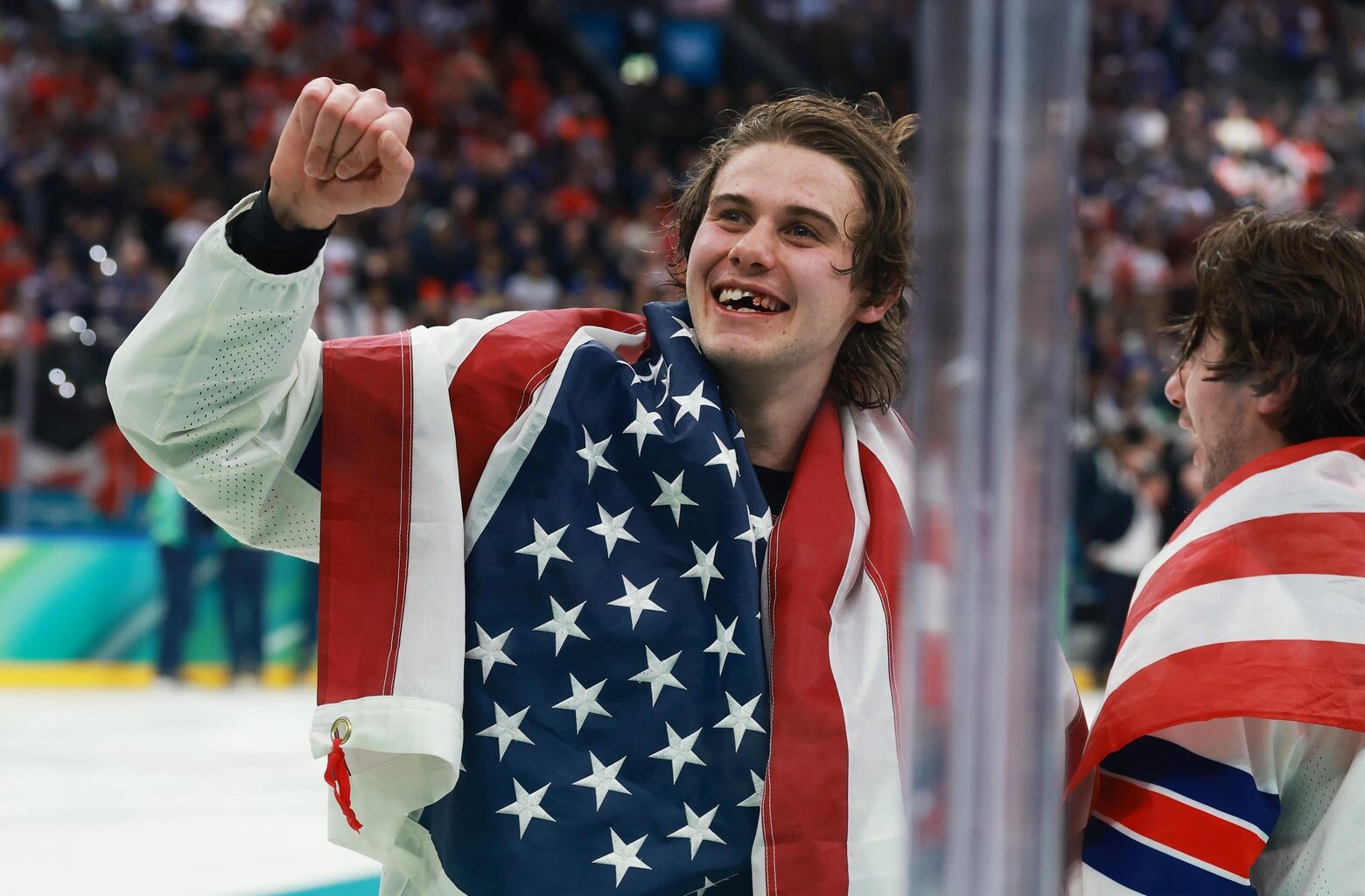
The people who built the U.S. Olympic men’s hockey team used a roster-building strategy that was right on the edge between bold and insane. Their approach almost destroyed them on Sunday, in one of the most-hyped and most-consequential games in the history of the sport. And then, in sudden-death overtime, that strategy worked perfectly, delivering the United States a 2-1 victory, its biggest hockey triumph since the 1980 Miracle on Ice, the last time this program won a gold medal.
The American team had more skill than ever before, a natural byproduct of the country’s improved player development over the past 20 years. But it could’ve had a lot more, and general manager Bill Guerin intentionally made sure it didn’t, because he is a hockey caveman. Three of the four leading American goal scorers in the NHL this year, all with 30 goals in not even three-quarters of a season, did not make the roster. The NHL’s No. 2 point-getting defenseman also did not make the roster. Nor did the New York Rangers’ Adam Fox, a former Norris Trophy winner who’s averaging nearly a point a game in the NHL for head coach Mike Sullivan’s lousy New York Rangers. Instead, the GM loaded the team with heavy hitters, faceoff specialists, and players heavy on “truculence.” These players mirror Guerin himself, a man who scored 30 goals in the NHL four times but cleared 100 penalty minutes eight times.
You could see what Guerin was going for here. Canada beat the United States in overtime in the final of last year’s 4 Nations Face-Off on a goal by Connor McDavid, the best player in the world. Canada also has Nathan MacKinnon, the next-best forward in the world, and an embarrassment of offensive riches behind them. All-time superstar Sidney Crosby, who missed the gold-medal game due to injury, was arguably the fourth- or fifth-best forward on the Canadian team.
Guerin and his players surely didn’t believe that they needed a 1980-esque miracle to beat Canada in 2026. But the American GM seems to have determined that the Canadians had his nation outgunned, so the best alternative was to head into Milan with a bunch of machetes. This U.S. team would earn the most vaunted label in hockey: They would not send out all of their best talent, but they would be hard to play against.
For most of the gold-medal game, this strategy was “working” in the most tenuous way possible. The U.S. scored early, on a lovely one-man rush by forward Matthew Boldy. But Canada tied it in the second period on a Cale Makar wrister, and from that point on, the Americans spent the rest of regulation getting caved in by Canada’s high-end talent. McDavid had failed to score on an earlier breakaway, and late in the game, 19-year-old sensation Macklin Celebrini failed on another. MacKinnon, an easy Hall of Famer, missed a wide-open net on his forehand. Meanwhile, the Americans failed to score on a four-minute power play on which they sure could’ve used more finishing ability.
Then the game went to three-on-three overtime, unquestionably the worst possible format for a team with a clear deficit in open-ice skill. One of the guys the Americans brought because he’s good at faceoffs (Vincent Trocheck) lost a faceoff, surrendering possession to Canada. And after a few minutes of back and forth, one of America’s most talented guys, Jack Hughes, scored a goal that will live forever.
Score one for contrarianism in roster management: The Americans’ outrageous strategy turned out to be a golden one. Regrettably, Guerin gets to call all of us who doubted his approach losers while he grins and bites into his gold medal. (He can have one made custom, as the International Olympic Committee gives them out only to players.)
Before getting carried away praising someone who didn’t play, it’s worth mentioning the primary reason the United States has a gold medal today. Connor Hellebuyck was already the best goaltender in the world, a three-time Vezina Trophy winner who won MVP of the whole damned NHL last year. Hellebuyck hasn’t yet gotten deep into the Stanley Cup Playoffs, because there is only so much a man can do behind the Winnipeg Jets. But he ascended to the ranks of all-time greats on Sunday, stopping 41 of Canada’s 42 shots on goal and almost singlehandedly keeping the Americans afloat. It would not have taken much for Canada to have won 4-1 with three goals in the third period, but Hellebuyck stood on his head. To put it simply, our national advantage in hockey comes down to Hellebuyck’s native Michigan being a state rather than a province.
The United States didn’t make it easy on itself this tournament. In the quarterfinals, the U.S. took a 1-0 lead on Sweden halfway through and then stopped playing offense, trying instead to sit on the game. The Americans got four shots on goal in the third period and let the Swedes tie it up with a minute and a half left. On the ice for the Americans were two of the “truculence” guys, Trocheck and JT Miller, who got roster spots instead of the far more talented Jason Robertson and Cole Caufield. As nonsensical as it all may have been, the Americans prevailed in overtime that day, too, when Jack Hughes’ brother Quinn scored the winner. If Guerin figured his team could turn every game against a good opponent into a complete slog but then win in overtime because he had the Hughes brothers, that turned out to be a good prediction. (Also, the American penalty kill did not allow a goal all tournament, and Trocheck and Miller both played a substantial part in that. Canada’s failure to score in more than a minute of five-on-three action on Sunday paved the way for American victory.)
On the Canadian side, this loss will be nothing less than a national tragedy. The 38-year-old Crosby, who suffered a lower-body injury in the quarterfinals, is one of the sport’s great winners, with three Stanley Cups and two prior gold medals, one of which he clinched with an overtime game-winner against the U.S.. But it’s now possible that his last Olympic experience will be watching on a monitor in the dressing room as his successors—McDavid, MacKinnon, and Celebrini—could not get the puck past Hellebuyck. At no point in Canada’s history has a hockey silver medal been acceptable. Now they’ve been forced to accept two in a week, at a time when the U.S.-Canada hockey has been a point of geopolitical contention.
The U.S. Had a Crazy Strategy to Beat Canada for Men’s Hockey Gold. I Can’t Believe It Worked.
This Terrible New Olympic Event Must Be Exiled From the Games Forever
The American women’s victory may well usher in an extended period of hockey hegemony for the United States. The American men beating the Canadians feels different and, in a way, more fun. It wasn’t just that the United States had not won Olympic gold since 1980—the U.S. hadn’t won any best-on-best tournament with NHL players included since the 1996 World Cup of Hockey. In the meantime, Canada had racked up championships, most recently in the 4 Nations almost exactly a year ago.
The U.S. had worked hard to become a credible No. 2 in the men’s hockey scene, but the rivalry lacked teeth because the Americans could not win when it mattered most. Now they showed they can, thanks to a player who chipped a bunch of teeth before scoring a golden goal.
Going forward, Canada will still carry a better on-paper roster into every international tournament. The United States, though, now has a blueprint to neutralize that talent advantage. I’m not sure that strategy will ever work again. But on Sunday it did, and the U.S. has the gold medals to prove it.
Alex Kirshner
The Olympic Hockey Tournament Is About to Get Very Trumpy
Read More
Get the best of movies, TV, books, music, and more.