
A year ago, Aaron Glenn arrived at the NFL combine for the first time as the Jets’ head coach. He made one thing clear: “We’re here to win now.”
When asked what he was looking for in a quarterback: “We’re looking for winners.”
The story is well-told at this point. The Jets went 3-14, and Justin Fields, who signed with the team as a free agent a few weeks after that combine, was benched midway through the season.
Glenn will return to the podium again Tuesday afternoon with much less wind behind his sails after a tumultuous start to the offseason — and a perception that he enters 2026 on the hot seat. This will be a crucial week for Glenn, general manager Darren Mougey, and all the Jets’ staff attending the combine. This is a team with significant draft capital and cap space. The roster will look much different by the start of May, and the changes start here.
Here are all the things Glenn and Mougey need to figure out in Indianapolis — and beyond:
1. What will the Jets’ identity be on defense?
Tuesday will mark the first time Glenn has spoken publicly since the end of the season, and a lot has changed since then. He overhauled his coaching staff. The biggest headline coming from those changes: Glenn will be taking over as the primary play caller on defense.
A year ago at this event, Glenn stressed the importance of being a “CEO” head coach, like Dan Campbell, who oversees everything while allowing the coordinators run their own show. A historically poor season by the Jets defense changed things — though Glenn’s plan at the start of the offseason did not include him calling plays. The expectation should be that Glenn will completely change the team’s defensive scheme and philosophy, at least in comparison to what Steve Wilks did before he was fired in December. Glenn said at the end of the season that the defense the Jets ran last year was the same one Wilks ran in San Francisco — which was similar to the one Robert Saleh ran in New York.
What we don’t know is exactly how this version of an Aaron Glenn defense will look. His time as the Detroit Lions’ defensive coordinator offers some clues, such as aggressive blitzing and heavy use of man-to-man coverage. But Glenn also hired Brian Duker as defensive coordinator and Karl Dunbar as defensive line coach, both of whom come from 3-4 defensive schemes with the Miami Dolphins and Pittsburgh Steelers. The Lions ran a 3-4 in Glenn’s first year in Detroit in 2021, but not after that.
2. What will the offense look like under Frank Reich?
Reich gave some insight to The Athletic’s Dan Pompei about how the Jets offense might change with him at the helm. The gist: They’re still figuring it out. Two lines stuck out in Dan’s piece:
• “There will … be fresh concepts like more passing off wide zone, he says, but that probably will depend on which quarterback the Jets settle on.”
• “He plans to dial up wide receiver Garrett Wilson’s number frequently. Reich says he’s looking for ways to get him lined up at X, F and Z, depending on the formation and play concept.”
The second point will make Jets fans happy. The first point won’t really be resolved until the Jets have their next quarterback figured out — and by all accounts, nobody has a great grasp on who that might be just yet. Reich hasn’t called plays in the NFL since 2023, when he was the Panthers’ head coach, a season during which he was fired after 11 games.
3. What kind of quarterback do they want?
Reich has typically geared his offense toward pocket passers, but by no means does that mean the Jets will lock in on a quarterback who can’t move. No stone will be left unturned.
The combine will be a prime opportunity for Mougey, Glenn and Reich to dig into this draft class of quarterbacks. It’s viewed as a weak draft at the position, after Indiana’s Fernando Mendoza, the presumptive No. 1 pick, but the Jets will look deeper to determine if any of the other QBs are worth drafting to develop. It will be a crucial week of evaluation for two of the Jets’ potential targets on Day 1 or 2: Alabama’s Ty Simpson and LSU’s Garrett Nussmeier, the two favorites to be the second quarterback drafted. Simpson only had 15 career college starts and struggled down the stretch last season, while Nussmeier had a down year in 2025 as he dealt with injuries.
How they test will be important — but even more crucial will be how they interview and process what the Jets’ brass throws at them.
4. Which starting-caliber QBs will become free agents?
The quarterback crop in free agency will soon expand. Some notable names could be added to the fray as soon as this week, though the full picture won’t become clear until free agency begins on March 11. Some of the veteran QBs the Jets will likely consider are:
• Kirk Cousins is a mortal lock to be released by the Atlanta Falcons, as he has a $67.9 million guarantee for 2027 that will kick in if he’s on the roster on March 13.
• The Arizona Cardinals will try to find a trade partner for Kyler Murray. That might be difficult, considering he’s due $36.8 million in 2026, and another $19.5 million guaranteed for 2027 kicks in if he’s on a roster on March 15.
• The Miami Dolphins will surely have trouble moving Tua Tagovailoa’s massive contract.
• Geno Smith seems likely to be released by the Las Vegas Raiders.
Those four would be much more appealing options for the Jets as free agents, as opposed to trade targets.
5. How much will it take to trade for a coveted backup QB?
The Jets have enough draft capital that it’s worth at least exploring what it would take to acquire one of the intriguing young quarterbacks on another roster — whether it’s to bring that player in as a stopgap or to see if he can develop into a starting-caliber QB.
Mac Jones tops that list. The San Francisco 49ers have insisted they don’t plan on trading him, but that’s likely a bargaining position meant to drive up his value. It would probably take at least a second-round pick to acquire him.
The Philadelphia Eagles’ Tanner McKee fits the physical mold (6-6, 231) that Reich likes in his quarterbacks, with the added benefit of him being a Stanford alum (where Reich coached a year ago). Reich is also close with Eagles coach Nick Sirianni, who worked for Reich in San Diego and Indianapolis. McKee has flashed potential in preseason appearances but is otherwise unproven, and the Eagles’ asking price might be higher than you’d think.
Houston Texans backup Davis Mills also has the size (6-4, 225) and some experience (29 starts), but Houston extended him last offseason. It’s also worth checking in on Cardinals veteran Jacoby Brissett, along with a few other veterans under contract who aren’t in line to start elsewhere.
6. Who will be released for cap savings?
There’s really only one cut that feels inevitable, a rarity for any offseason: quarterback Justin Fields. If the Jets release him before June 1, they’ll only save $1 million and carry a $22 million dead cap penalty — in addition to the $35 million dead cap they’re already carrying for Aaron Rodgers. If they designate Fields a post-June 1 cut, the Jets would save $10 million and spread the dead cap over two years.
Defensive tackle Harrison Phillips is due $7.5 million, none of it guaranteed, but he’s not going anywhere. The Jets could technically trade linebacker Jamien Sherwood and save $1.5 million pre-June 1, or $9 million post-June 1, but that feels unlikely as of now.
7. Are the Raiders at least willing to listen to an offer for the No. 1 pick?
The answer is almost certainly no, but it can’t hurt to ask what it would cost to move up from No. 2 to No. 1 in pursuit of Mendoza.
8. What does the market look like for Breece Hall?
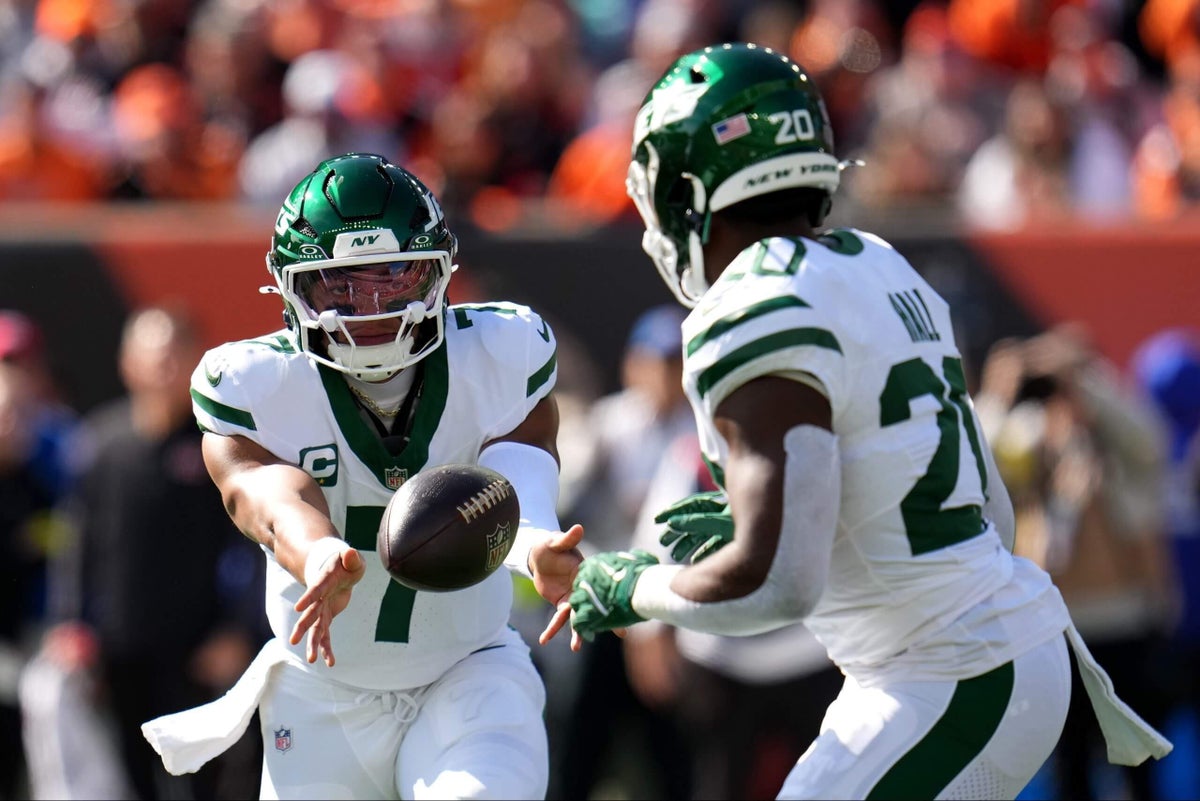
The Jets have until March 3 to decide if they want to place the franchise or transition tag on Breece Hall to keep him from free agency. If they don’t already know what their plan is on that decision, they’ll likely know by the end of this week after conversations with Hall’s agent — and with other teams around the league to gauge the running back’s value.
If the Jets do tag him — which remains the expectation — they would then have the ability to trade him for draft capital. If Hall doesn’t want to be a Jet, or if the Jets don’t want him long-term, that would be a much better outcome than losing him for nothing; a potential compensatory pick in 2027 wouldn’t be guaranteed, especially if the Jets are active in free agency.