
The Trump administration has rolled back a scientific finding that serves as the backbone for federal climate change policy, a move that could leave Louisiana’s industrial players in a state of regulatory uncertainty while exposing the state to more extreme weather, rising seas and hotter temperatures.
The Environmental Protection Agency on Feb. 12 rolled back the “endangerment finding,” which allowed planet-heating greenhouse gases like carbon dioxide to be regulated like other pollutants under the Clean Air Act. That finding has served as the foundation of federal regulations aimed at limiting the long-term impacts of climate change.
In practical terms, standards for tailpipe emissions and other climate rules aimed at power plants and major industrial sources could be stalled, rewritten or struck down in court. That could leave companies and regulators operating in a gray area for months or years as lawsuits play out.
“This radical rule became the legal foundation for the Green New Scam, one of the greatest scams in history,” said President Donald Trump at a press conference announcing the move.
Louisiana Attorney General Liz Murrill praised it as a step toward eliminating a slate of climate change policies, often referred to as the “Green New Deal,” that some Democratic lawmakers have championed.
“This is the single largest act of deregulation in U.S. history and will make buying a car more affordable for Louisiana families,” Murrill said.
The Trump administration estimated that the change will save $1.3 trillion in costs over three decades, mostly by reducing the price of new cars, though environmental groups like the Sierra Club have stressed that figure ignores the health and infrastructure costs of allowing additional air pollution.
Many of those health impacts may fall on Louisianans, some of whom already live in areas with poor air quality. The move is also likely to increase Louisiana’s climate risk, potentially increasing already high insurance costs while making hurricanes stronger and more likely to rapidly intensify.
Sections of New Orleans floodwalls are sinking faster than sea levels are rising, study finds
“This increases the likelihood of another Katrina,” said Joshua Basseches, a professor of public policy and environmental studies at Tulane University. “This is the single most damaging thing that this administration has done with regard to climate change.”
Louisiana is on the front lines of climate change, Basseches said. It is a hurricane-prone state, and storms can be supercharged by hotter Gulf waters, which not only make the storms more powerful but also more likely to undergo rapid intensification — giving the city less time to prepare and residents less time to evacuate.

Upper Little Caillou School was razed after Hurricane Ida. Students now get on buses and travel north, to Houma, for school.
Photo by Chris Granger | The Times-Picayune
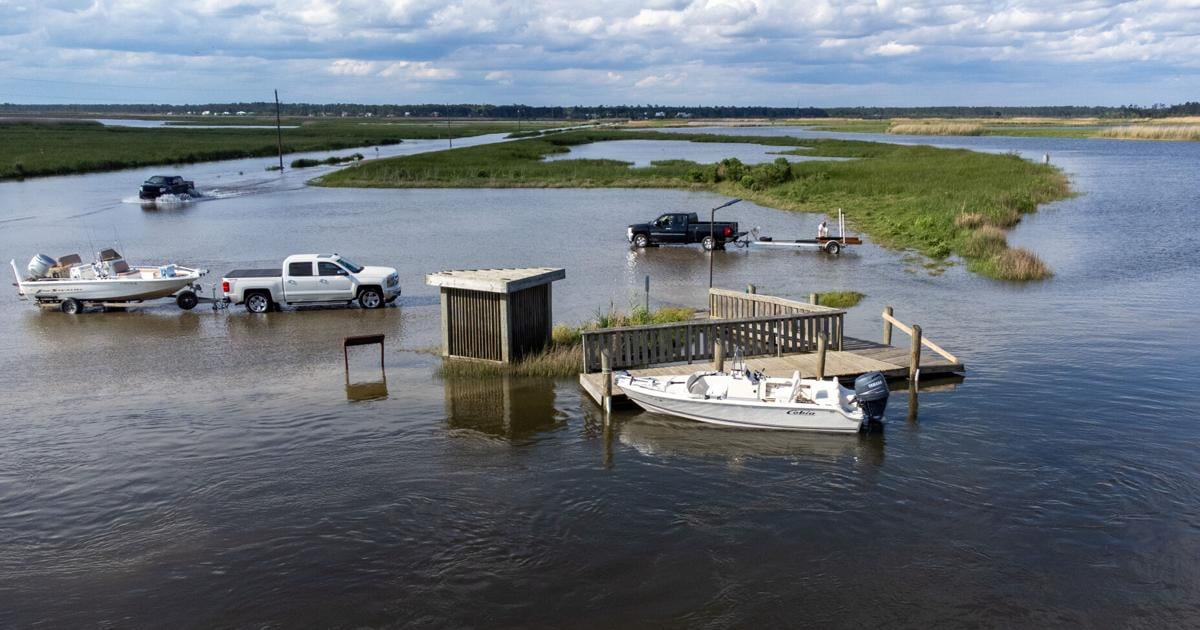
Land loss and chronic flooding are also likely to become more severe on a hotter planet. Rising sea levels will eat away at Louisiana’s already diminished coastal marshes, giving metropolitan areas like New Orleans and Baton Rouge less buffer from storm surge. Day-to-day tidal flooding will get worse, too, particularly in places outside of levee systems, like Cocodrie.
Plus, New Orleans’s levee system is only built to withstand a so-called 100-year storm — one that has a 1% chance of happening during any given year. As the climate changes, those storms are set to become more likely. Congress has authorized but has not completely funded a study aimed at providing 200-year protection to New Orleans’ levee system on the east bank.
In the long-term, however, it’s not yet certain that the Trump administration’s move will stick. Already, the rescission has been challenged in federal court. Environmental and health groups, including the American Public Health Association, the Alliance of Nurses for a Healthy Environment, and the Environmental Defense Fund, filed a lawsuit on Wednesday.
‘Wait and see’
The endangerment finding traces back to a 2007 Supreme Court decision, Massachusetts v. EPA, which held that greenhouse gases qualify as “air pollutants” under the Clean Air Act and required the agency to decide whether those emissions endanger public health or welfare. The rollback is already headed for a legal showdown in the D.C. Circuit, and observers expect the dispute could ultimately return to the Supreme Court, which has previously recognized EPA’s authority to regulate greenhouse gases under the Clean Air Act.
Industry may wait to see how the Trump administration’s latest move plays out before making decisions based on it. Globally, investments in renewable energy have still been breaking records despite the Trump administration’s opposition. Energy experts in Louisiana don’t think that is likely to change now.
“Trump isn’t dictating what happens in world energy markets,” said David Dismukes, a professor emeritus at the LSU Center for Energy Studies. “When you create this kind of uncertainty in policy, whether you think it’s ‘good’ or ‘bad,’ you start changing things — that’s just not good for capital formation, regardless of what side of the political coin you’re on.”
“From a pure economist, finance-guy perspective,” he added, “this isn’t a good thing.”
To Dismukes, a bigger deal than the rollback of the endangerment finding may be the Trump administration’s move to undo tax incentives for renewable energy that the Biden administration put forward.
“In the here and now, that has much bigger implications,” he said.
Keith Hall, the director of LSU’s Energy Law Center, said that if the endangerment finding is rescinded, that could open the door for cities run by Democratic administrations, like New Orleans, or environmental groups to bring new lawsuits against companies for climate pollution.
“Some of these groups may feel like if nothing’s going to happen at the federal regulatory level, we need to file lawsuits,” he said. “But I think there’s going to be some wait and see, both because of the legal challenges and the fact that the next administration may take a different view.”
Louisiana’s climate plan
Under former Gov. John Bel Edwards, the state convened a task force that put forward a plan aimed at guiding the state toward limiting its greenhouse gas emissions. But that plan appears to have been shelved by Gov. Jeff Landry’s administration.
That plan was not law, Basseches said, and had no framework for holding companies to account if they did not follow it. “But it was extremely important compared to nothing, which appears to be the direction that this state is going in now,” he said.
He added that the state’s plan was not reliant on the federal government’s climate regulation. “There’s nothing stopping Louisiana from reviving its climate action plan,” he said, “other than the lack of political will.”