
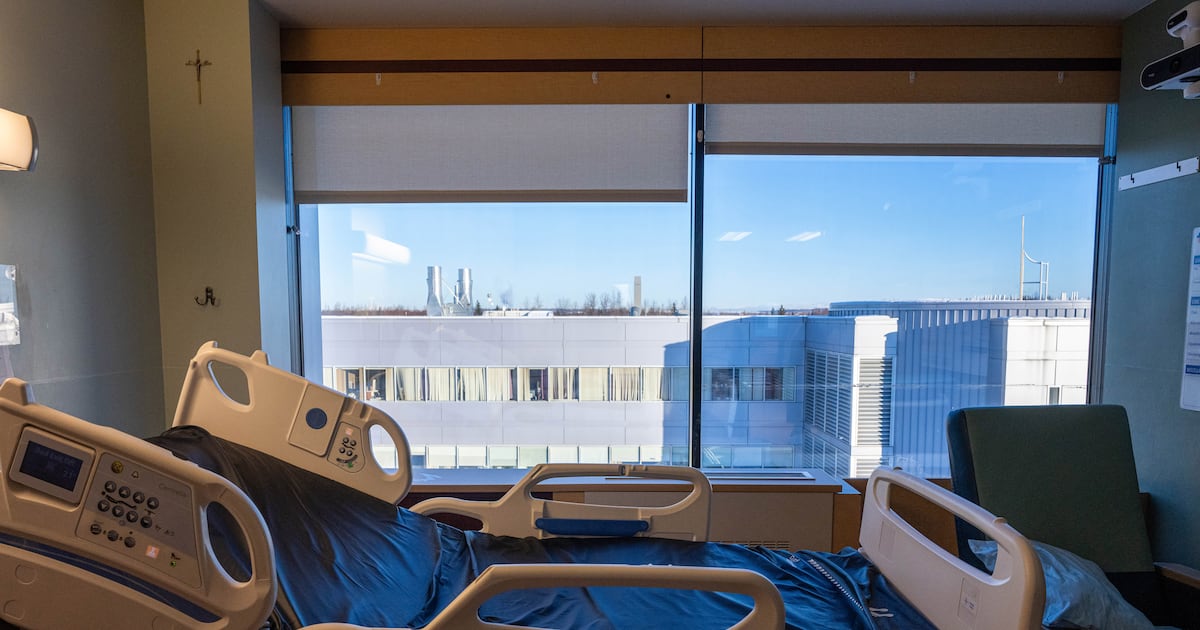
 A patient room at a medical-surgical unit at Providence Alaska Medical Center in Anchorage. (Loren Holmes / ADN archive)
More than 9,000 Alaskans could lose access to Medicaid under a federal bill enacted last year, according to a new report prepared for the Alaska Department of Health.
The bill, backed by all three members of Alaska’s congressional delegation, extended tax cuts first enacted during President Donald Trump’s first term. To partially pay for the tax cuts, the bill made massive reductions to spending on Medicaid and other programs.
Cuts to Medicaid, which provides health care access to more than 200,000 Alaskans, were enacted through several provisions, including new “community engagement” requirements, which obligate adult Medicaid recipients to participate in 80 hours per month of work, study or job training to qualify for the program.
In Alaska, between 9,400 and 13,600 recipients are projected to lose access to Medicaid because they fail to meet those requirements or submit the required paperwork, according to the report, produced for the state health department by Manatt, a consulting firm.
The study was commissioned by the department as it prepares to implement changes to its Medicaid program to meet the requirements in the new federal law. Alaska health care experts have been warning for months that the new law would cause thousands of Alaskans to lose health care access. The report, released earlier this month, provides a first look on how the coverage losses may unfold.
Alaska already has one of the highest rates of uninsured in the country, with more than one in 10 Alaskans going without health care coverage. The projected changes to Medicaid come on top of other changes to federal health care policies that are expected to curtail health care access.
Congress last year failed to extend insurance subsidies known as enhanced premium tax credits, which substantially lowered the cost of insurance bought on the marketplace for thousands of Alaskans. Since the subsidies were allowed to expire, the number of Alaskans insured through the marketplace has decreased by more than 2,700, according to preliminary federal data.
The new Medicaid work requirements will apply to more than 61,000 low-income Alaskans as early as Dec. 31. They may be delayed until 2028 under a yet-to-be-announced federal waiver program, according to Department of Health Deputy Commissioner Emily Ricci. But Ricci said the department is already preparing to implement the requirements.
Roughly 69% of Alaskans on Medicaid expansion will be automatically exempted from the new work requirements, according to the new report. Exempted categories include Alaska Native people, residents of areas with high rates of unemployment, food benefits recipients, parents of children ages 13 or younger, and others.
The report found that over 42,000 Medicaid recipients in Alaska will be eligible for an automatic exemption based on one of the qualifying categories. Of the roughly 19,000 Medicaid recipients who will have to request exemptions manually, or will have to seek employment or other opportunities, between 50% and 72% could lose coverage altogether because they fail to submit required paperwork or meet new requirements.
The estimate is based in part on the real experiences in other states that previously imposed work requirements for Medicaid enrollees.
When Arkansas implemented a work requirement for its Medicaid in 2018, the number of adults with health insurance declined while the employment rate did not materially change, researchers later found. Many Arkansans who were disenrolled from Medicaid had, in fact, been working but found the reporting requirements difficult to meet for technical reasons, such as a lack of reliable internet access, according to subsequent reviews.
The new findings posted by the health department raised concern among some state lawmakers last week. Responding to questions from legislators, U.S. Sen. Dan Sullivan sought to assuage their concerns last week, noting that Alaska is immune from other parts of the GOP-backed law that eliminated Medicaid-funding mechanisms that Alaska does not use.
Alaska will not be impacted by new prohibitions on Medicaid provider taxes and state-directed payments included in last year’s bill. Alaska is the only state that does not use these funding methods to subsidize its Medicaid program.
States that use those funding mechanisms to subsidize their Medicaid program “are having to make some very hard decisions about how to make up some of the financing changes that the bill presents,” said Ricci. Alaska, she added, is not having to make the same decisions.
“Fundamentally, our core funding remains stable,” said Ricci.
However, the imposition of new work requirements is expected to have a large impact on federal Medicaid spending when compared with other changes included in the bill, according to the nonpartisan Congressional Budget Office. The office estimated last summer that in total, 7.8 million people would lose access to Medicaid as a result of provisions on the bill. Of them, 4.8 million would lose access to Medicaid because of the new work requirements.
Sullivan said that he and U.S. Sen. Lisa Murkowski worked to increase the number of Alaskans who would qualify for automatic exemptions from the work requirements, adding Alaska Native people and residents of areas with high unemployment to the list. But he said that he supports the requirement in principle, because his goal is to give Medicaid recipients “the skills, to move them off Medicaid, to get a job working for a union, where they get good health care and go up on the (North) Slope.”
In Alaska, less than half of residents get their health insurance through an employer. Alaska’s rate of employer-sponsored health insurance ranks near the bottom of the nation.
Sullivan said that if individuals lose Medicaid access because they are unable to meet the new work, study or volunteer requirements, “that is not a Medicaid cut — that is a choice from that individual.”
“I think it’s important, as I mentioned, for those individuals to encourage them to advance and help their community through school through volunteering, through training,” said Sullivan.
The 2025 law will have other impacts on Alaska’s Division of Public Assistance, which oversees Medicaid enrollment, federal food assistance and several other programs.
Under a provision in the bill, the state will see an increase in the cost of administering the Supplemental Nutrition Assistance Program by $10.7 million annually. The new cost begins in October.
The state may be required to pay penalty rates for errors in its SNAP program beginning in the 2030 fiscal year. Alaska has had the highest error rate in the nation for the preceding three years.
If the error rate remains above 10%, the cost to the state will be over $42.3 million. If the error rate is between 8% and 10%, the cost will be $28.2 million. If the error rate is between 6% and 8%, the cost will be $16.9 million. There will be no cost if the error rate is below 6%.
The last time Alaska’s error rate was measured below 6% was 2018.