
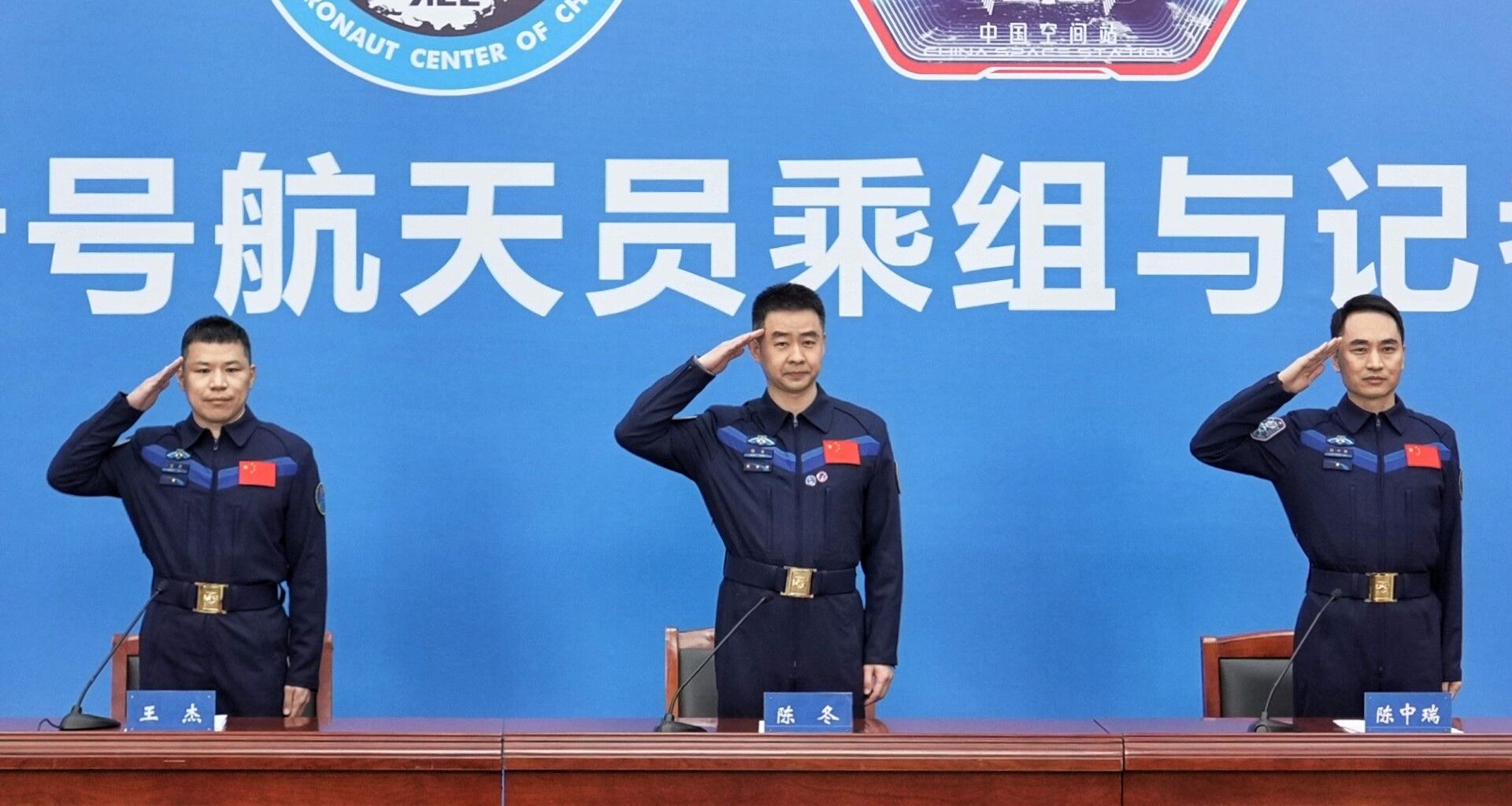
It has been billed as China’s first emergency operation in the country’s human spaceflight program. The three astronauts (or taikonauts) of China’s Shenzhou-20 mission were originally slated to return to Earth last Nov. 5, but after discovering cracks in the viewport of their spacecraft, their landing was postponed.
Chen Dong, commander of the Shenzhou-20 crew, first noticed the damage to the window while conducting final checks on the return capsule. The believed culprit: space debris striking the window. The incident meant the crew had to ride back to Earth in an alternative spacecraft, the Shenzhou-21 vehicle that their relief crew rode to orbit. The crew returned safely, and their spacecraft was eventually brought back to Earth uncrewed after another was sent up to the Tiangong Space Station for the other three astronauts aboard.
You may like
Window anomaly
China rocketed the Shenzhou-20 crew — Chen Dong, Chen Zhongrui and Wang Jie — into Earth orbit on April 24, 2025. Sent spaceward on a projected six-month mission, the trio linked up with the country’s Tiangong space station.
As mission commander for Shenzhou-20, Chen said he was the one who went for checking out the return craft. During that work, “I spotted something like a triangular on the viewport,” he said.
“My first thought was whether a small leaf had somehow stuck to the outside of the window,” said Chen. “But then I quickly realized that couldn’t happen because we were in space. How could there possibly be a fallen leaf there?”
Chen pointed out the window anomaly to his two other colleagues also in ready mode for the return trek to Earth.
Analysis and experiments
Wang, who served as the flight engineer on the Shenzhou-20 mission, had previously worked as an aerospace technician involved in the construction of China’s space station before becoming an astronaut.
“I wasn’t really nervous, actually. The outermost layer of the viewport is a protective layer, and inside it there are two pressure-bearing layers, and we are safe as long as the cabin pressure doesn’t change,” said Wang.
“I also know well about our ground team that no matter what happens, they will go through analysis and experiments to determine whether we can return safely,” Wang added, “and whether the crack affects our safety before making a final conclusion. So I wasn’t too worried.”
You may like
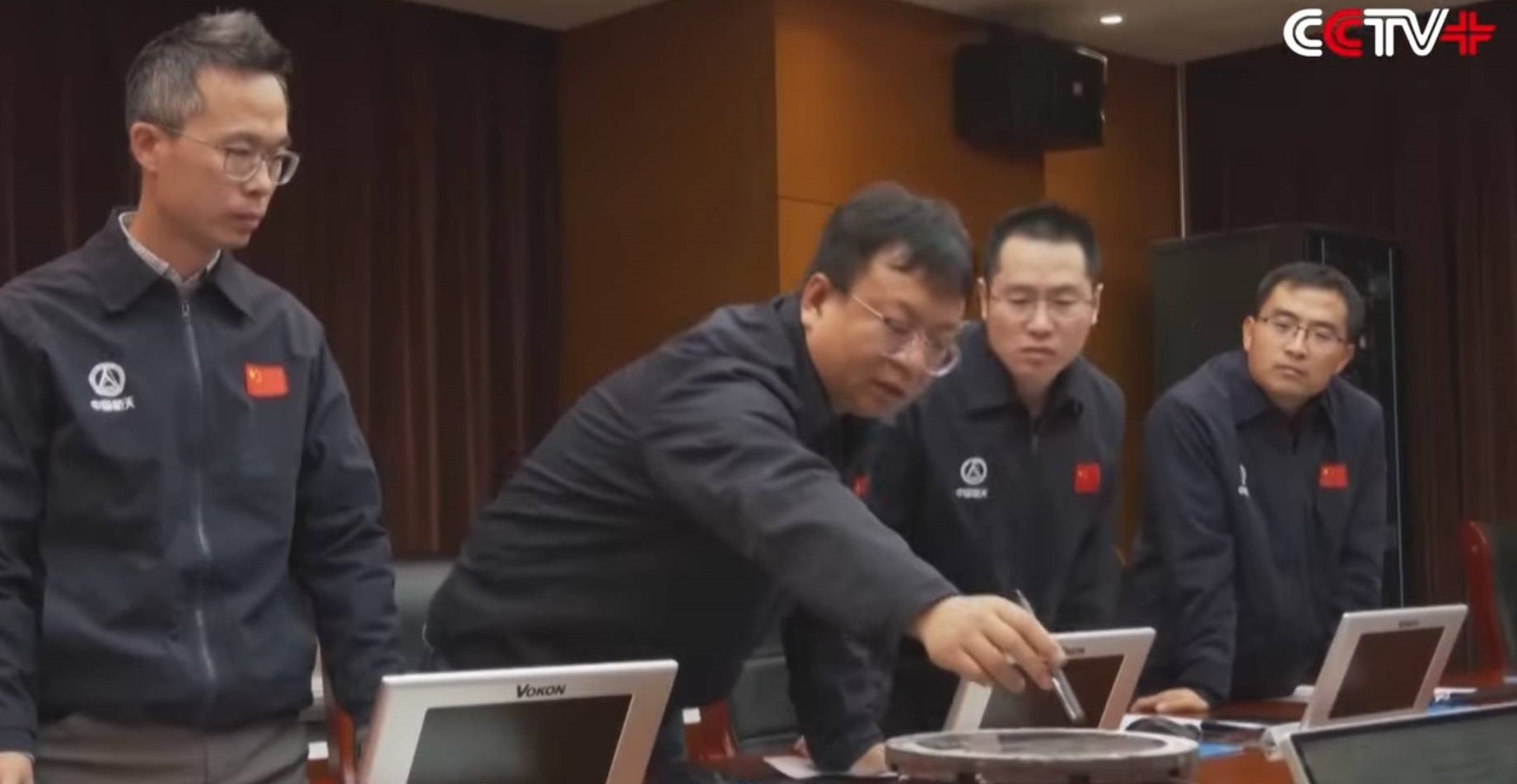
Ground team experts discuss the Shenzhou-20 cracked window. (Image credit: CCTV+)Action plan
Meanwhile, ground teams began to appraise the situation, deciding to rearrange the crew’s return. Both mission planners and engineers put into action emergency response measures based on the principle of “putting the safety of astronauts first,” stated the China Manned Space Agency (CMSA).
The emergency action plan called for hurriedly preparing an uncrewed, cargo-loaded Shenzhou-22 spaceship, successfully launched on Nov. 25, 2025. That craft, without a three-person crew aboard, was filled with space food, medical supplies, fresh fruit and vegetables, as well as devices for treating the cracked window on the Shenzhou-20 spaceship.
In unpiloted mode, Shenzhou-22 docked with the front port of China’s Tiangong space station’s Tianhe core module.
Small cracks
How best to determine exactly what was on the return capsule’s viewport?
The crew used every piece of equipment available inside the space station to photograph and document the abnormal area, including a work pad, a work phone and a magnifying glass. They eventually confirmed the crack using a 40-times microscope.
“It was a pen-shaped microscope. One end is the lens, connecting to a tablet — the device we use to inspect the extravehicular suits, especially to check whether there is any damage in the sealed areas,” said Chen Dong.
“We could see very clearly the small cracks [with the microscope]. Several were relatively long, and one was shorter, added Chen. “We could also see that some of the cracks had penetrated through.”
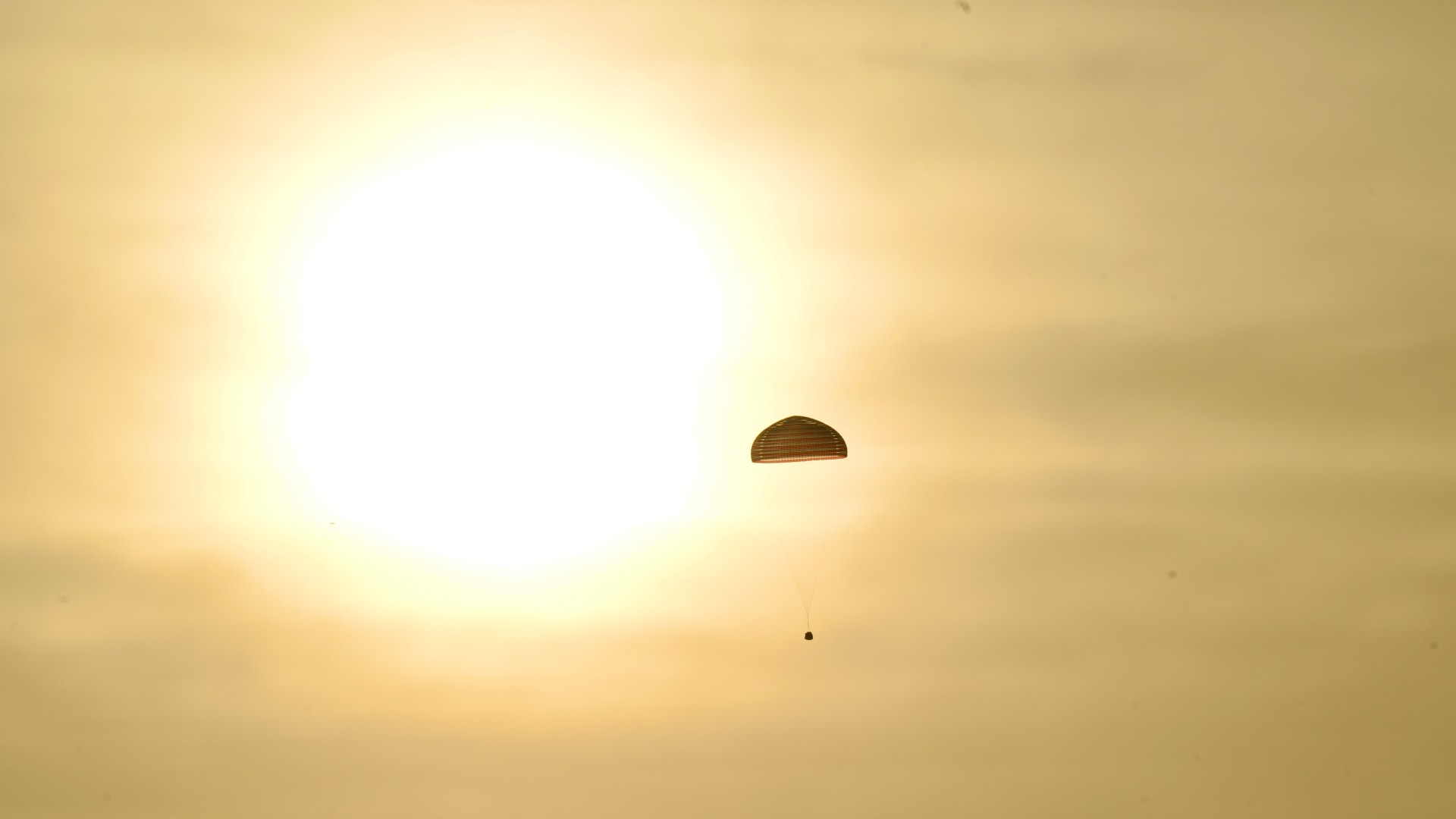
The return capsule of the Shenzhou-20 spaceship descends under parachute on Jan. 19, 2026 in the Inner Mongolia Autonomous Region of China. (Image credit: VCG/VCG via Getty Images)Porthole repair device
Crew, ground control, and technical engineers concluded the need to use the Shenzhou-21 spacecraft, while the damaged Shenzhou-20 return craft would remain attached to the Chinese space station.
China purposely delayed the return of its Shenzhou–20 crew for roughly a week due to the suspected encounter with space debris that compromised the crew’s return vessel’s window.
“Furthermore, in conjunction with the emergency launch of the Shenzhou-22 spacecraft, a porthole crack repair device was expedited and sent to the launch site,” said the China National Space Administration (CNSA). “Astronauts installed it inside the Shenzhou-20 capsule, effectively improving the spacecraft’s heat protection and sealing capabilities during reentry.”
Fresh spacecraft
The trio of taikonauts did return to Earth in the fresh but “borrowed” Shenzhou-21 spacecraft on Nov. 14.
However, that left the other on-orbit, three-person space station crew with a damaged and docked vehicle that had been deemed unsafe for reentry.
With the Nov. 25 launch of the uncrewed Shenzhou-22 at China’s orbital outpost, the now in Earth orbit team of Zhang Lu, Wu Fei, Zhang Hongzhang have a fresh spacecraft for their transit back to terra firma.
China’s first emergency operation in its human spaceflight program came to an end when the astronaut-empty Shenzhou-20 return capsule parachuted into the Dongfeng landing site in north China’s Inner Mongolia Autonomous Region on Jan. 19 of this year.
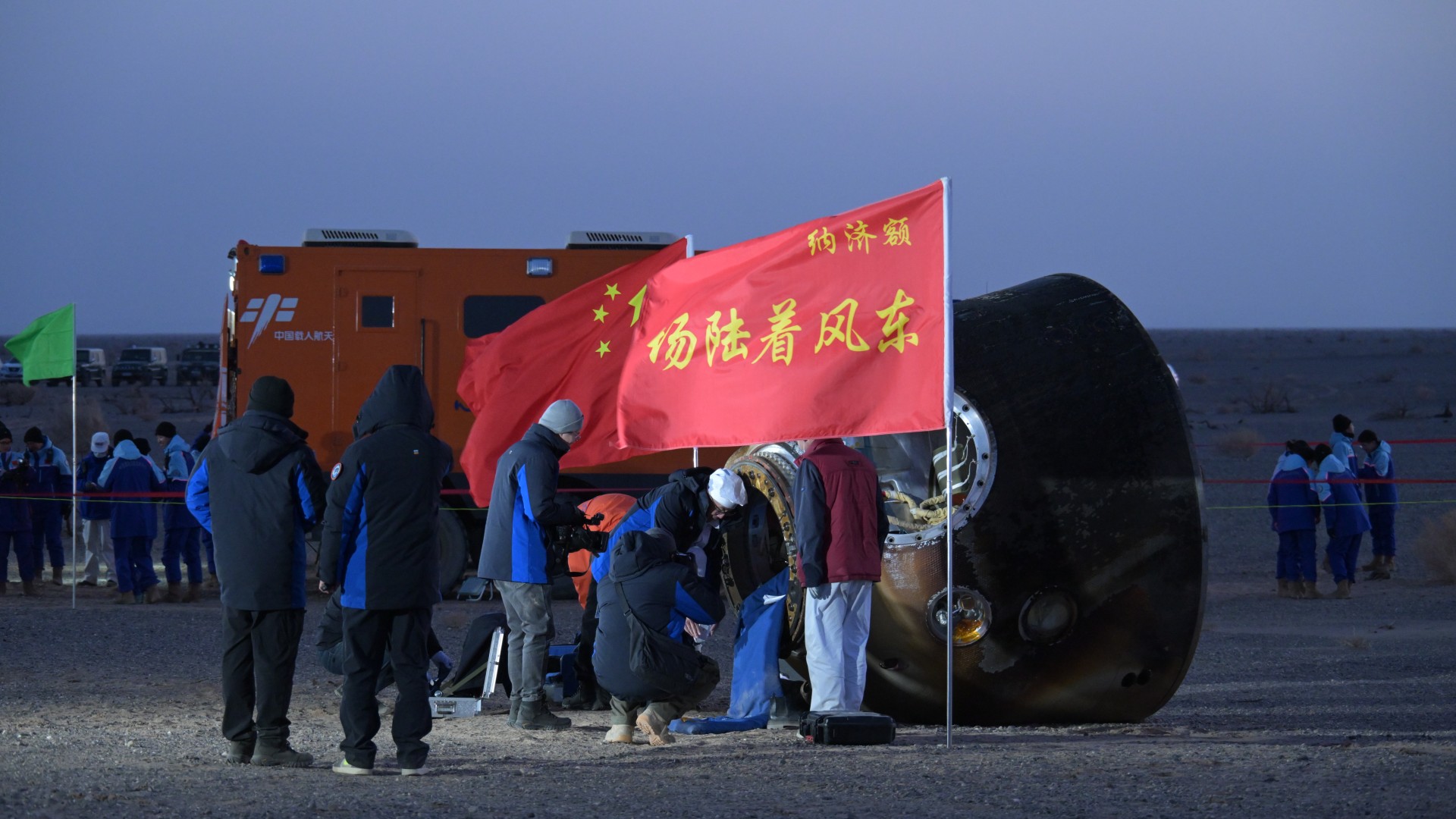
The return capsule of the Shenzhou-21 spaceship, carrying the Shenzhou-20 astronauts Chen Dong, Chen Zhongrui and Wang Jie, touches down at the Dongfeng landing site on Nov. 14, 2025 in Inner Mongolia Autonomous Region of China. (Image credit: VCG/VCG via Getty Images)Extreme conditions
At the capsule’s Dongfeng Landing Site, search and recovery teams had to cope with extreme weather conditions in the area. Frigid temperatures and strong winds posed challenges in retrieving the return craft.
“This marks the first time the Dongfeng Landing Site has carried out a spaceship recovery mission during the coldest season of the year, with cold weather posing a test for both our search and rescue teams and equipment,” said Xu Peng, the on-site commander at the touchdown locale.
“We made special cold-protection preparations in advance to ensure that both personnel and the equipment remained in good condition throughout the mission,” Xu told CCTV.
Xu added that, since the Shenzhou-20 return capsule was not crewed, there was no astronaut to manually separate the parachute.
“As a result, the main parachute did not automatically detach upon landing, and in strong winds, it could have dragged the return capsule along the ground. This requires our ground personnel to reach the landing point and cut the parachute as quickly as possible,” Xu said.
On-site inspection
Recovery personnel quickly took steps to protect the damaged porthole on the return capsule upon its landing. That action was driven by a post-landing assessment on the damage the Shenzhou-20 capsule sustained in space.
An on-site inspection confirmed that the exterior of the Shenzhou-20 return capsule was “generally intact” after its fiery reentry with items inside the craft in good condition, CMSA reported.
Overall, the Shenzhou-20 spacecraft spent a total of 270 days in orbit, “validating its long-term docking capability,” CCTV reported, with engineers saying the follow-up work will also provide “an important basis for China’s space program to continually refine operating procedures.”
Good responsiveness
What a coincidence that both the U.S. and Chinese programs have had issues with human-rated reentry capsules within about a year of each other, said Jan Osburg, a senior engineer within the RAND engineering and applied sciences department in Pittsburgh, Pennsylvania. RAND is a leading think tank on policy and decision-making.
Osburg said the recent revelations regarding the Boeing-built Starliner capsule, albeit with a different failure mode, that in both cases the affected capsule was still able to return to home planet Earth safely.
In Osburg’s opinion, “the Chinese demonstrated pretty good responsiveness, being able to launch a backup spacecraft within a few weeks.” The U.S. eventually also got their “not-stranded” astronauts back to Earth after the Starliner issue, Osburg told Space.com, “but did not demonstrate the same kind of responsiveness in action.””
Osburg said that, in the case of Starliner, there may have been a way to also send a new SpaceX Crew Dragon up within a few weeks, “but the details were never really discussed publicly and thus we don’t know if SpaceX could have done it.”
For Osburg, “both cases underline the importance of having space rescue capabilities in place before something happens,” he concluded.