
It’s been a while since we added anything to our fake trophy case. That’s where we store the Carson (for best sophomore season), the Bourque (for best final season), the Pollock (for best trade) and the Thornton (for best debut with a new team).
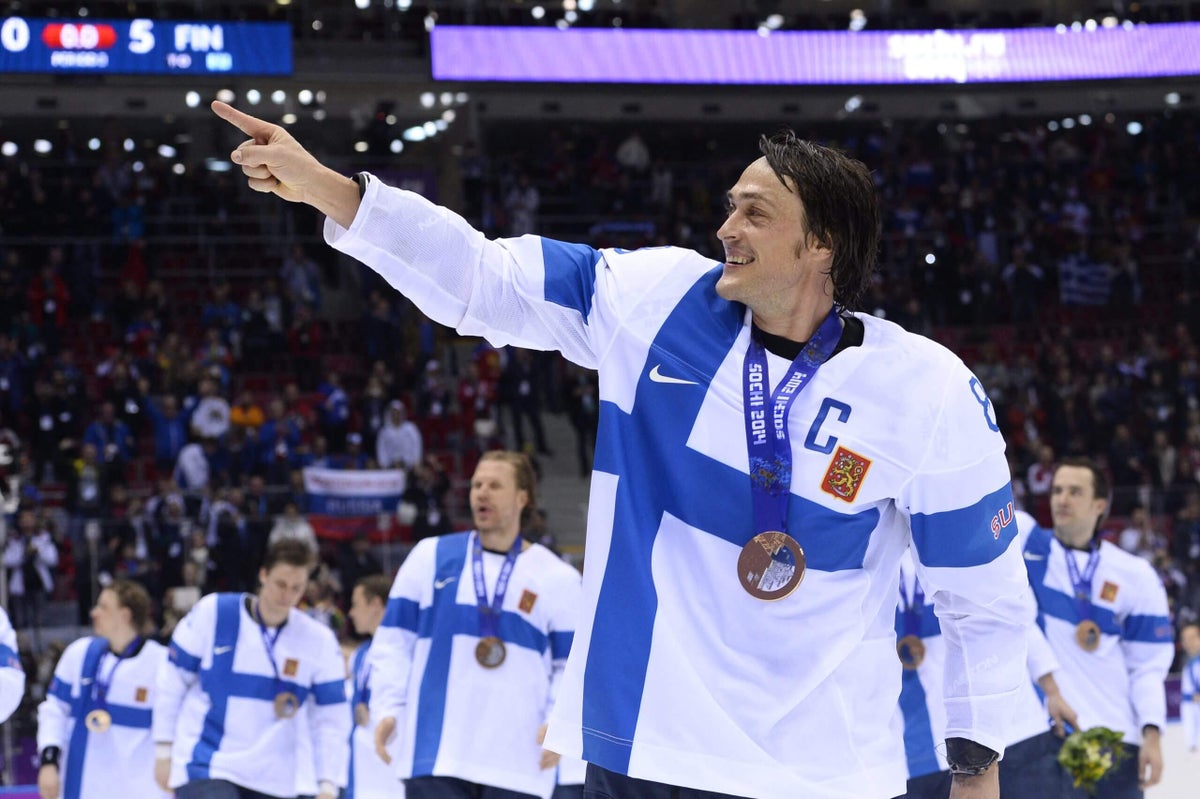
Today, we’re unveiling a new fake trophy for the best combination of NHL and Olympic performance in the same season. Please ooh and ahh at the shiny new Teemu Selanne Trophy.
Selanne was a relatively easy choice for the honor of having the award named after him. After all, he’s the all-time leading scorer in Olympic hockey among NHLers, and it’s not all that close. He’d also been tied for the most points in any NHL-attended tournament until Connor McDavid broke the record this year. Oh, and when Selanne wasn’t dominating best-on-best, he found time to score nearly 700 NHL goals. He was good.
So our trophy for the best combination NHL/Olympic year will be the Selanne. We used the combo concept to build some all-time all-star teams a few weeks ago, but now we’re looking for single seasons.
The ground rules:
Players get 50 percent credit for what they did in that year’s Olympic tournament, and 50 percent for what they did in that NHL season (not calendar year).
Unlike other NHL awards, playoffs count for this one.
A player does not need to have won a gold medal to qualify, although it would certainly help their case.
We’ll do this for every year that the NHL sent players to the Olympics, which means we start back in …
1998
As it turns out, we get to kick things off with an easy one.
The candidates: Team Canada and Team USA were both busts this year, so with apologies to Rob Zamuner or the folks who had to dodge flying furniture from the American hotel rooms, we’ll look to Europe for our inaugural edition. And some very plausible picks quickly emerge.
Let’s start with Selanne himself, a strong candidate for his own award. He racked up 10 points in the tournament while leading Finland to bronze. On the NHL side, he led the league in goal-scoring with 52, although his Ducks missed the playoffs.
Then there’s Russia’s Pavel Bure, who had a record-setting nine goals, including five in the semi-final, on his way to a silver medal, then finished second to Selanne with 51 goals in the NHL.
In most years, either one of those guys could be worthy picks. But this isn’t most years.
But the Selanne goes to: In a unanimous vote, Dominik Hasek. A goalie that many consider the greatest of all time was never as good as he was this year. He almost single-handedly led the Czechs to a surprise gold medal, including a 1-0 win over Russia in the gold medal game. And in the NHL, he swept the Vezina and Hart for the second straight year.
All told, it’s the best season of goaltending anyone’s ever had, and I’m guessing the only controversy here will be on whether Hasek was so dominant that the award should be named after him instead.
Will they all be this easy? They will not, as we’re about to find out…
2002
This was a relatively low-scoring tournament, with nobody hitting double-digit points or scoring more than five goals, which will complicate things.
The candidates: Mats Sundin led the tournament in goals and points and then got the Maple Leafs to a conference final while finishing in the top ten in MVP voting. Speaking of a maple leaf, Team Canada won gold, but two of their leading scorers, Mario Lemieux and Steve Yzerman, missed big chunks of the NHL season. Jarome Iginla was the runner-up for the Hart, but he only had four points at the Olympics. Joe Sakic was one year removed from winning his Hart, but he got some votes this year too and scored the biggest goal of the tournament, so he’s a possibility.
But the Selanne goes to: Team USA’s Brett Hull, in a close vote. Hull led the Americans in scoring on their way to a silver medal. In the NHL, he scored 30 goals during the season and then a league-leading ten more in the playoffs, winning his second Cup ring with a loaded Red Wings team. Iginla comes in second because the 2002 awards voters loved disrespecting him.
2006
Another low-scoring year, one where Brad Richards led Team Canada in scoring with four points in six games, while Scott Gomez and Craig Conroy led Team USA with five.
The candidates: With no runaways, it’s a deep field this year. Selanne once again makes a strong case, as he tied for the lead in Olympic scoring while also posting 90 points for the Ducks. Pavel Datsyuk burst onto the scene as a legit star, leading both the Red Wings and Team Russia in points. Marián Hossa had an impressive ten points for Slovakia while posting a then-career-high 92 points in his first year in Atlanta.
We’re not done. How about Jaromir Jagr, who finished second among Czechs in scoring while winning bronze, then had one of his best NHL seasons while finishing second in both the scoring race and MVP voting in the NHL? And Daniel Alfredsson led Team Sweden with 10 points on their way to a gold medal, then finished fifth in Hart voting while his Senators went to the conference semifinal.
But the Selanne goes to: Alfredsson’s Team Sweden teammate, Henrik Lundqvist, who becomes our first NHL rookie to win the award. He went 5-1 in the Olympics to lead Sweden to their only best-on-best tournament win, including a 27-save performance to beat Finland in the gold medal game. He was also a finalist for the Vezina while finishing in the top ten in Hart voting with the Rangers.
2010
Not surprisingly, arguably the most memorable tournament of the NHL era provides several strong candidates.
The candidates: We could make good cases for a pair of players who went on to win the 2010 Stanley Cup in Chicago. Hossa finished second in tournament scoring for Slovakia, while Jonathan Toews led Team Canada and then went on to win the Conn Smythe.
But there’s an even stronger candidate, and he comes from Team USA. Ryan Miller posted the best goaltending numbers of the Olympics and then went on to win the 2010 Vezina with the Sabres. In most years, that would be more than enough.
But the Selanne goes to: I think we have to go with Sidney Crosby, right? He had a productive Olympics, capped off by scoring what’s indisputably the biggest goal any NHLer has ever scored at the tournament with a full mouth of teeth. And back in the NHL, he had his first and only 50-goal season, winning the Rocket Richard and finishing as a Hart finalist.
2014
The last tournament that we can definitely hand out a Selanne for might be tough, since this was the one where Canada basically beat everyone 1-0. But let’s see what we can come up with …
The candidates: Erik Karlsson was the best player on Team Sweden, but this year came in between his first two Norris wins. Phil Kessel led both Team USA and the Maple Leafs in scoring, but didn’t make the playoffs. Our best American candidate is probably Jonathan Quick, who was good in the Olympics and then great in the playoffs while guiding the Kings to another Cup.
And for the first time, we have a serious contender to become a repeat winner: Henrik Lundqvist, who went 5-1 with a .943 save percentage for Sweden and then ended a so-so regular season with a very strong playoff run that fell just short of a Rangers title.
Then there’s Team Canada. They had a weird tournament for our purposes, winning easily but doing it without a single forward averaging a point per game, and with only Jeff Carter and Jamie Benn scoring multiple goals up front. That would seem to make Carey Price a favorite, as he put up a ridiculous .972 save percentage and 0.50 GAA across five games. Then again, you or I could have probably kept the GAA under 1.00 on that version of Team Canada.
But the Selanne goes to: In a narrow vote over Price, I’m going to go with Drew Doughty. He had six points in six games and actually led Canada in goals with four, then headed back to L.A. to finish a regular season that saw him finish sixth in Norris voting. He topped it all off by averaging over 28 minutes a night while leading the Kings to three Game 7 wins and a Stanley Cup championship.
2026
We obviously can’t name our winner just yet, because we still have that pesky “rest of the NHL season and playoffs” thing to cover off. Still, we can at least mention some candidates…
The candidates: Connor Hellebuyck was the tournament’s best player, but he’s tricky because his Jets are likely to miss the playoffs and his earlier injury means his streak of being a Vezina finalist probably ends. Auston Matthews and Jack Hughes are probably both headed to playoff misses too, as is Canadian breakout star Macklin Celebrini. That opens the field up quite a bit.
For who? That’s where we have to wait and see, although a few names stand out. Connor McDavid may have only been named tournament MVP because of the early voting cutoff, but he still set the scoring record and would have to be a favorite assuming the Oilers make some noise in the playoffs. The other favorite would be Quinn Hughes, who led Team USA in scoring while also notching an overtime goal in the elimination phase; if he also wins a Norris and/or leads the Wild past the Stars and beyond, he’d be a great pick.
Speaking of Dallas, roughly half its roster won bronze with Team Finland, so a Cup run could put some of those guys in play. And don’t forget Juraj Slafkovský, one of the breakouts stars of the tournament who could make a case if he can do some postseason damage.
But the Selanne goes to: To be determined.