

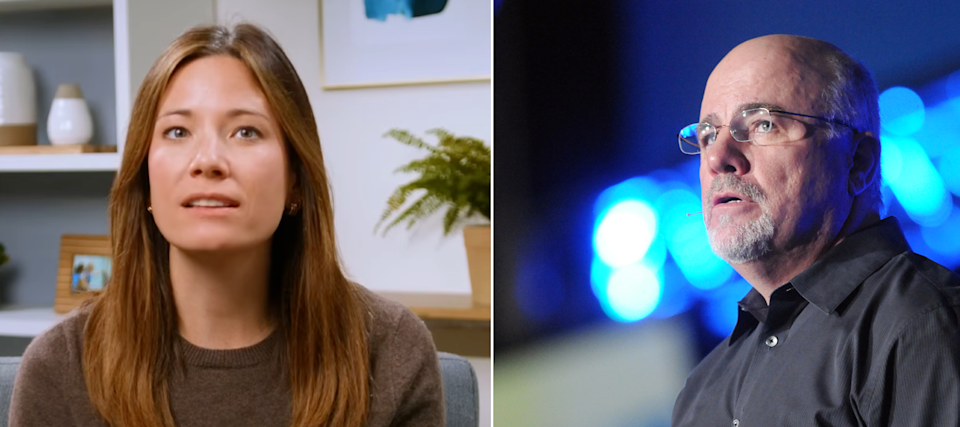
 Rachel Cruze / YouTube: Jackson Laizure / Getty Images
Moneywise and Yahoo Finance LLC may earn commission or revenue through links in the content below.
As Dave Ramsey’s daughter, Rachel Cruze knows a thing or two about money. So when she saw the amount of funds boomers have stashed in their 401(k)s, she was “shocked” (1).
The startling stat? At the end of 2024, baby boomers had an average 401(k) balance of just $249,300, according to Fidelity (2). By the end of 2025, that figure had only risen to $267,900, a change of just 7% (3).
If that’s all boomers have saved for retirement, they could be in trouble, with Cruze noting “that’s less than what I’d be comfortable with.”
With the youngest boomers now 62, much of the generation is already retired or nearing retirement. But just because you’ve achieved sexagenarian status doesn’t mean you’re financially ready to retire.
“Retirement is not an age,” Cruze emphasized on her YouTube channel. “It’s a number.”
And that number has less to do with the years you’ve lived and more to do with the funds you’ve saved.
Here’s a closer look at baby boomers’ financial state — and what it takes to get ahead on the path to financial freedom.
According to a 2025 Vanguard report, only the top 30% of income-earning baby boomers are ready for retirement (4).
Vanguard also found that median-income individuals are expected to experience an annual spending shortfall of $5,000, or 13% of their overall spending needs, in retirement.
That could make for a significant change in lifestyle.
Meanwhile, a 2025 Northwestern Mutual research study found that the average “magic number” Americans think they will need for retirement is $1.26 million. With average savings and net worth well below that figure, it’s no surprise that the study also found 51% of Americans think it’s somewhat or very likely they will outlive their savings (5).
With limited resources, many boomers may be forced to take on debt, rely heavily on Social Security, cut back their lifestyles or even return to work to maintain their quality of life.
Of course, none of these paths are optimal — especially since one of the key rules of thumb for retirement readiness is to be debt-free, according to Cruze.
But even if you’re a boomer, there’s still time to chart a different course.
Read More: I’m almost 50 years old and don’t have retirement savings. Is it too late to catch up?
Read More: Non-millionaires can now invest in this $1B private real estate fund starting at just $10
Whatever your personal magic number for retirement may be, starting early and staying consistent can help you get there.
The median salary for someone aged 55 to 64 is $1,322 per week or $68,744 per year, according to SmartAsset (6).
Fidelity recommends having twice your base salary by age 35, four times by 45 and seven times by 55. To hit these milestones, they suggest investing 15% of your pretax income into a diversified portfolio focused on growth and income.
Cruze echoed that recommendation, adding that boomers should be “aggressive” when it comes to savings.
For example, if you earned $70,000 and consistently saved 15% per year in a low-cost S&P 500 index fund — which has averaged 10.56% annual returns since 1957 (7) — you could save double your income in around nine years and have seven times your income in about 18 years.
If you’re not sure how to find an extra 15% in your budget for retirement investments, consider starting small with an automated investing platform like Acorns, which can help you squirrel away your spare change.
By signing up and linking your bank account, Acorns automatically rounds up the price of everyday purchases to the nearest dollar and deposits the difference into a smart investment portfolio for you.
With consistent contributions to blue-chip ETFs like VOO, which tracks the S&P 500, Acorns ensures your money can grow steadily — and your spare change can be a real contribution to your retirement fund.
If saving your spare change isn’t enough, Acorns also lets you set up recurring monthly contributions for your portfolio. The best part? If you sign up with just a $5 monthly deposit, Acorns will give you $20 to get your investment journey off on the right foot.
With consistent investment on these terms, a 15% saving target and an annual salary of $70,000, you could surpass the average boomer’s 401(k) balance of $267,900 in about 12.5 years (3). This breaks down to putting away about $875 per month, assuming a 10.56% average return on investment and monthly compounding.
In short, consistency pays off — and you don’t need to be wealthy to build a secure retirement. But if you want to reach your target even faster, you can also cut back on costs.
One of the best ways to find room in your budget to invest more is to consistently track your saving and spending.
Understanding your budget inside and out is an evolving process. In the early days, you’ll likely be more focused on the simple stuff, like groceries and gas. Over time, you’ll add more line items, like student debt payments or appreciation on assets such as a home. In the end, this culminates in a single number that many people use to see how they’re doing: their net worth.
You can get a real-time snapshot of your finances with Rocket Money’s premium net worth feature.
You can link your accounts, including bank accounts, investments, retirement accounts, property, vehicles, and even manually added items like jewelry or collectibles, so you see what you own versus what you owe, all in one place. Balances update automatically, giving you a clear picture of your financial progress without having to manage multiple spreadsheets.
Security is built in at every step with bank-level 256-bit encryption and Plaid-powered connections, so your login info is never stored.
Rocket Money’s intuitive app offers a variety of free and premium tools. Free features include subscription tracking, bill reminders, credit scores and budgeting basics, while premium features — like automated savings, customizable dashboards and more — make it easier to stay on top of your retirement contributions and overall financial goals.
Then, once you know your financial self inside and out, it’s time to start directing your savings.
A financial advisor can also help you crunch the numbers and build a plan that works.
But hiring an advisor can be a lifelong commitment, which might make or break your retirement. That’s why finding reliable advisors is crucial.
And that’s where Advisor.com can come in. The platform connects you with an expert near you for free.
Advisor.com does the heavy lifting for you, vetting advisors based on track record, client ratios and regulatory background. Plus, their network comprises fiduciaries, who are legally required to act in your best interests.
Just enter a few details about your finances and goals, and Advisor.com’s AI-powered matching tool will connect you with a qualified expert best suited for your needs based on your unique financial goals and preferences.
Finding the right advisor isn’t always easy — there’s no one-size-fits-all solution. That’s why you can set up a free initial consultation with no obligation to hire to see if they’re the right fit for you.
Beyond budgeting and investing in the stock market, diversifying your retirement portfolio can better spread your risk across multiple assets. As a result, you can avoid dips in the stock market from drastically reducing your portfolio’s worth in the last years before you retire.
Alternative assets are one area that can provide some protection against a broader downturn in stocks and bonds. This asset class includes real estate, private equity, cryptocurrency and the like.
But one alternative asset that’s proven its resilience, especially in recent years, is gold.
Gold prices reached historic highs of $5,602 per ounce in January 2026 (8).
Often, this precious metal is seen as inflation-resistant and a “safe haven” investment from market turmoil. Although there was a pullback in late January, gold is still up over 80% over the past year.
One way to invest in gold that can also provide significant tax advantages is to open a gold IRA with the help of Thor Metals.
Gold IRAs allow investors to hold physical gold or gold-related assets within a retirement account, which combines the tax advantages of an IRA with the protective benefits of investing in gold — making it an attractive option for those looking to potentially hedge their retirement funds against economic uncertainties.
To learn more, you can get a free information guide that includes details on how to get up to $20,000 in free metals on qualifying purchases. Just keep in mind that gold is often best used as one part of an otherwise well-diversified portfolio.
Real estate can be another high-growth avenue for diversifying your retirement. While not everyone has the capital to buy a rental property outright, you can now invest in shares of properties through Arrived.
Backed by world-class investors like Jeff Bezos, Arrived’s easy-to-use platform allows you to invest in shares of vacation and rental properties for a mere $100 minimum.
The real estate platform offers you access to shares of SEC-qualified investments in rental homes and vacation rentals, curated and vetted for their appreciation and income potential.
Arrived’s flexible investment amounts and simplified process allows accredited and non-accredited investors to take advantage of this inflation-hedging asset class — without having to deal with the extra work that comes with being a landlord.
If diversifying into multifamily rentals appeals to you, you could consider investing with Lightstone DIRECT, a new investing platform from the Lightstone Group, one of the largest private real estate companies in the country with over 25,000 multifamily units in its portfolio.
Since they eliminate intermediaries — brokers and crowdfunding middlemen — accredited investors with a minimum investment of $100,000 can gain direct access to institutional-quality multifamily opportunities. This streamlined model can help reduce fees while enhancing transparency and control.
And with Lightstone DIRECT, you invest in single-asset multifamily deals alongside Lightstone — a true partner — as Lightstone puts at least 20% of its own capital into every offering. All of Lightstone’s investment opportunities undergo a rigorous, multi-stage review before being approved by Lightstone’s Principals, including Founder David Lichtenstein.
How it works is simple: Just sign up with your email, and you can schedule a call with a capital formation expert to assess your investment opportunities. From here, all you have to do is verify your details to begin investing.
Founded in 1986, Lightstone has a proven track record of delivering strong risk-adjusted returns across market cycles with a 27.6% historical net IRR and 2.54x historical net equity multiple on realized investments since 2004. All told, Lightstone has $12 billion in assets under management — including in industrial and commercial real estate.
As such, even if multifamily rentals don’t appeal to you, Lightstone could still serve you well as an investment vehicle for other real estate verticals.
Get started today with Lightstone DIRECT and invest alongside experienced professionals with skin in the game.
Join 250,000+ readers and get Moneywise’s best stories and exclusive interviews first — clear insights curated and delivered weekly. Subscribe now.
We rely only on vetted sources and credible third-party reporting. For details, see our editorial ethics and guidelines.
Rachel Cruze (1); Fidelity (2), (3); Vanguard (4); Northwestern Mutual (5); SmartAsset (6); Investopedia (7); APMEX (8)
This article provides information only and should not be construed as advice. It is provided without warranty of any kind.