
Tuolumne County officials declared a local state of emergency Monday afternoon for last week’s storm, as another warmer system is expected to bring rain this Tuesday and Wednesday to parts of the Mother Lode.
The emergency declaration was in response to damage caused by last week’s storm to Pacific Gas and Electric Co.’s Main Tuolumne Canal, which conveys 95% of Tuolumne Utilities District’s drinking water supply for more than 40,000 county residents.
“On Tuesday February 17, 2026, Tuolumne County was hit with a winter storm lasting several days, causing impacts to the entire county,” the county Office of Emergency Services stated in a news release after 4 p.m. Monday. “While we managed through mutual aid and local partnerships to address issues of power outages, low snow and debris removal, unbeknownst to us at the time, a central water infrastructure was damaged.”
In the meantime, Tuolumne Utilities District has put out urgent calls for all residents to conserve water until PG&E can make the repairs to get water flowing in the canal.
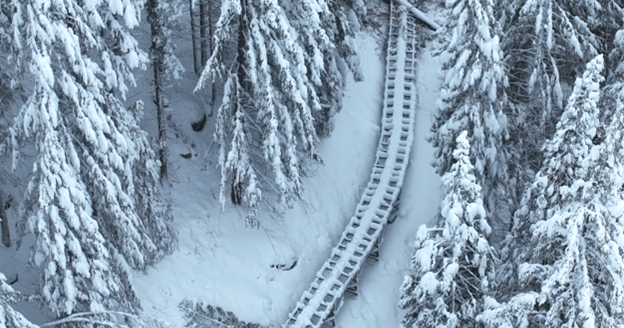
Fallen trees have crushed sections of the flumes, four of which must be repaired, including one flume with five complete breaks, PG&E said. Repairing the storm damage is urgent in part because more rain and mountain snow are forecast to return this week.
The canal’s trestle-supported flumes and dirt-clad, open-air ditches, which traverse 14 miles from Lyons Reservoir in the South Fork Stanislaus River canyon to the Phoenix Penstock above Phoenix Reservoir, date back to the mid-1850s. Miners financed and built the canal to bring water to the Mother Lode’s gold camps.
As of Monday, PG&E had 43 workers on the ground where the canal is damaged, and more support workers supporting their efforts with more resources on the way, PG&E Operations Communications Manager Jeff Smith told The Union Democrat.
County officials stated that the emergency declaration, which aims to open the door for more funding and resources from the state, now requires ratification from the Board of Supervisors at a special public meeting this Thursday.
The approaching storm could bring more than an inch of rain to Arnold and Murphys, and a half-inch to an inch of rain to Sonora, depending on how far south the storm pushes late Monday to early Wednesday.
“Snow levels will remain fairly high, so it will mainly be a rain event,” National Weather Service staff in Sacramento said Monday, adding there will be light snow accumulations over the highest peaks in Calaveras and Tuolumne counties.
More than 570 Pacific Gas and Electric customers remained without power Monday in Cedar Ridge, Twain Harte, and Mi-Wuk Village. Some of those outages began last Tuesday. More than 700 PG&E customers remained without power in the Arnold area, and many of those outages began last Monday. Last week’s storm was described as the strongest, coldest storm of the winter season so far.
Tuolumne County authorities closed the Tuolumne Community Resilience Center as a shelter and warming center Monday morning. Given the forecasts for the warm storm this week there are no plans to open warming centers this week, Dore Bietz, the county Office of Emergency Services assistant director, told The Union Democrat.
Again, the Tuesday-Wednesday storm this week is expected to bring rain, not snow, to the Mother Lode foothills.
As of Monday, storms since the current water year began Oct. 1 had brought 28.3 inches of precipitation to the Central Sierra region, including the Stanislaus River and Tuolumne River watersheds. That was 112% of average for the date Feb. 23.
Water storage as of Monday at major reservoirs in the Mother Lode included 91% at Pardee on the Mokelumne River; 21% at Donnell’s, 47% at Beardsley, 76% at New Melones, and 88% at Tulloch on the Stanislaus River; 86% at Hetch Hetchy and 85% at Don Pedro on the Tuolumne River; 88% at Cherry Reservoir on Cherry Creek; and 69% at McClure Reservoir on the Merced River.
Snow depths in the Central Sierra as of Friday showed 81 inches at Ebbetts Pass, 68 inches at Sonora Pass, and 67.7 inches at Tuolumne Meadows, according to instruments monitored by the California Nevada River Forecast Center.
As of Friday, the Central Sierra snowpack snow water equivalent was 16.7 inches, 76% of average for the date Feb. 20, and the statewide snowpack snow water equivalent was 15.8 inches, 75% of average for Feb. 20.
Contact Guy McCarthy at gmccarthy@uniondemocrat.net or (209) 770-0405. Follow him on X, formerly Twitter, at @GuyMcCarthy.