
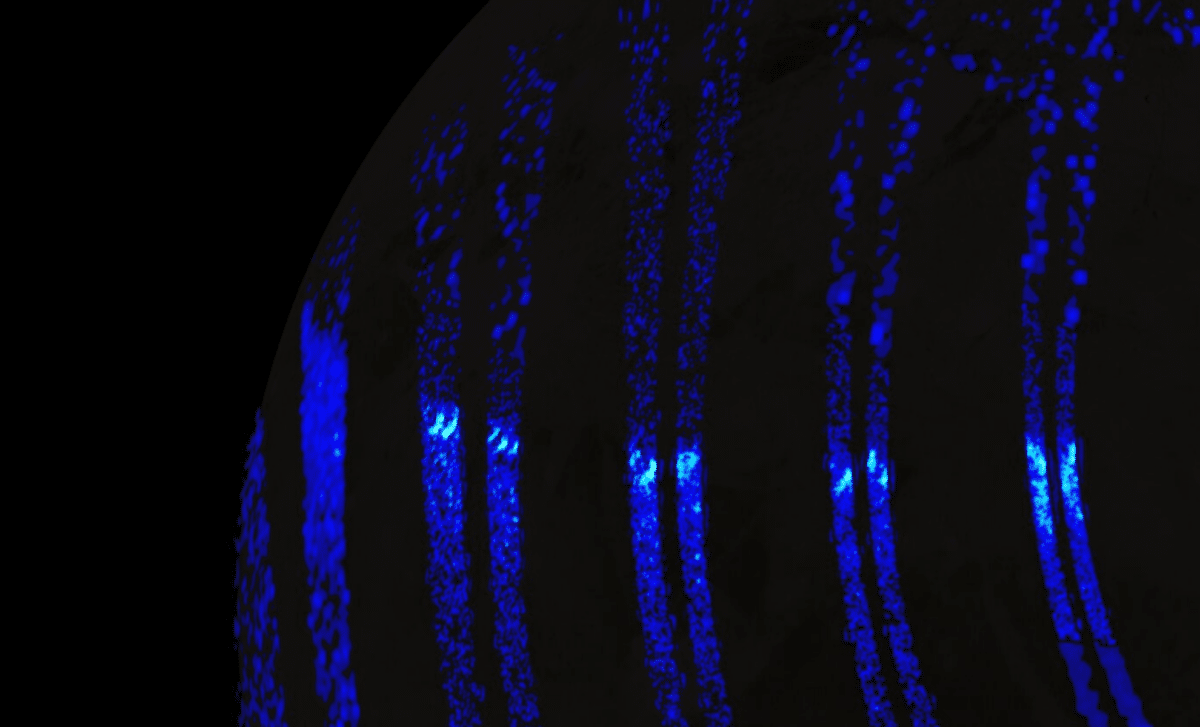
Researchers have revealed stunning new details about the auroras on Ganymede, Jupiter’s largest moon. This research, led by astrophysicists from the University of Liège, uncovers striking similarities between the auroras on Ganymede and those seen on Earth, providing crucial insights into the fundamental processes driving auroras across the solar system. The team used high-resolution data from NASA’s Juno spacecraft, which flew by Ganymede in 2021, to map the auroras and explore their origins. Despite differences in atmospheric conditions, the study suggests that auroral processes are surprisingly universal across various celestial bodies.
The Formation of Auroras: A Cosmic Dance Between Magnetic Fields and Solar Wind
Auroras, those mesmerizing light displays that often light up the polar skies of Earth, are caused by the interaction between a planet’s magnetic field and the solar wind. On Earth, these colorful lights form when charged particles from the sun collide with Earth’s atmosphere, exciting oxygen and nitrogen molecules and making them glow. This phenomenon is most commonly seen near the magnetic poles, where the Earth’s magnetic field funnels charged particles into the atmosphere.
The new findings about Ganymede’s auroras show that the fundamental physics behind these events are not unique to Earth.
“Auroras are also observed on Ganymede and are caused by the precipitation of electrons in its thin oxygen atmosphere,” explains Philippe Gusbin, whose master’s thesis in Space Sciences formed the foundation for this study.
Unlike Earth, however, Ganymede’s thin atmosphere offers a different environment for auroral formation, influenced heavily by the moon’s interaction with Jupiter’s powerful magnetosphere.
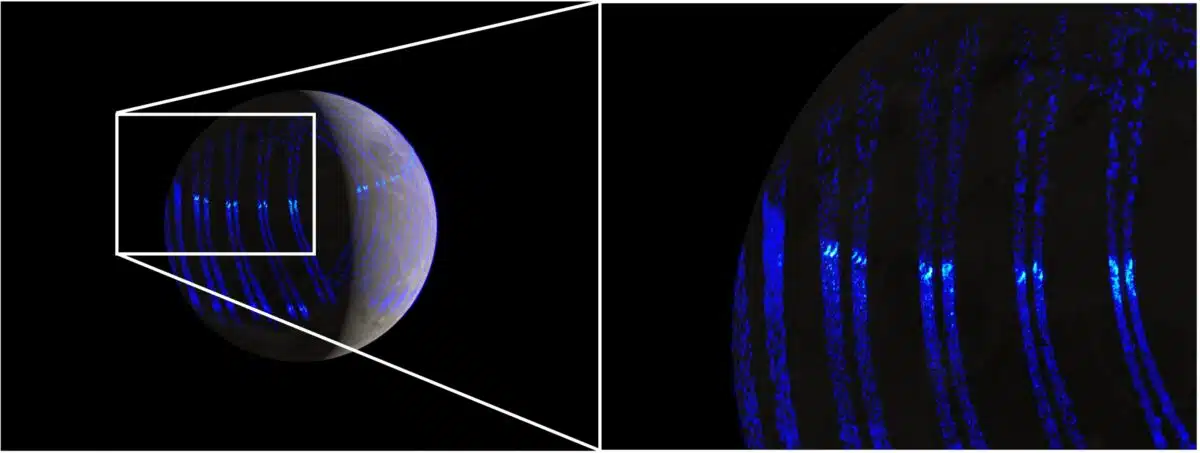 Artistic views of the ultraviolet aurorae on Ganymede, based on Juno’s close-up observations from 7th July 2021. As Juno flew by Ganymede at high speed, its UV spectrograph could only acquire narrow strips, combined here to display the overall shape of the aurora (left). However, when zooming on individual strips (right), it becomes apparent that this aurora is formed of a chain of patches rather than a uniform curtain. Similar auroral forms have been observed at Earth, as well as on other planets such as Jupiter or Saturn, suggesting that universal processes are at play.
Credit: NASA/JPL-Caltech/SwRI/UVS/ULiège/Gusbin/Bonfond
Juno’s Groundbreaking Observations of Ganymede’s Aurora
Before the Juno spacecraft’s observations, scientists had only limited views of Ganymede’s auroras. Ground-based observations, with lower spatial resolution, couldn’t capture the fine details of these auroral features. Juno, with its advanced ultraviolet spectrograph, provided unprecedented high-resolution images, revealing the intricate structures of the auroras in extraordinary detail.
“Observations of Ganymede’s auroras prior to Juno were limited by the spatial resolution of ground-based observations, and they could not resolve the small-scale structures typical of planetary auroras,” Gusbin notes.
These high-resolution images allowed scientists to discover a unique and fragmented structure of Ganymede’s auroras. Instead of a smooth curtain of light, the auroras were observed to form in distinct patches, a phenomenon seen on Earth and Jupiter as well. This discovery could hold the key to understanding the dynamics of auroras across the solar system, especially in environments where magnetic fields play a major role.
Auroras on Other Planets: A Universal Phenomenon
Ganymede is not the only celestial body to showcase stunning auroras. Planets like Venus, Mars, Jupiter, Saturn, and Uranus also display their own versions of auroras, though the processes behind them vary. On Jupiter, for instance, auroras are even more intense, largely due to the planet’s massive magnetosphere and energetic solar wind interactions. Similarly, auroras have been observed on Venus and Mars, where the lack of global magnetic fields causes different types of auroral phenomena. However, Ganymede stands out because it is the only moon in the solar system known to have its own intrinsic magnetic field, similar to Earth’s.
These findings, published in Astronomy & Astrophysics, underscore the idea that while the conditions may vary, the fundamental physical processes behind auroras remain consistent across different bodies in our solar system. The study provides a new layer of understanding about how space weather impacts celestial bodies, enhancing our ability to predict and study these phenomena on both Earth and beyond.
Beads and Patches: Common Features in Auroral Displays
In the high-resolution images of Ganymede’s auroras, scientists discovered a feature known as “beads,” or small, patch-like structures. “Similar structures, known as ‘beads,’ have been observed in the auroras of Earth and Jupiter, where they are linked to sub-storms and dawn storms, large-scale rearrangements of the magnetosphere that release enormous amounts of energy and produce intense auroral activity,” says Alessandro Moirano, post-doctoral researcher at the University of Liège. These beads appear as localized bursts of light within the aurora and are connected to disturbances in the magnetic environment, much like how auroral displays on Earth intensify during geomagnetic storms.
These findings suggest that, although the physical environments may differ greatly, the way in which auroras manifest is fundamentally the same, driven by similar magnetic and energetic processes. This realization could help scientists better understand how auroras behave on other planets and moons, and potentially how space weather might impact these bodies.
The Future of Ganymede Exploration: What’s Next?
While Juno’s observations provided invaluable data about Ganymede’s auroras, the spacecraft’s brief encounter with the moon, lasting less than 15 minutes, was just a glimpse into what could be a much more complex phenomenon. The spacecraft will never fly over Ganymede again, leaving scientists with many unanswered questions.
“Juno’s close observations of Ganymede lasted less than 15 minutes, and the spacecraft will never fly over Ganymede again. Therefore, we do not know how common these patches are or how they evolve over time,” says Bertrand Bonfond, an astrophysicist involved in the study.
Fortunately, future missions, such as ESA’s Juice (Jupiter Icy Moons Explorer) mission, promise to extend our understanding of Ganymede’s auroras. Scheduled to arrive in 2031, Juice will carry a similar ultraviolet spectrograph to Juno’s, enabling longer-duration observations of Ganymede’s auroras and potentially revealing new insights into the moon’s magnetic interactions. This mission could uncover crucial information about the evolution of Ganymede’s auroras and how they change over time, providing a more comprehensive picture of auroral processes on this fascinating moon.