
Two decades ago, NASA Administrator Michael Griffin observed that the space agency has become too dependent on outside contractors. He said over the last few decades, NASA hollowed out some of the skills the agency needs in-house to oversee and evaluate programs.
Griffin was not the first, nor the last, to express these concerns. Over the last 20-plus years, lawmakers, NASA leaders and others have tried and tried again to address workforce challenges, including when NASA kicked off its Vision 2040 project in 2018.
Now it’s NASA Administrator Jared Isaacman’s turn to pave over this well-known ground.
But observers say for Isaacman’s plans to refocus and reinvigorate NASA’s workforce to be different, he has to overcome some stiff cultural barriers that hamstrung, and eventually choked off, previous efforts.
]]>
“What Isaacman is trying to do is a culture reset,” said Mary Davie, a former deputy associate administrator for mission support directorate who retired in 2023 after 35 years of government service. “When he talks about things like mission-driven intensity and bias toward action, he’s probably discovered there is a lot of governance and oversight, that decisions take a long time, and it feels like every executive in the agency is involved in every decision.”
That culture reset is focused on addressing what many say are long-term and systemic problems for NASA.
Isaacman wants to shift work away from contractors and toward federal employees focused on the agency’s core competencies.
He said approximately 75% of the workforce are contractors who are managed by a small civil servant workforce. He said using so many contractors is not only highly inefficient, but it leads to continuous program delays. Isaacman said it’s also costly, with NASA spending nearly $1.4 billion a year on what he called “needless expenses.”
“NASA recognizes that contractors have and will continue to play a vital role in achieving mission objectives. This directive focuses on correcting over-reliance on outsourced engineering and staffing that diminishes NASA’s core competencies and resources essential to agency priorities,” Isaacman wrote in a Feb. 6 memo, which Federal News Network obtained. “The future state aims to use contracted workforce primarily for limited-term assignments, surge staffing and specialized functions outside NASA’s core competencies.”
To reshape NASA’s federal workforce, Isaacman laid out several new short-term initiatives.
“Within 30 days, every center and mission directorate will assess which technical and operational roles need to come back in house. Within 60 days, we’re implementing rapid onboarding to ensure the funnel of new talent is always filled,” Isaacman said in a video message posted on X. “We’re fostering a culture of technical excellence, hands-on engineering and continuous learning, recognizing technical contributions and creating maker spaces at every center. We’re restoring in-house engineering and operational excellence to reclaim technical autonomy and concentrating our resources on the most needle-moving objectives.”
]]>
After 50 days on the job, visits to every NASA center, a dozen town halls, and reviewing thousands of workforce submissions, it is clear there is much we can do to better empower our people and focus resources on the most pressing objectives.
Getting back to the Moon means… pic.twitter.com/q8vBaY3QHz
— NASA Administrator Jared Isaacman (@NASAAdmin) February 6, 2026
Along with the speech, Isaacman issued a workforce directive, offering more details about NASA’s new workforce objectives.
Under the 30-day workforce assessment, Isaacman wrote that these assessments “will identify outsourced or missing technical and operational expertise and provide a proposal to convert core roles to civil service,” and should “categorize their proposals by priority, mapping to core competency and current contracting mechanisms” and should “emphasize solutions that enable mission execution without introducing additional redundant layers of management.”
Additionally, Isaacman said the assessments should identify engineering, operational, scientific, manufacturing and other mission-critical work currently outsourced, and provide a proposal for what should be brought in-house, aligned with the workforce assessment.
Hiring more people isn’t just a matter of instituting rapid onboarding. There has to be bigger cross-agency coordination.
 NASA Administrator Jared Isaacman answers a question during a monthly coffee and donuts with the Administrator event, Tuesday, Feb. 24, 2026, at the Mary W. Jackson NASA Headquarters building in Washington. (NASA photo/Aubrey Gemignani)
To that end, Isaacman said NASA’s the chief human capital officer, chief acquisition officer and CFO will develop a transition strategy, consolidating workforce assessments and creating an implementation plan to convert or add targeted roles to civil service, addressing contract changes, renegotiations or terminations, timelines and cost implications.
]]>
“We are supporting OPM’s Tech Force initiative bringing in term-based hires from industry and academia, and launching robust internship training and mentorship to develop the technical talent we require,” he said in the video.
The workforce focus isn’t just on bringing in new employees. Isaacman said NASA must do more to empower the current workforce.
While NASA remains one of the top places to work in government, according to the Federal Employee Viewpoint Survey and Partnership for Public Service reports, it has seen both a drop in satisfaction and a reduction in its workforce over the last year.
From 2012 to 2024, NASA was ranked number one among large agencies in the Best Places to Work rankings. Most recently it has a score of 81.6, which is down for the fourth year in a row, but still generally high.
At the same time, NASA saw a huge workforce reduction in 2025. Data from the Office of Personnel Management shows NASA lost about 2,300 employees since 2024. Its total workforce of 16,869 is the lowest in a decade. It remains heavy in the GS 13-15 range, with fewer than 500 people at the GS-11 or below levels.
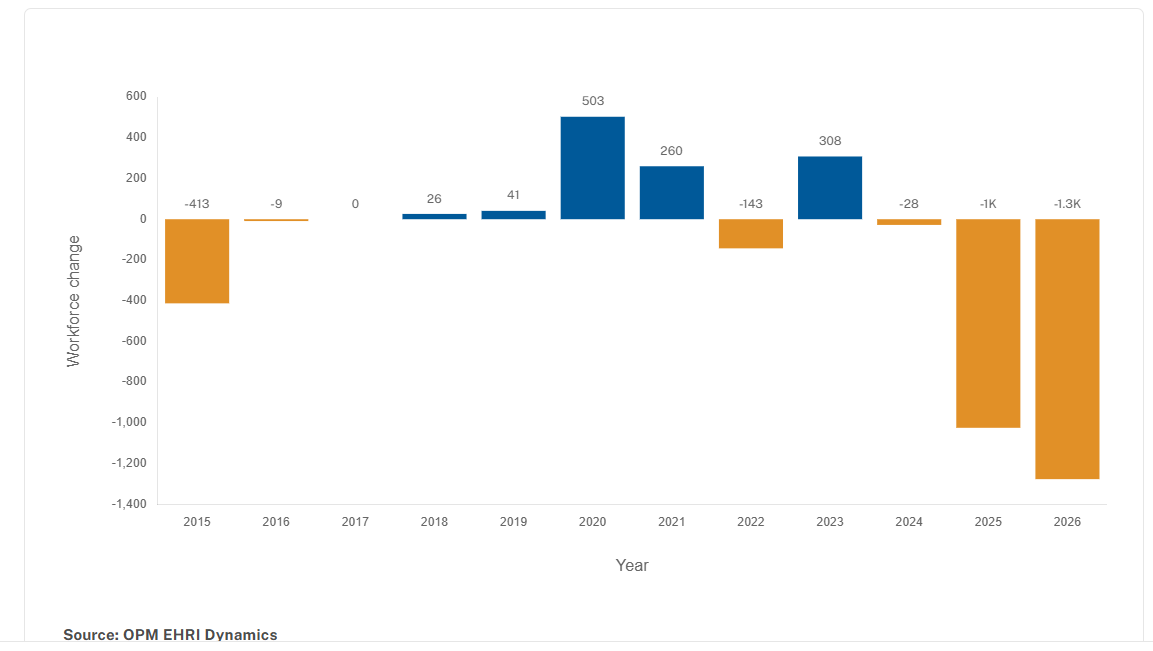 NASA workforce changes from 2015 to 2026. (Source: OPM data dashboard)
Isaacman issued another memo on Jan. 13 that specifically focused on the current workforce:
Immediately, leadership across the agency, with the assistance of the chief human capital officer, will promote and embed the following principles across the workforce:
Duty and competence: Working at NASA is a privilege. To serve in the world’s most accomplished space agency, you need to be dedicated to excellence in your profession.
Mission-driven intensity and urgency: Maintaining a bias toward action and achieving objectives in support of the mission is the highest priority of every NASA employee.
Ownership and accountability: We own our responsibilities and the outcomes. Every project, problem, part, and requirement has a clear owner.
Recalibrated risk framework: We will ensure safety is at the forefront of our decisions but achieving the mission of NASA means accepting that some risks are worth taking.
As part of this effort, he is setting up new approaches to recognize and reward performance of employees, including a ride-along program in NASA aircraft, the ability to observe a mission launch and the honor to receive “flown hardware” awards.
Another approach Isaacman is taking to empower the workforce is through the creation of MakerSpaces at each center. Isaacman gave center leaders 60 days to develop a plan for these offices to “enable rapid prototyping and proposal development. Include an assessment of potential funding mechanisms, such as sponsorships from partners and critical vendors, to support implementation and sustainability.”
Davie said a lot of these efforts have a familiar feel to them.
She said NASA has been trying to address through an assortment of initiatives many of these same challenges over the past two-plus decades.
For example, in 2003, then-Comptroller General David Walker told lawmakers about NASA’s goals to close critical skill gaps.
Then in 2006, the House Committee on Science, Space, and Technology held a hearing focused on the workforce. Toni Dawsey, the agency’s chief human capital officer, said NASA’s workforce strategy hinges on certain key actions and initiatives, implementing a new workforce planning process, assessing competency gaps with greater detail and accuracy, and making effective use of a broad array of human capital tools and options to address workforce issues.
Then in 2018, NASA launched its Vision 2040 effort.
“The 2040 effort was trying to answer several questions about the workforce, including what is core competency of workforce and what does NASA want to use outside expertise for?” Davie said. “It’s clear the commercial sector has proven it can do things NASA would never have thought of, like reusing rockets, and can do it at a much higher cadence. So the idea of this review and report was how NASA has to look at its role versus the private sector and how to keep oversight, safety and risk as well as keeping projects on time and on budget.”
The National Academies of Sciences, Engineering, and Medicine added to this discussion in 2022 with a report that lawmakers requested in the CHIPS and Science Act of 2022. The National Academies report goes much deeper than just the workforce challenges, but it recognized challenges like lower salaries and the transition of hands-on engineering opportunities being moved to private sector firms as two big issues the workforce has to address.
Davie said the 2040 Vision and many other similar efforts have tried to reimagine the organizational structure over the years. But too often, she said, NASA never implemented the changes recommended by these efforts.
The question that Davie and others are asking is whether Isaacman’s latest entrée into the NASA culture will be more than a paper exercise? There are few things harder than changing an entrenched culture, and given how traumatic the last year was for many federal employees, the hill Isaacman is climbing is bigger and filled with more boulders than ever.
Copyright
© 2026 Federal News Network. All rights reserved. This website is not intended for users located within the European Economic Area.