
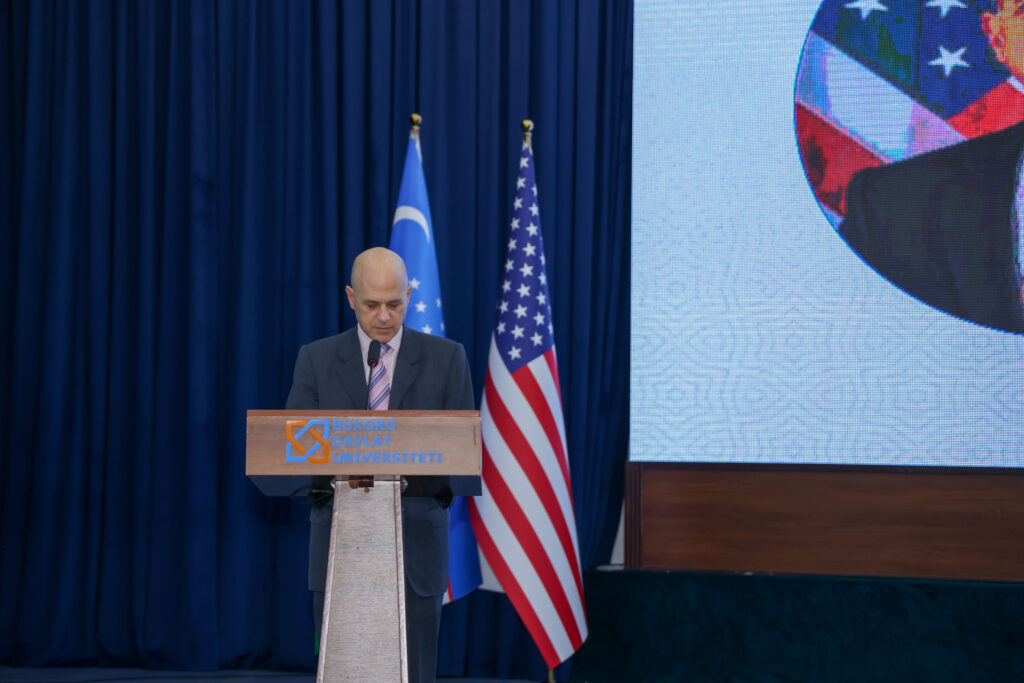
Ambassador Jonathan Henick – Bukhara State University February 24, 2026
Good morning, distinguished guests, Deputy Governor, conference organizers, scholars, and friends. Ramadan muborak!
Thank you for the warm welcome to this historic city and for the honor of celebrating the important contributions of Bukharan Jews for the Socio-Economic and Cultural Life of the Region.
This conference comes at a time when relations between the United States and Uzbekistan have never been better. Last week our presidents spent time together thanks to President Mirziyoyev’s commitment as a member of the Board of Peace. I would like to thank him for his efforts to build peace building between people of differing faiths in Israel. Last week’s meeting represents the fourth within a four-month period. These meetings continue to strengthen our strategic cooperation an d economic ties, resulting in major trade and investment deals. It is a very fitting time during Ramadan to reflect on interfaith dialogue and strengthening economic ties in Bukhara, one of the major trade hubs on the Silk Road.
Historical Ties
This year Uzbekistan will celebrate the 35th anniversary of its Independence but the relationship between the United States and Uzbekistan started long before. Beginning in the early 20th century, thousands of Bukharan Jews made their way to the United States, settling primarily in New York City’s Queens borough. They brought with them the rich traditions, languages, and cultural heritage of this very region—establishing communities that remain vibrant today.
Queens’ “Bukharian Broadway” with Bukharan restaurants and, notably, “Meros” Museum with Aron Aronov’s collection of artifacts.
This community has maintained its connection to Uzbekistan through language, music, cuisine, and family ties. In doing so, they became some of our earliest
cultural ambassadors—teaching Americans about the Silk Road, about Central Asian traditions, and about the remarkable history of this region.
A Model of Tolerance
For centuries, Bukhara has been home to Muslims, Jews, Christians, and others living side by side. The Bukharan Jewish community flourished here for over two millennia, contributing to commerce, crafts, music, and intellectual life. This legacy of coexistence is not merely historical—it represents values that Uzbekistan continues to uphold today.
The United States stands firm in its commitment to uphold religious freedom and to counter antisemitism worldwide. In a time when religious intolerance threatens peace in many parts of the world, Uzbekistan’s commitment to protecting its diverse heritage and promoting interfaith dialogue deserves recognition. It should serve as an example to others.
Bridges of Culture and Commerce
Conferences like this one do more than examine history—they build bridges for the future. The Bukharan Jewish diaspora in America has created business networks, cultural exchanges, and people-to-people connections that benefit both our nations. American Bukharan Jews invest in Uzbekistan, promote tourism to their ancestral homeland, and facilitate educational exchanges. They are living proof that cultural heritage can be a foundation for modern partnership.
Looking Forward
I applaud the organizers for convening this conference and the scholars who will share their research. By documenting and celebrating the contributions of Bukharan Jews to this region’s socio-economic and cultural life, you preserve an essential part of Uzbekistan’s diverse heritage.
The United States looks forward to continuing our partnership with Uzbekistan—a partnership enriched by the cultural bridges built by Bukharan Jews and strengthened by our shared commitment to religious freedom and expression and economic prosperity.
Thank you, and I wish you a productive and enlightening conference.