
Welcome to “On That Note,” a rock-and-roll-centered column that will dive into the big stories, trends, and crazy ideas coming out of the music industry.
“His aesthetic has always been inside of me a little bit. I’m always amazed that he didn’t have a stylist, he just dreamed it up.”
Photo: Neon
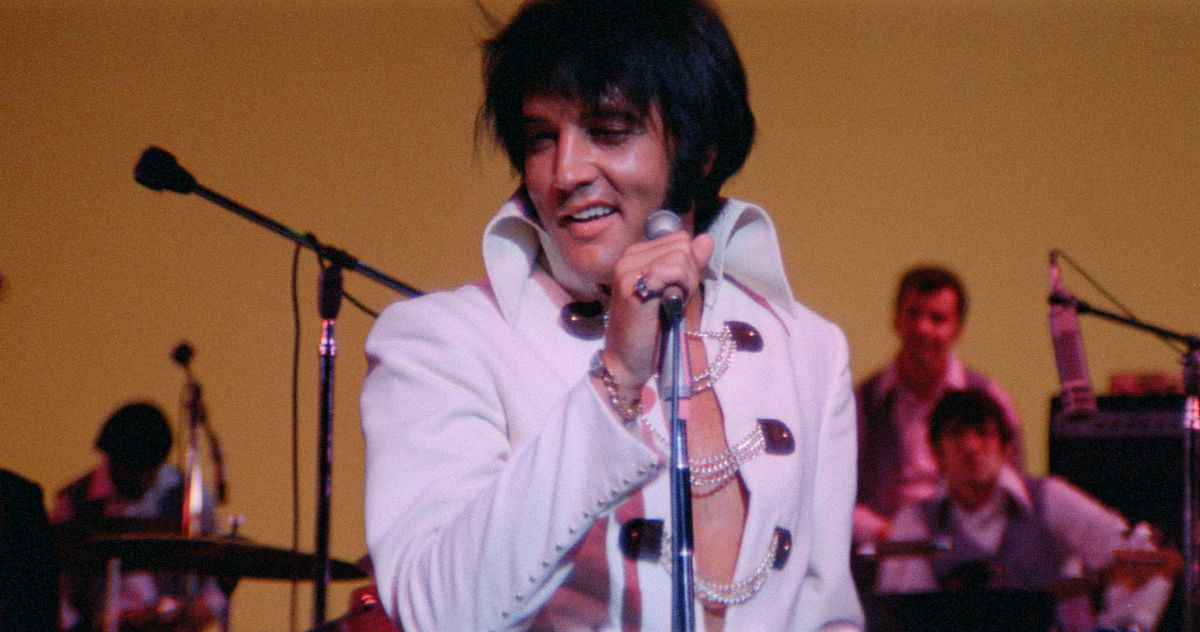
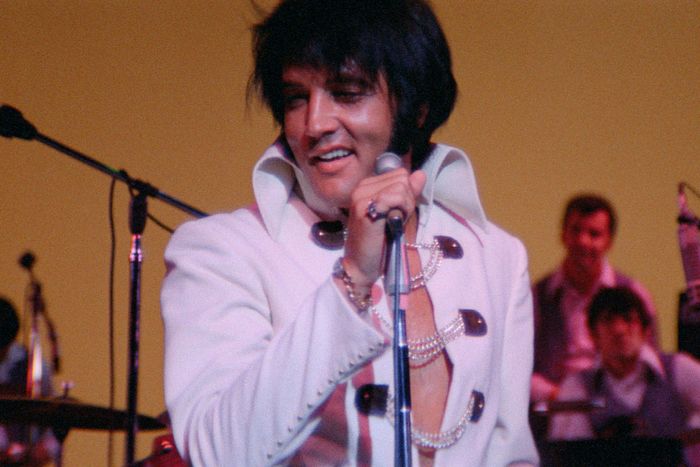
Baz Luhrmann gives you permission to party like it’s 1971 while watching EPiC: Elvis Presley in Concert. The filmmaker, pretty much the Stanley Kubrick of confetti, was of course the man behind the 2022 biopic Elvis, in which Austin Butler portrayed the king and helped Luhrmann earn eight Oscar nominations. EPiC, though, has nothing to do with Tom Hanks doing heavy accent work as Colonel Tom Parker. During Elvis’s production, Luhrmann was able to negotiate and unearth the oft-mythicized footage of Presley in the early 1970s during his Las Vegas residency, which was sitting in a Kansas City salt mine for decades. The excavation yielded extraordinary results: Luhrmann’s team found 59 hours of film from ten concerts, in addition to new, reflective interviews from Presley, who often eschewed communicating outside of press conferences. Luhrmann prefers to call this concert documentary a “tone poem,” in which viewers transcend being stand-ins for the International Hotel audience — you get to experience Presley telling his own story for the first time, all while experiencing the gyrations of “Burning Love” and “Always on My Mind” in the prime of his career. “If there’s ever a show where you’re allowed to make as much noise as you want, it’s this one,” Luhrmann says. “We want it to be a real concert.”
Luhrmann spoke to us shortly after the final figure-skating event of the 2026 Winter Olympics, where, seemingly, a record number of skaters chose to perform to the music of Moulin Rouge! (“It’s funny how much of my stuff ends up in figure skating,” he notes. “I get it, because it’s storytelling and it’s dramatic. I love it.”) EPiC, which is already out in Imax and will receive a general release on February 27, shares that same kinetic style — so much so that Luhrmann jokes he might abandon his upcoming Joan of Arc movie in favor of doing another spin on a documentary. “I might give up making movies and just do found-footage stuff,” he says, “because you don’t have the battle of writing, shooting, and getting the casting right.”
I got very hot and bothered watching Elvis during the prime of his career. If that was one of your many goals, congratulations.
I always think of the moment when Elvis says, “I’d love to tour in England and Japan.” And for the Colonel reasons, Elvis is like a bird hitting a glass wall. He never goes around the world. We wanted to give him the global tour he never really had. And I wanted to put on a rock show. When people say it feels like they’re actually at an Elvis show, I’ve done my job.
In an interview a few years ago for Elvis’s release, you explained to us how your preferred editing style is to challenge the audience and make them really work for what they’re seeing. How closely did you want to adhere to that approach for your take on a concert documentary? Did your directorial sensibility change at all?
It did. It’s different in the sense that, number one, I didn’t write or shoot a frame, and I didn’t cast it. It was already precast with this lead player. It was accidental that we found the material. We literally sent someone into the salt mines in Kansas City, Raiders of the Lost Ark style, and boom, there were 65 canisters of negatives but no sound. Then there were two whole years of scraping back sound, finding it, and getting all the rights holders together to obtain the music rights. A lot of the tracks were good, but then you have to deal with gangsters to buy back the black-market stuff. After all that, then it’s like — what to do with it?
The idea came when we found those 30 minutes of Elvis just speaking and being very unguarded. This is where it got particularly different from my other films, because I wasn’t going, Oh no, how do I get an audience to get onboard with Elvis as the storyteller? I realized the film should do something unprecedented with Elvis, which was to get us out of the way. His whole life was about people managing him or telling their story. But if Elvis was going to tell his story, then we had to be guided by Elvis’s telling. Now, that doesn’t mean we didn’t have energetic cutting. Elvis would use the latest technology and want a big sound. We really worked with our great music teams in making it as concertlike as possible. There’s stuff in there that’s like a dreamscape. It’s not a documentary, it’s not a concert film. It’s its own babe.
Elvis is, effectively, the narrator of this film, and the footage you unearthed finds him at an introspective moment in time. He talks about the difference between the image and the human being. What went through your mind while watching all of this footage for the first time? Did it align with what your image of Elvis was?
I discovered his humor, which is locked in with a type of goofiness. This is only my theory — having done so much research on Elvis and meeting Sam Bell, his childhood friend who wasn’t someone living off the Elvis myth and was an older man of color. Sam told me, “Elvis was living in one of the few white houses in the Black community. The Presleys were in East Tupelo and were so, so poor.” His father went to a very famous jail. Elvis had a great hole in his heart and always felt less than, but then he grows into this Greek god who’s got the voice of Orpheus. He goofed around a lot and was always setting up to disarm himself, the audience, and the band, so that they could deal with the man and not the myth. The whole “man and the myth” thing was a really big thing with him, so the goofy humor was a big surprise. Like, he does it all the time. He’s nonstop.
He’s a goofy dude. At one point in the film, he fellates a microphone and then does some crowd work and tells his audience, “It gets dry up here, man, it feels like Bob Dylan is stuck in my mouth.”
And then he’ll sing a really huge power ballad and be like, “I’d get down on my knees if this suit wasn’t so tight and shove it up your nose!” It’s a silliness where there’s no embarrassment. I remember Whitney Houston’s mother, Cissy, met Elvis when she was still in the Sweet Inspirations. She must have been 10 years old. She said, “Elvis walked in the room and you didn’t go, ‘Hello, Mr. Elvis,’ you just stared.” If you’re someone, when you walk in a room, people just stare at you, you’re that famous. You have to do a lot for people to get past that shield of fame to connect with the person. Elvis used humor to get people to realize, “Hey, I’m a human being, you know?”
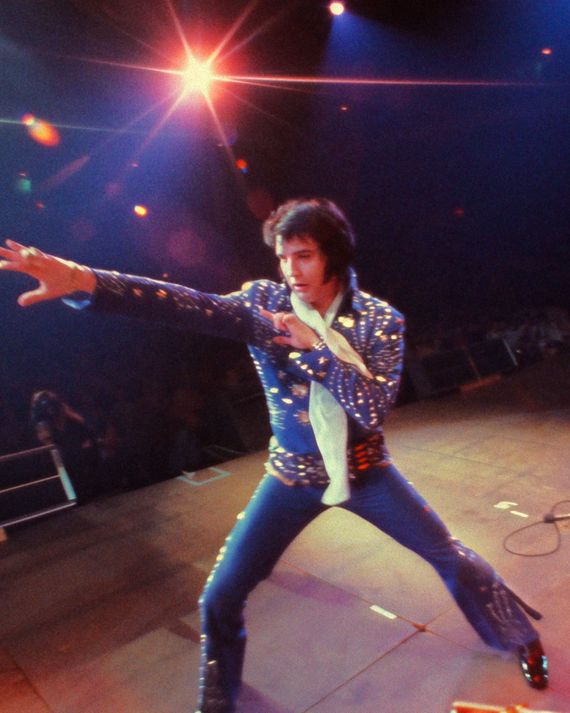
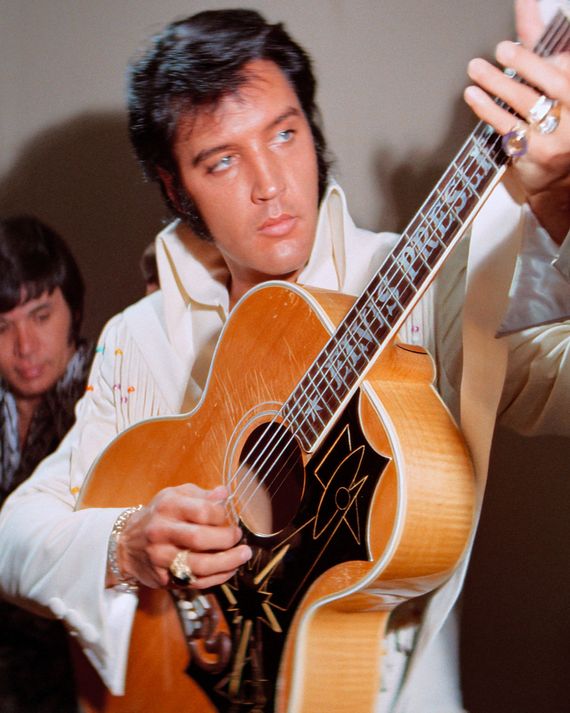
Presley working on his karate and tuning a guitar in EPiC. From left: Photo: NeonPhoto: Neon
Presley working on his karate and tuning a guitar in EPiC. From top: Photo: NeonPhoto: Neon
Did you have any concert-film North Stars that helped guide you? I know discovering and working with footage is different from directing a live performance, but I’m curious if, say, Martin Scorsese or Jonathan Demme’s work in the genre provided any inspiration.
Those are some of my favorites. I love Stop Making Sense and The Last Waltz. But the answer is “Not really.” I consider what Peter Jackson did for The Beatles: Get Back as sort of the go-to — if you want to understand the creative process, collaboration wise, that’s the highest-possible watermark. It’s the rough and tumble and the craziness of John Lennon belting something out from the piano and going, “What do you think, Paul? Got anything for me, George?” What Jean-Luc Godard did for the Rolling Stones in Sympathy for the Devil is really kind of crazy, because as a fly on the wall we pick up all these expressionistic things. I remember thinking, Oh, there’s something interesting about seeing the randomness of bands creating.
But the difference with Elvis is he wasn’t in a band, which was why it was so hard for him. The bands fare better because they have each other. Elvis was alone. Music aside, do you know Listen to Me Marlon, which featured tapes of Brando just talking? Leonardo DiCaprio and I are huge Brando fans. He was going to, at one stage, be in my Romeo + Juliet film, and I still have the beautiful letters he sent me. Hearing him sit there and rattle on about what he really felt, you feel close. You start to understand the person when they’re actually telling you their story.
There are several moments of Elvis playing around with the Beatles’ work. In rehearsals, he covers “Yesterday” and “Something” — he notes that “Something” has “very suggestive lyrics” — and he incorporated “Get Back” into a Vegas show. What did you gather from his attitude toward the band or other contemporaries? The Beatles were a rare match for Elvis in terms of fame.
Funny enough, Paul McCartney spoke very openly with Austin Butler about this. They took a train ride together before Austin started shooting Elvis about what it was like to meet him. Paul was all about how they were kids, smoking a bit of weed, and they went up to the house here in Los Angeles. They just sort of stumble out of a car and meet Elvis. They were struck by how beautiful looking he was. But the Beatles all remembered it differently because they were probably all high, you know? Paul talked very warmly about how he and Elvis jammed on a song. Even Bob Dylan has said, “One of the greatest moments in my life was Elvis covering one of my songs.” You can’t overstate how much of an influence Elvis has on all of these musicians. A lot of what’s been said about Elvis’s attitudes towards the Beatles is made up or when he was going through his degenerated period of being on drugs and doing crazy things. You see in this film that he covers Bob Dylan and Simon & Garfunkel songs. He has no prejudice when it comes to good music. He’s looking for great material and then makes it his own.
I was keen to ask about the “Polk Salad Annie” sequence, where it switches between Vegas, rehearsals, and a Presley family portrait. Elvis ad-libs “Because that’s all they had to eat, but they did all right,” and it’s very much alluding to his upbringing. I’d love to learn more about the editing for this one and what it helps us understand about, as you said earlier, the man behind the myth.
It defines the film, and it’s something that Jonathan Redmond, my editor and collaborator, cut early on. It’s masterful. In the rehearsal, it’s running at a different tempo than the one he ultimately performs onstage. We wanted to show Elvis finding the song — he has the same energy in rehearsals as he does onstage, which is unusual. If Elvis was telling you his story, it’s how the songs were there to illuminate his story. He’s famously not someone who launches into speeches about anything. But if you want to know what his heart is, look at his song choices. Look at what he says in a song like “Polk Salad Annie.” It’s a fun, jokey song about being down in Louisiana. “The alligators look so mean and there was a girl razor-blade clean.” What they eat is, essentially, swamp greens. The cheapest of the cheapest. You’ve got to be really poor to eat polk salad, but the Presleys did it. Sam Bell, who I mentioned earlier, told me that they had a good vegetable patch despite being beyond poor. That’s the key to it.
And then there’s a moment like Elvis debuting “Burning Love” at his residency, where he declares, “If you don’t know it you will.” I’m like, Yeah man, we sure will.
Elvis didn’t even like the song. He was wary of it. Onstage he thought he was going to screw it up because he was very nervy with lyrics, so he had the paper in front of him and he’s actually singing it while looking from a page. Now, of course, we know it’s a giant hit. So we cut between him finding the song onstage and you can see all the musicians and backup singers eyeing him down, because no one has any idea what he’s going to do, including the band. So they have to watch him all the time. He never went on and said, “Here’s the set, everyone.” He wanted to be spontaneous, change his mind, and keep them all on their toes. He never rehearsed his steps, nothing. I love when he says, “I just do what I feel.” We also use it to show that period where he is doing 15 cities in 15 days. The Colonel has got him doing, like, three shows a day in two cities, and it’s the touring that really starts to wear him down. Because he thinks he’s going to finally get the chance to tour overseas, but the Colonel’s got him doing the Vegas show over and over and over again. That’s a lot to do with the gambling and the deals he made.
What was the most interesting piece of footage of Elvis you discovered that, for whatever reason, didn’t make the final cut?
There’s an old saying: “When you edit, the first thing you should do is cut your favorite shot.” Because you can’t fall in love with a shot, you fall in love with the story. I’m having trouble thinking of a specific number because once you let it go, it’s surprising how it makes what remains behind better, so you sort of block it out. There’s a lot more of Elvis clowning around in cars and in rehearsal rooms. That was great but didn’t really advance the plot. You know what, I’ll call Jonathan and find out how many musical numbers we cut. We’ll get in a lot of trouble because it’ll be like, “Release the files, release the files!” I know, for sure, we cut about two or three. It had to be on point — otherwise you’re indulgent.
I get that. I remember leaving the theater and thinking, Wow, I wish it was longer, but it’s because of those editing choices.
Listen, I’ll be Uncle Baz for a moment: What we have to do is get enough people in the cinema to make it economically viable to do more of these. It’s extremely expensive to bring this material back at a quality you can see on Imax. I funded this myself. We look like we’re on track to pay the bill. And if we pay the bill, the sky’s the limit. It’ll be an ongoing legacy of Elvis. We had to scan all of the material before we even had the idea of the footage, because it was rotting. When all the reels came in, they possessed this intense vinegar smell. And it’s the smell of negative film dissolving. So our first job was to preserve it. Now it’s all scanned at the highest-possible resolution. If we put it back in the salt mines, it would’ve died. So it means there’s endless years of work that can be made from it, and that’s up to those who come after me to do. But the first thing to do is to show it’s economically viable and there’s an audience for it.
Has your exposure to all of Elvis’s incredible costumes changed the way you dress? I can unequivocally state that, in the weeks after watching this film, all I’ve been shopping for is colorful sunglasses and flashy pants.
There’s nothing wrong with a flashy trouser and cool glasses. With whatever film I’m doing, I very early on adopt the sartorial styling, the look, and the feel. But I think his aesthetic has always been inside of me a little bit. I’m always amazed that he didn’t have a stylist, he just dreamed it up. Even early on he had sideburns and was wearing makeup at school — it was coming out of his inventive mind. He was bullied a lot. So he was defying them by going, The hell with that, and obsessively hanging out in the Black community and being on Beale Street. He was like any kid who feels isolated. I was speaking to someone just last night who was very close to Elvis. I said, “What was the reason for the big long collars? People thought they made him look like Napoleon.” And they responded, “His parents told him he had a really long neck, like a turkey. So he felt he had too long a neck.” Which is funny, because I don’t see anything wrong with his neck, you know? Always follow the clothes for the story.
I didn’t realize just how wild Elvis’s performance schedule was until that title card at the end, where it states he played well over 1,000 shows during that time period. When you look back at your own career, what were the most demanding years you made it through?
Getting through Australia. It was a vast epic and we were spread out all over the country. We had so much bad luck. I mean, you have to expect bad luck when you’re making a big movie. But we had equine flu and it rained in the desert for the first time in 100 years. There was grass everywhere. We did some silly things to deal with that. We went like, Well, we’ll shoot up in the north, then. And the north of Australia makes the Sahara look positively populated. But it was such a grand adventure, I wouldn’t give any of it up. It was really hard but beautiful. When I’m shooting, I expect to get three hours of sleep at night. You just keep moving forward. I’m not one of these people who screams or has histrionics on set, because it’s called “play acting.” It’s a “screenplay.” As I see it, my job is to take on everyone else’s fear and lead through positive vibes. Nobody wants another scared person on set.
Related