
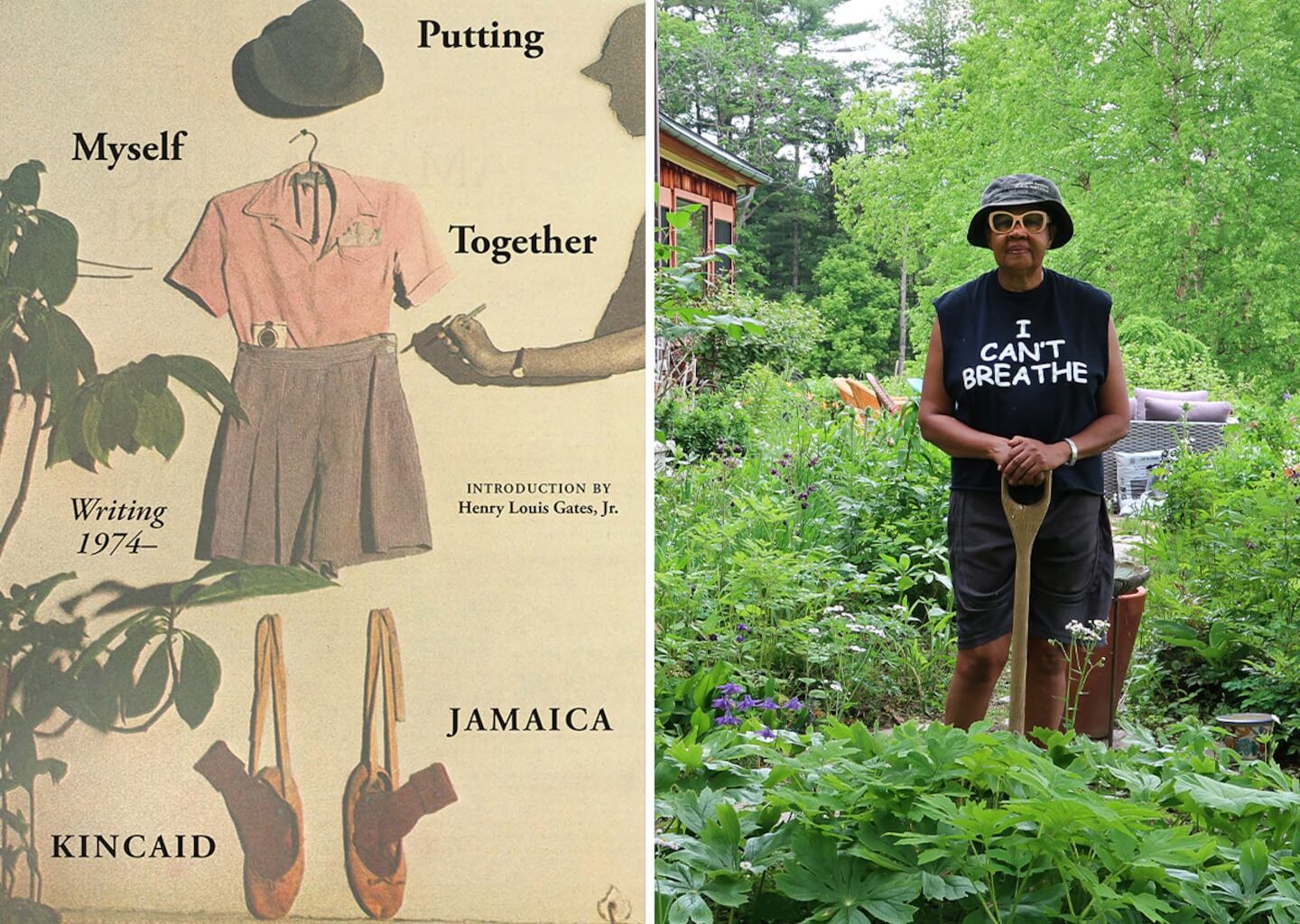
“Putting Myself Together,“ Jamaica Kincaid’s new, career-spanning essay collection, is a kind of intellectual autobiography. Elaine Potter Richardson emigrated from Antigua to the United States in 1965. She was 16 years old. Her family sent her away to study nursing, become a nurse, and remit her salary back home. By the early 1970s, Richardson was living alone in Manhattan, designing a new life plan and renaming herself Jamaica Kincaid. Before ever publishing a word, Kincaid called herself a writer: “At one minute I wanted to be a writer, and instinctively realizing I was in America, the next minute I decided I was a writer, and so when anyone asked me who I was, I said, I am a writer. I did not know exactly what that means, I still do not know exactly what that means, but even now, when I am asked what it is that I am, I say, I am a writer.” Both style and self-invention remain central obsessions in Kincaid’s oeuvre.
In 1974, after a brief stint at Ingenue, a magazine where she learned how poorly suited she was for working “under anyone’s thumb,” 25-year-old Kincaid began filing unsigned essays in The New Yorker’s “Talk of the Town.” She published in that section until 1983. In “Talk Stories” (2001), which collects those pieces, Kincaid recalls her writerly beginnings as both a period of economic deprivation —“I had no money, I had no place to live, and I almost never could afford to buy myself my own food” — and a time of artistic development — “I did not hear anything anyone else said, I only heard my own voice, I was only interested in my own story.”
Kincaid was also writing for The Village Voice, Ms., and Rolling Stone, where she published essays like 1977’s “Jamaica Kincaid’s New York” and “Antigua Crossings: A Deep and Blue Passage on the Caribbean Sea” in 1978. These essays demonstrate, on one hand, that very early in her career, she’d identified the elemental music of her unique prose style (Henry Louis Gates Jr.’s introduction explains that Kincaid writes with “a driving, unremitting eye — though never without humor”) and, on the other hand, that in her Caribbean familial story she’d located the limestone foundation on which to build her future efforts in fiction and nonfiction. Kincaid had already begun cultivating an array of overlapping, perennial obsessions: matriarchal power and mothers (specifically her own), banishment and excommunication from family structures, the British empire, colonial literary education, Antigua, and travel.
Get Starting Point
A guide through the most important stories of the morning, delivered Monday through Friday.
Several times in “Putting Myself Together” Kincaid details the scene of her original subjection: when she was nine, her mother shipped her off to Dominica to live with her maternal grandmother and aunt. In the 2000 essay “Islander Once, Now a Voyager,” Kincaid re-enters that wound: “The first time I traveled anywhere, I was not yet a writer, but I can now see that I must have been in the process of becoming one. I was nine years old and had been the only child in my family until then, when, suddenly it seemed to me, my first brother was born. My mother no longer paid any attention to me; she seemed to care only about my new brother. One day, I was asked to hold him and he fell out of my arms. My mother said that I had dropped him, and as a punishment, she sent me off to live with her sister and her parents, all of whom she hated.”
Writing in the introduction to her 1996 edition of “The Best American Essays,” Kincaid recalled that her early teachers taught her that the essay’s formal principles require writers to make statements, build upon those statements, and sum up their building. “[H]ow dry, how impossible,” she writes of such formulae, and then of her realization that “this definition was meant to be a restriction, and it worked very well; for how could I express any truth about myself or anything I might know in the form of state, build, and sum up when everything about me and everything I knew existed in a state of rage, rage, and more rage. I came into being in the colonial situation. It does not lend itself to any literary situation that is in existence. Not to me, anyway.” Kincaid iterates certain anecdotes and histories, both intimate and colonial, because her conception of the essay form demands a kind of elliptical experimentation, recycling expulsions, eras, poems, slavers, sailors, and crimes to reveal new layers of insight and truth.
Though Kincaid is most frequently identified as an accomplished novelist — “Annie John” (1985), “Lucy” (1992), “Autobiography of My Mother” (1996), “Mr. Potter” (2003), “See Now Then” (2013) — her masterpiece may be her book-length travel essay about the failures of British colonialism and Antiguan postcolonial governance, “A Small Place” (1988). I have read the paperback copy I purchased in 1995 so frequently and closely that the book, which radically rearranged my mind, must be stored in an envelope to keep its loose pages contained. Not only does “Putting Myself Together” pick up threads from “A Small Place” it extends and amplifies the claim forwarded by her turn of the century books — “My Brother” (1997), “My Garden (Book)” (1999), “Talk Stories,” and “Among Flowers: A Walk in the Himalayas” (2005) — that Kincaid is a master of literary nonfiction’s multifarious forms.
During this century’s first quarter, Kincaid has enhanced her catalog with meditative essayettes and longform efforts about gardening for Architectural Digest, The Paris Review, and Book Post, a Substack magazine. In some of these she pivots from writing about “myself, my mother, the place where I had grown up, myself and my mother again,” and enters the garden as a reader, taking up gardening catalogs and tomes about “landscape design and also from accounts of Explorers and Conquerors.” The garden becomes “an essential part of that thing called history” from Columbus to Thomas Jefferson to the Bloomsbury Group.
Yet, the garden holds all the world’s concerns and all of Kincaid’s obsessions, so, eventually, the book’s ending returns to reading, writing, and her mother. Though arranged chronologically, “Putting Myself Together” is a finely made garden: teeming, various, surprising. However, it offers “not complete satisfaction, only some satisfaction.” As Kincaid notes in her introduction to “My Favorite Plant,” “a garden, no matter how good it is, must never completely satisfy. The world as we know it, after all, began in a very good garden, a completely satisfying garden — Paradise — but after a while the owner and the occupants wanted more.” Kincaid’s retrospective satisfies incompletely, provoking both our astonishment and desire for more.
Putting Myself Together: Writing 1974-
By Jamaica Kincaid
Farrar, Straus and Giroux, 336 pages, $30
Walton Muyumba teaches literature at Indiana University-Bloomington. He is the author of “The Shadow and the Act: Black Intellectual Practice, Jazz Improvisation, and Philosophical Pragmatism.”