
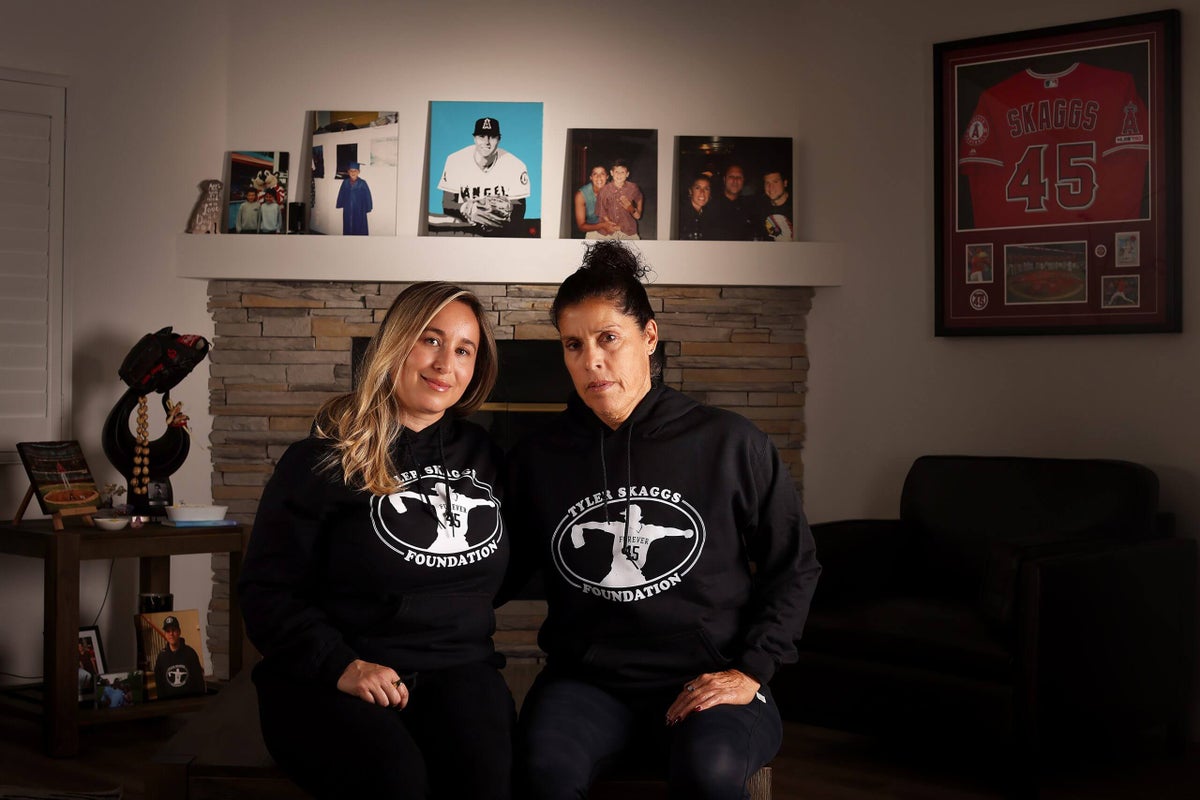
SANTA MONICA, Calif. — In a dingy courtroom corridor that had become all too familiar to Carli Skaggs and Debbie Hetman over a lengthy three-month trial, there was a disagreement.
The jury had just begun their third day of deliberations. The wrongful death civil trial brought against the Los Angeles Angels by the family of pitcher Tyler Skaggs was about to finally end.
How it would end, however, was up for debate in a tense, last-second decision.
The Angels had upped their settlement offer, hoping to take the decision out of the jury’s hands. Tyler’s widow, Carli, and his mother, Debbie, could not immediately come to a consensus.
“I said, ‘Debbie, I want a verdict,’” Carli recalled.
“I said, ‘No, we’re taking the deal,’” Debbie replied.
The Skaggs family ended up taking the settlement offer, ending the trial before the jury came back. It’s a decision that elicited immediate relief, closing the case and preventing any risk of a lengthy appeal process.
Debbie and Carli sat down with The Athletic earlier this month for their first interview since litigation ended on Dec. 19. It’s also their first since the death of the third plaintiff, Tyler’s father Darrell Skaggs, who died a week after the trial following a lengthy illness. The trio initially brought the suit against the Angels in June 2021, alleging the team knew that ex-Angels communications director Eric Kay was providing illegal pills to players. Kay is serving 22 years in federal prison.
Skaggs died on July 1, 2019, in a Southlake, Texas hotel room, after ingesting a fentanyl-laced pill provided by Kay. The Angels have been funding Kay’s legal defense.
While the Skaggs family is required to keep the financial terms of the settlement confidential, there was no non-disparagement agreement. That means they are able to speak their minds about the Angels and the contentious trial, and their desire for Major League Baseball’s commissioner’s office to investigate Tyler’s former team.
“They tried to cover it up,” Debbie said. “I hope that MLB investigates it. I don’t want this to happen to any other player in any organization.”
“MLB’s legal staff obtained the full transcript for the entire trial,” a league spokesperson told The Athletic. “They are in the process of reviewing and assessing the information.”
The league declined to say how long the review is expected to take.
Debbie stressed that she remained shocked by the Angels’ strategies and conduct throughout the saga.
“It’s hard for me to believe that somebody who is in their organization, who was so loved by the community, was so loved by the Angels family, that they would take Tyler and throw him under the bus. Basically, that’s what they did. It’s almost like, ‘We don’t care. … Forget about Tyler,’” Debbie said.
When reached for comment, Angels spokesperson Marie Garvey said, “We’re not going to rehash this,” and referred to the team’s previous statement at the conclusion of the trial.
“The death of Tyler Skaggs remains a tragedy, and this trial sheds light on the dangers of opioid use and the devastating effects it can have,” the team said.
The Angels’ trial strategy was to portray Kay positively, Skaggs as a “reckless” drug abuser and the plaintiffs as enablers who had known about his drug use but did little to stop it. Both were called to the stand multiple times, with Angels lawyers cross-examining them for hours.
Carli was careful about what she texted her own mother, who was listed as a potential defense witness, but was never called. Every one of their texts were theoretically discoverable, even mid-trial, and could have been used against them in questioning.
Her mother spent months of the trial sitting alone on a bench outside the courtroom. Neither Carli nor Debbie could have their confidants in the courtroom, because of the potential for them to take the stand. They relied on the support of their lawyers, Leah Graham, Daniel Dutko, Lara Hollingsworth, Bill Haggerty, Shawn Holley and Rusty Hardin.
During questioning, Angels attorneys argued that Carli saw and heard various instances that should have signaled that Tyler had a problem. They also argued that Debbie concealed Tyler’s 2013 drug addiction to his surgeon in 2014, for fear it would impact his baseball career.
“Whether it’s the truth or not, (the Angels) have a job to convince the jury,” Carli said. “I know my truth, I know what my experience with Tyler was. … When I feel like someone’s trying to break me, it just fuels my fight.”
“You can go through all the evidence and all the mistakes that (the Angels) made,” said Debbie, who was less understanding that Angels lawyers were just doing their jobs. “But (Kay) was such a great person? He was so great?”
The Skaggs family’s lawyers argued that Tyler was not a drug addict at the time of his death, and that his use was more recreational. They argued that he and other players relied on illegal pain medication to deal with the physical toll of pitching in the big leagues.
The Skaggs side’s case was centered around proving the Angels were aware of Kay’s drug abuse, and that certain team officials, namely ex-communications director Tim Mead and current traveling secretary Tom Taylor, were aware of Kay’s drug dealing to Angels players.
But Carli and Debbie still internalized coverage of the trial and reaction on social media, and understood that the public didn’t always agree with their perspective. They saw the criticisms of their decision to even bring the lawsuit. Tyler was a grown adult who chose to snort the pill in his body. Why, many asked, should his family be entitled to a payout?
“I don’t think Carli and I have ever backed away from the fact that Ty has some personal responsibility for taking the pill,” Debbie said. “However, Tyler never consented to taking a pill laced with fentanyl. There’s a huge difference.
“The fact that (Kay’s) going out on the streets and buying pills, that’s pretty scary. All he had to tell the players is, ‘No, I can’t get anything.’ And then it’d be done, and Tyler would still be here.”
The anxiety of the public scrutiny, all the drama associated with the civil and criminal trial and the need to testify numerous times, all against the backdrop of losing her husband, has made it hard for Carli to move on.
She’s volunteered as a victims rights advocate in the district attorney’s office, but has admitted it’s been hard to find love or re-start her life in a meaningful way.
Debbie, to this day, speaks to her son via his ashes; having daily conversations with the boy she raised, who supported the high school softball team that she coached and would call and text her after every game. During the trial, she asked him for strength to get through it.
When they think of Tyler, they think of someone who was caring, who treated everyone like they were a “friend for life.” He was someone “that would never talk negatively about you, ever.” Accepting his loss, in even in the smallest ways, has not been easy. Fighting the Angels in court became a full-time job, and an emotional drain.
“This wasn’t just about driving to Orange County every day. It was all the depositions, reading everything, it was so much,” Debbie said.
“You don’t realize until it’s behind you, how much you were carrying,” Carli said. “Now we have a chance to breathe, and the space to think about other things, and enjoy other things that bring us joy.”
They both hope to put more time and resources into the Tyler Skaggs Foundation — founded in 2019 — whose mission is to “provide equitable access to sports programs and recreation.” Close friends of Tyler’s like Yankees ace Max Fried, along with pitchers Lucas Giolito, Andrew Heaney and Jack Flaherty, have been supportive of the foundation.
Superstar Shohei Ohtani — who shared an agent with Skaggs, and who Debbie said was a friend of his — has donated signed apparel, as well. Debbie said she’s yet to reach out to Mike Trout, who testified in the trial, but that she probably will; Trout has always been responsive to her.
But as for the Angels as a whole, Debbie and Carli want more accountability. Moving on, focusing on the foundation, and finding a life after this tragedy is important to them. But so too is seeing the league look into the Angels’ conduct.
Debbie and Carli have been the two most visible plaintiffs in the case. They were in the courtroom every day, and have been the de facto spokespeople for Tyler in the years since his death.
But Darrell Skaggs, Tyler’s father, and also part of the case, testified via Zoom from his hospital room during the trial. He’d been diagnosed with Castleman’s disease, a disorder that leads to enlarged lymph nodes.
During his testimony, he recalled how excited he was when Tyler told him that he and Carli were planning to start a family. Darrell glowingly discussed his son’s childhood, and the kindness Tyler showed to a special needs teammate during a high school basketball game.
Darrell was 67 years old at the time of his death, just days after the settlement was reached.
“I’m glad he got to be here for the outcome of the case,” Carli said. “He didn’t have anything after he lost Ty.”
There was a certain peace that Carli and Debbie took, knowing that Darrell could see this long ordeal reach its resolution. He’d been sick for years, hospitalized in one form or another since his son’s death.
The trial, they believe, took an extreme strain on his health. But they also believe that Darrell had held out for so long so he could see it through — to have what he viewed as the truth about his son, and this case, presented to everyone.
Ultimately, both Debbie and Carli are glad that this went to trial, and that everything, good and bad, could be out in the open for the world to hear. All three of them got to see it to its conclusion, all these years later.
“He held on until the end,” Carli said. “He was ready to go be with his son. That gives me comfort.”