
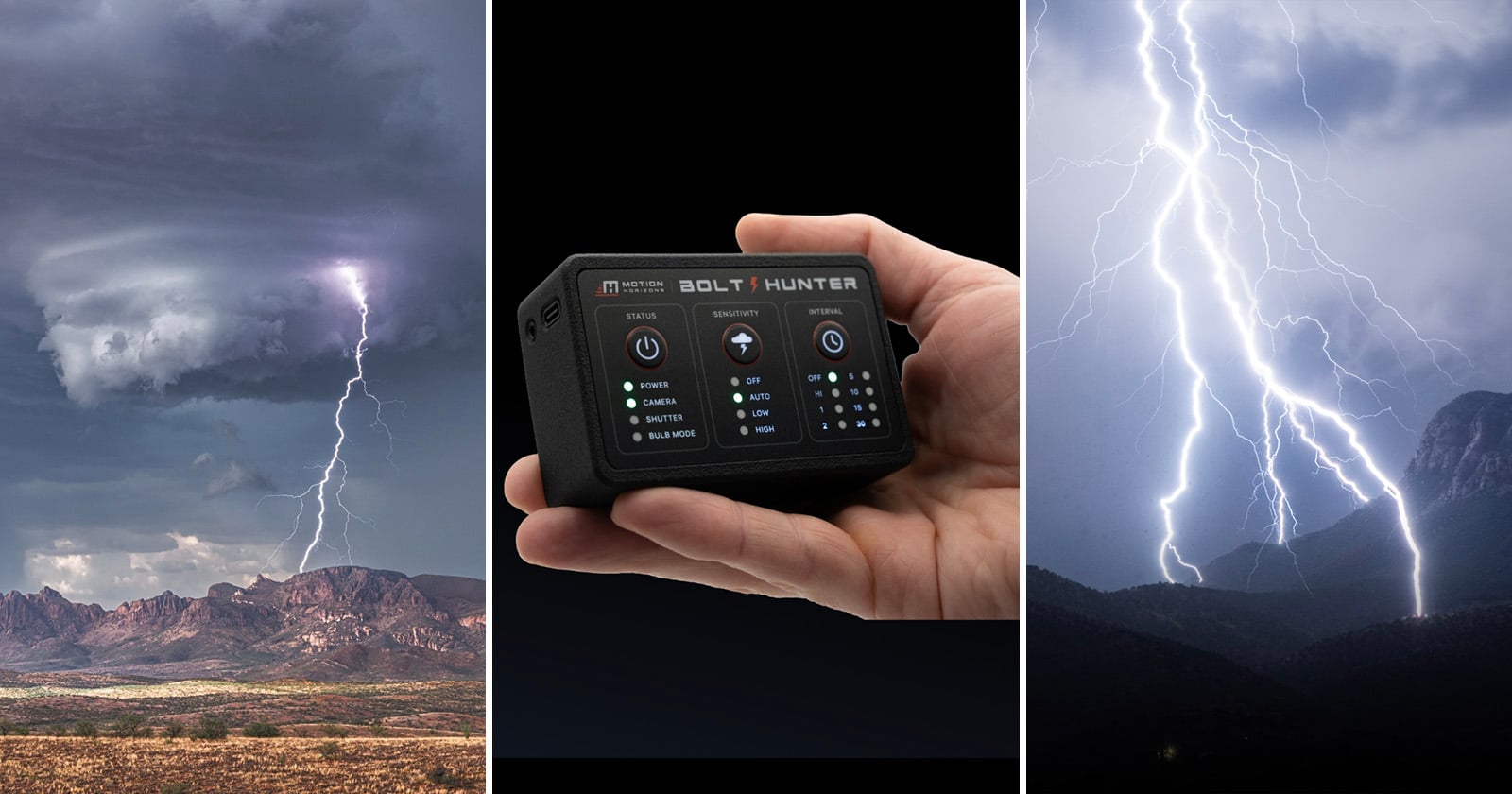
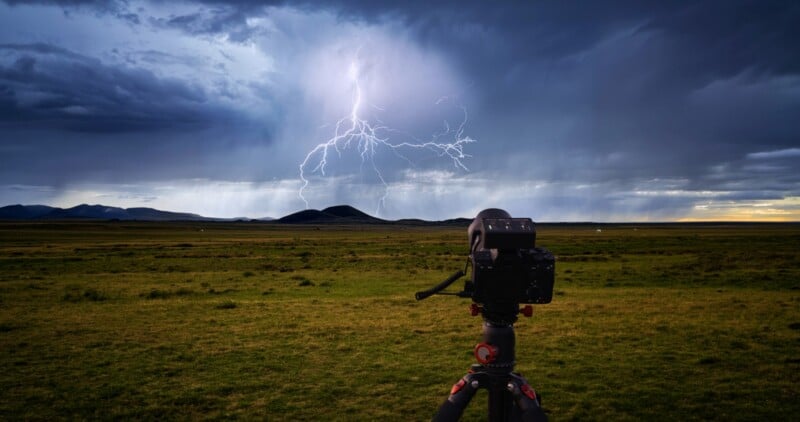
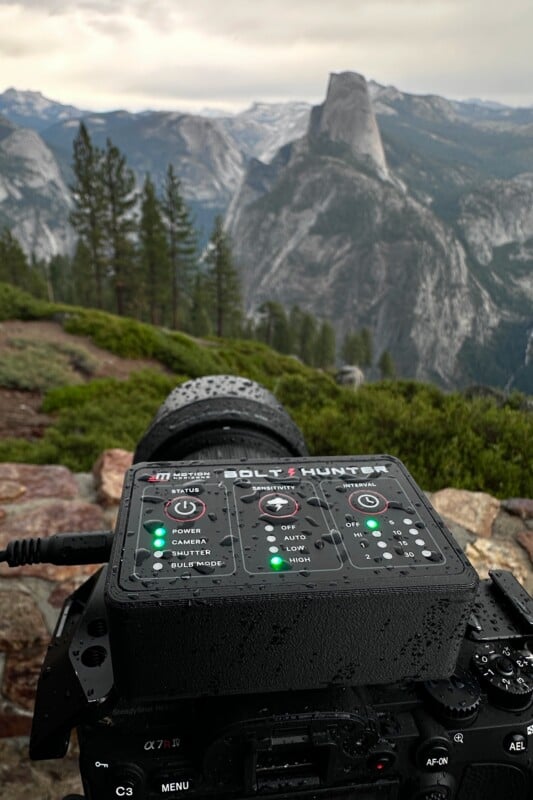
Motion Horizons LLC has announced Bolt Hunter, a purpose-built lightning camera trigger that it describes as “the most advanced lightning photography tool ever built,” designed to address some of the most persistent challenges in storm photography, including missed daytime strikes, overexposed nighttime frames, and inconsistent shutter timing.
A Singular Focus on Lightning
Founded by Jeff Boyce, Motion Horizons says Bolt Hunter was engineered with a singular focus. Rather than attempting to build a multi-purpose device that blends lightning detection with a wide array of secondary features, the company concentrated exclusively on refining lightning capture performance. That design philosophy informed everything from the detection algorithms to the physical controls, battery system, and mounting solution. According to the company, every aspect of the device was evaluated through the lens of one question: Does this improve lightning photography?
“We designed Bolt Hunter to address the complaints and shortcomings of every trigger on the market,” Boyce says.
“Instead of building a do-it-all device that’s marginal at many things, we built something exceptional at one thing: lightning photography.”
Boyce frames the product as a response to years of user frustration with inconsistent triggers, false positives in bright conditions, and the delicate balance required to capture early-stage lightning structure without blowing out the frame.
Beyond Reactive Triggers
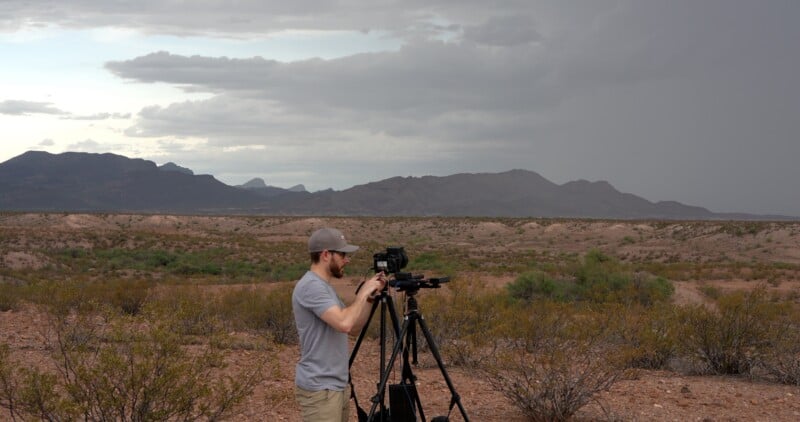
Traditional lightning triggers rely primarily on brightness spikes to fire the shutter, meaning they react to visible changes in light intensity. Bolt Hunter takes a more analytical approach. According to Motion Horizons, the device detects faint intracloud precursor activity that can precede visible stepped leaders. It then measures the camera’s actual shutter lag and compensates for it in real time.
The system analyzes return stroke timing during an active lightning event and can schedule subsequent exposures within milliseconds. Motion Horizons refers to this as predictive triggering. The first detection is reactive, but once a bolt begins, the device calculates when the camera will be ready to fire again and buffers additional exposures to maximize capture reliability. The company emphasizes that it is not predicting when lightning will strike, but rather optimizing exposure timing once a lightning event is already underway.
This distinction is important for storm photographers who work in fast-moving cells where timing differences of just a few milliseconds can determine whether the stepped leader is captured cleanly or missed entirely.

Built for Dynamic Conditions
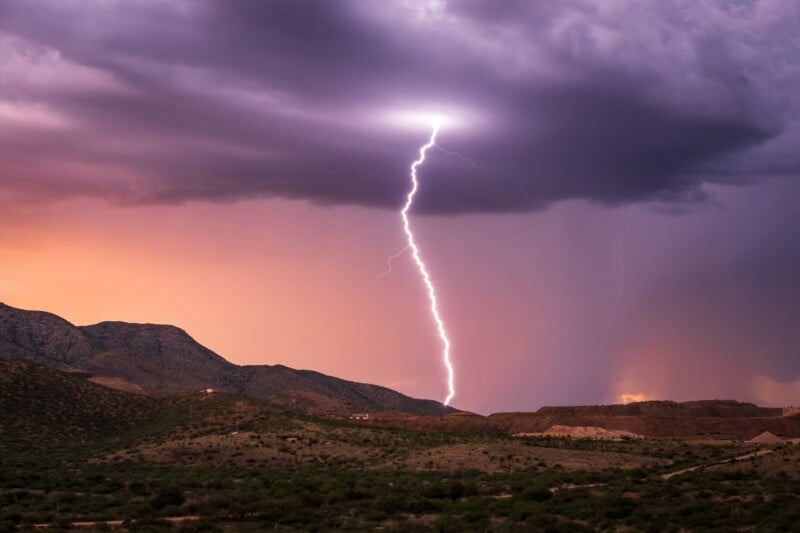
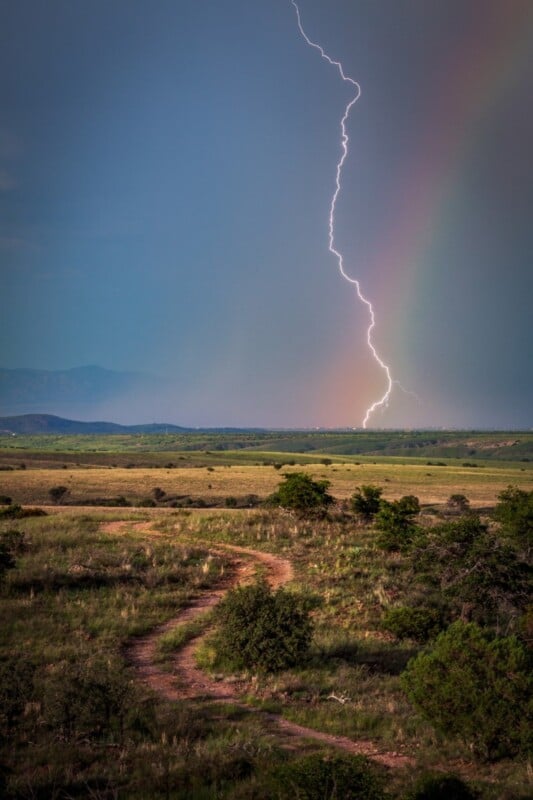
Bolt Hunter is designed to function in rapidly changing ambient light, including conditions that can confuse conventional triggers. Bright skies, shifting cloud cover, and even direct sunlight can introduce false triggers or prevent a system from detecting lightning altogether. Motion Horizons says Bolt Hunter automatically adjusts sensitivity as lighting conditions shift, allowing users to configure the device once and leave it operating without constant recalibration.
The company states that the device can trigger even when pointed directly into the sun, a scenario that often presents challenges for brightness-based systems.
For nighttime shooting, Bolt Hunter includes a dedicated Night Mode. Rather than triggering to start an exposure, Night Mode holds the shutter open in BULB mode and closes it once lightning is detected. This approach is designed to capture the earliest visible stages of a strike while limiting the risk of overexposure caused by repeated return strokes within the same frame. For photographers working after dark, this method offers an alternative to stacking multiple strikes into a single exposure and hoping for balanced results.
Workflow-Focused Features
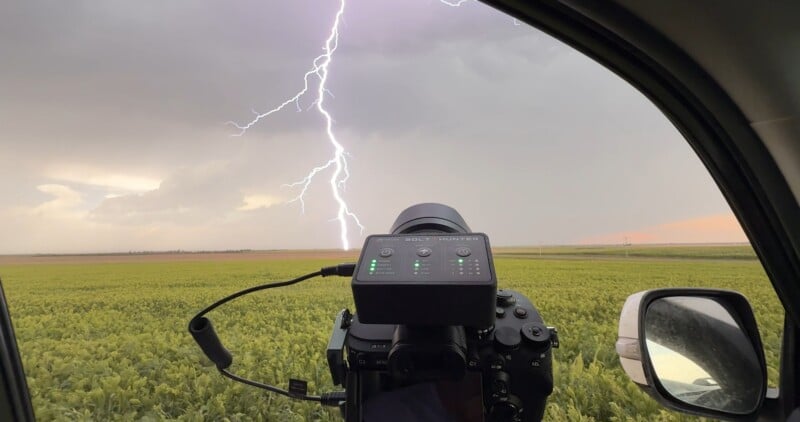
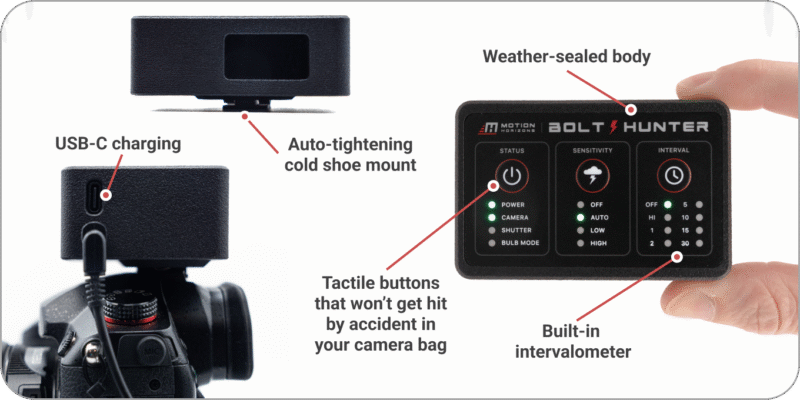
Bolt Hunter integrates directly into storm-chasing workflows. A built-in intervalometer allows photographers to run a timelapse while simultaneously triggering on lightning, eliminating the need for multiple external accessories. This dual functionality is intended to streamline setups during rapidly evolving weather events.
A lightning simulation mode enables users to test their configuration in the field and evaluate return-stroke capture performance before a storm fully develops. The device operates independently with a single-button setup and does not require a mobile application for basic lightning triggering or timelapse functionality.
However, a Bluetooth companion application unlocks additional capabilities, including shutter lag measurement tools, predictive triggering controls, firmware updates, and connection monitoring alerts. Optional motion detection alerts notify users if a camera tips or shifts position, and an integrated speaker can provide audible confirmations or error notifications. These additions are aimed at reducing uncertainty during long waits between storm cells.
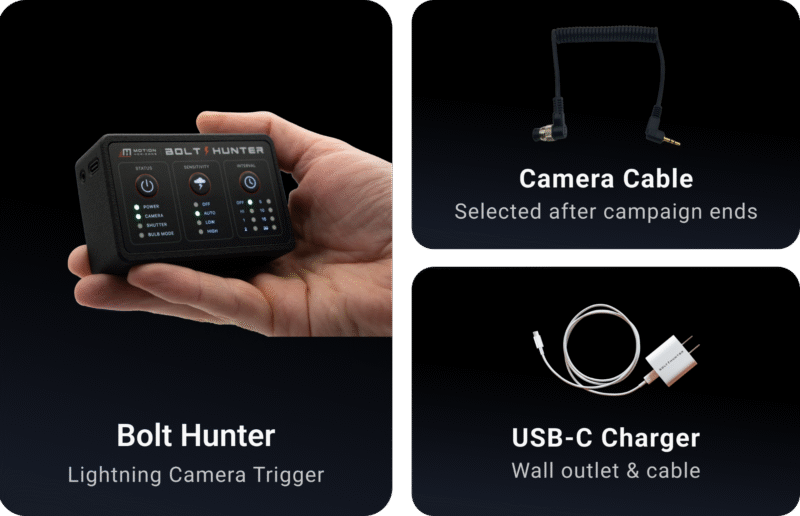
Designed for demanding outdoor environments, Bolt Hunter features a compact, weather-sealed housing intended to withstand heavy rain. It includes an internal lithium battery rated for more than 48 hours of runtime, eliminating the need for disposable 9-volt batteries. Charging is handled via USB Type C.
An auto-tightening cold shoe mount prevents slippage during use. The mount incorporates a sacrificial design intended to protect the camera body during hard falls, with a user-replaceable component priced at approximately $15. This approach acknowledges the unpredictable terrain and conditions that storm photographers often encounter in the field.
Compatibility
Motion Horizons states that Bolt Hunter supports the vast majority of modern cameras, including models from Canon, Nikon, Sony, Fujifilm, Panasonic, OM System, Pentax, Leica, Hasselblad, and Sigma.
The device uses standard, non-proprietary shutter cables for physical connections. For cameras without a dedicated shutter port, such as the Canon R50, Bolt Hunter supports Bluetooth Low Energy triggering. It also supports newer USB Type-C shutter connectors on select models, though the company notes that Bluetooth can offer lower shutter lag in certain lightning photography scenarios.
Motion Horizons states that manufacturing is already underway, with first production units scheduled for delivery in April 2026. Availability beyond the Kickstarter campaign has not yet been detailed, though the company indicates that the campaign will serve as the primary launch channel.
As lightning photography continues to attract dedicated enthusiasts and professional storm chasers alike, Motion Horizons is positioning Bolt Hunter as a specialized, performance-driven alternative to general-purpose triggers. Whether its predictive timing system and workflow-centric design translate into measurable gains in the field will ultimately be determined by the photographers who deploy it in real storm conditions.
Pricing and Availability
Bolt Hunter launches on Kickstarter on March 3, 2026. Early backers can secure launch pricing starting at $279, representing a discount of more than 20% off the planned manufacturer’s suggested retail price of $349.
Full disclosure: Make sure you do your own research into any crowdfunding project you’re considering backing. While we aim to only share legitimate and trustworthy campaigns, there’s always a real chance that you can lose your money when backing any crowdfunded project. PetaPixel does not participate in any crowdfunding affiliate programs.
To hold projects accountable, all crowdfunding campaigns on which PetaPixel reports are financially backed with the lowest tier option in order to give the publication visibility into all backer-only communications. If a campaign owner acts in a manner inconsistent with its promises, PetaPixel will share that information publicly.
Image credits: Motion Horizons LLC