
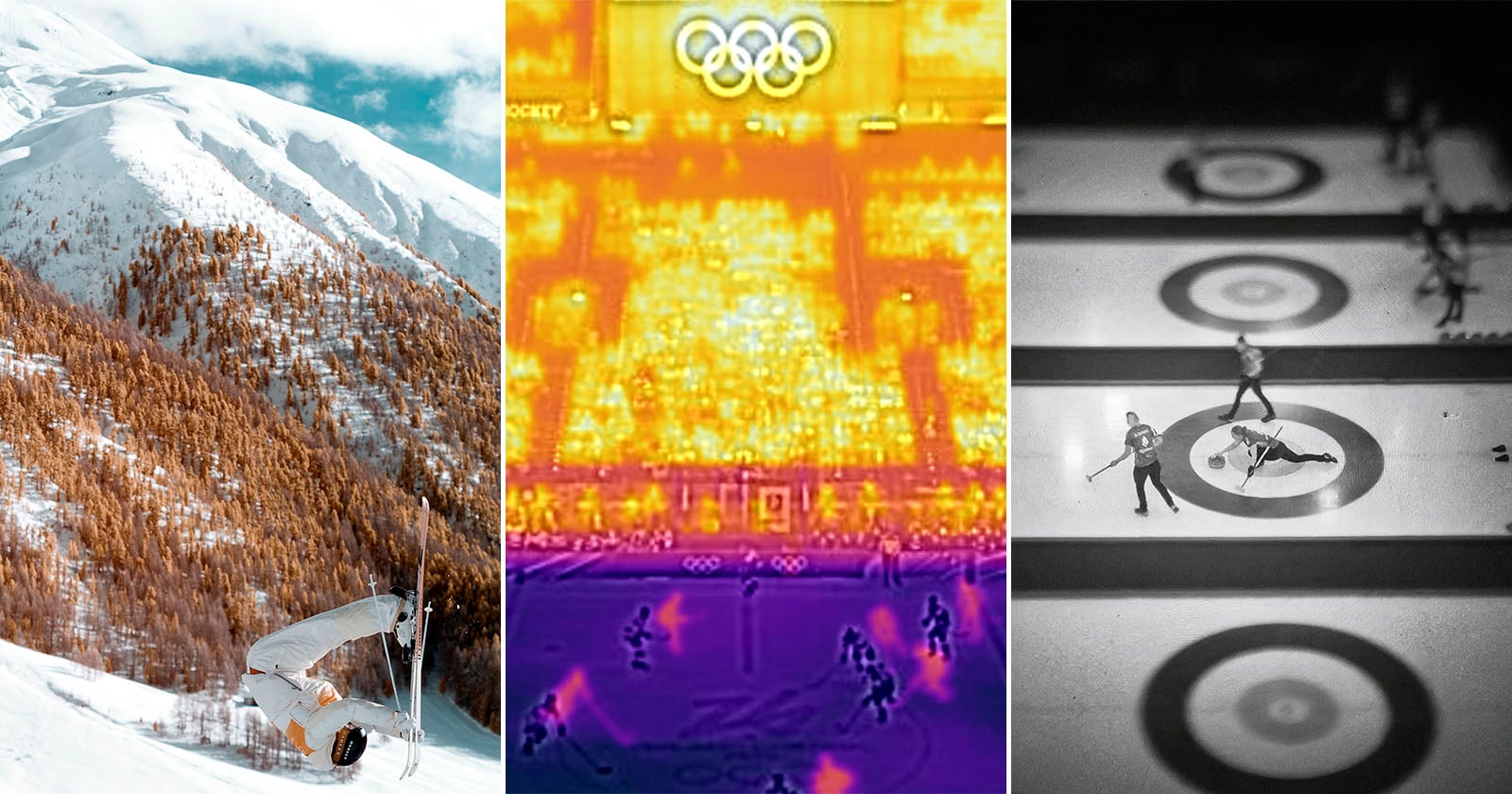
Many exceptional photographers captured jaw-dropping photos of world-class athletes performing incredible feats at the Milan-Cortina 2026 Winter Olympics in Italy. In most cases, these photographers used the expected equipment, the latest full-frame mirrorless cameras and telephoto lenses. However, a select group of Getty Images photographers took a very different approach, and documented the Winter Olympics with thermal, infrared, and vintage film cameras, and using unique processing techniques.
Getty Images photographers Pauline Ballet of France, Ryan Pierse from Australia, and Mexican photographer Hector Vivas headed to northern Italy armed with thermal cameras, infrared cameras, and even a 1956 Graflex camera, paying homage to the last time the Winter Games were in Cortina, Italy.
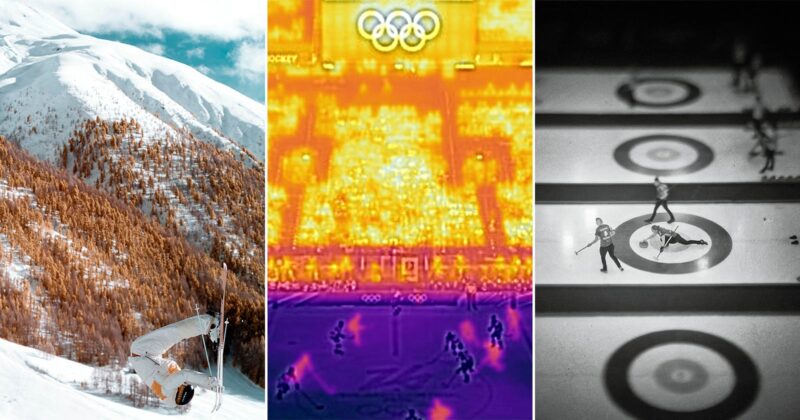
The trio of creative photographers embarked on special projects. “Back to the Future” utilized vintage Graflex cameras that photographers would have used back in 1956. “Infrared,” as its name suggests, is a series of photos taken on infrared cameras during the Olympics. These were shot on modified mirrorless cameras. The “Winter Heat” series was captured using thermal cameras to show the heat of the athletes and the crowds in stark contrast to the snow and ice that most Winter Olympics events take place on.
There was also “Layers of the Games,” in which photographer Hector Vivas used fixed-position cameras and many exposures to show the drama of an entire game or event in a single frame. Finally, “Olympic Projections” was a special Getty Images initiative that projected images from the games as they happened on the key architecture and landscapes of Milan, Cortina, and the surrounding areas.
Photographing Sports In a Fresh, Creative Way
PetaPixel spoke to Matthias Hangst, Director of Sports Content, EMEA & APAC, Getty Images, and Paul Gilham, Getty Images’ Senior Director of Global Sports Content, to learn more about the experimental imaging techniques Getty Images photographers used in Milan Cortina.
“About 12 to 18 months out from Paris 2024, Matthias and I got together and asked ourselves how we could repicture the Olympic Games and bring something different to our coverage, to show that we think in different creative ways, as well as the ways that we’re well known for,” Gilham tells PetaPixel. “We talked about what brought us to photography in the first place — being drawn to a creative, expressive art form. We ended up in sports because we love sports, but there is a lot to the genre of photography, and we wanted to explore how we could bring something different to our coverage.”
Hangst and Gilham chose a group of photographers they knew were creative in their photographic approach and style, and challenged them to come up with fresh, distinctive ways to photograph the Winter Olympics, unlike anything that had been done before.
“They were given creative free rein,” Gilham says.
‘We ended up in sports because we love sports, but there is a lot to the genre of photography, and we wanted to explore how we could bring something different to our coverage.’
That said, there were projects from Paris 2024 that Getty Images wanted to continue in Milan Cortina, including Vivas’ “Layers of the Games.”
“The thermal imaging idea, which came from Pauline Ballet, was one where we saw a real opportunity to show almost the invisible side of the Games, especially with the extremities of temperature that you experience at the Winter Olympics,” Gilham explains. “Overall, our approach was to take the various influences from our love of photography and bring them into our day-to-day environment at the Games — we wanted to show how the beauty and artistry of photography can come into the world of sport.”
“We had been developing the idea for quite some time,” Hangst adds. “But Paris was the right time and place. We wanted to prove that we could execute these ideas on the highest level, in the Olympics or any other major event, and not just on a lower scale.”
“We went all in, and the risk paid off.”
However, as Hangst adds, the most important thing is that the photographers enjoy it, and they absolutely did.
“It’s a great way of expressing creativity, different to what we do on a day-by-day basis.”
‘We went all in, and the risk paid off.’
“The number one thing that we’re trying to achieve here is to show something different,” Gilham says. “What’s unique about our team is that they are industry-leading sports specialist photographers who know their sports inside out. They put a lot of time and energy into researching and understanding them.”
“When it comes to the big moments, they use their expertise and their experience to make sure that they’re in the right place. They’re able to marry the two — creative expression and faithful capture — quite naturally. The fact that they’re using these alternative technologies to do it brings something different.”
“We chose some of the best sports photographers and gave them the freedom to express themselves in a different way,” adds Hangst. “It’s not just a piece of art. It’s a piece of art at the right moment.”
‘It’s not just a piece of art. It’s a piece of art at the right moment.’ A Monumental Undertaking
Unlike the 2024 Summer Olympics in Paris, the 2026 Winter Olympics in Milan Cortina were spread out. Beyond Milan and Cortina, events occurred in other towns and cities throughout northern Italy. This forced Getty Images to spread its team of photographers across many locations, which comes with its own logistical challenges.
It also meant that each photographer, located in different areas, had to work on multiple creative projects at once.
“The creative projects team includes Pauline Ballet, Hector Vivas and Ryan Pierse. Each photographer has to have access to infrared, the Graflex vintage camera, all of the different technical pieces of equipment, and has to be trained in how to create the Layers of the Games imagery,” says Gilham.
As for which project Gilham thinks was the biggest success, he says it was the Graflex vintage camera.
“Shooting content in a way similar to what would have been used the last time Cortina held the games in 1956, while being able to distribute that content in real time, has been really exciting to see.”
“From a purely technical aspect, we are working with devices that had very limited testing in winter environments ahead of these Games. Infrared, thermal, all of these devices show a certain reaction to light, snow, and contrast. We tested what we could, but once you’re out on a snowy mountain with harsh sunshine, or covering ski jumping under a floodlight at night, the camera is going to react differently,” Hangst adds.
There was also no clear layout day-to-day. Each photographer had to be flexible and ready to shift gears at a moment’s notice.
“They all have a toolkit to express themselves, but when they arrive at a venue, they have to decide what is the best option to tell a story that day based on the condition,” says Hangst.
The Technical Challenges of Experimental Photography
The talented photographers, Ballet, Vivas, and Pierse, all know their way around modern cameras and routinely use them with extreme success. Their skills are immense, and they work in tandem with their photographic tools to get the best shots possible.
However, there is no question that modern mirrorless cameras come with many features and functions that make it easier for them to bring their creative visions to life. The autofocus technology and speed of modern cameras make them very powerful tools for sports photographers.
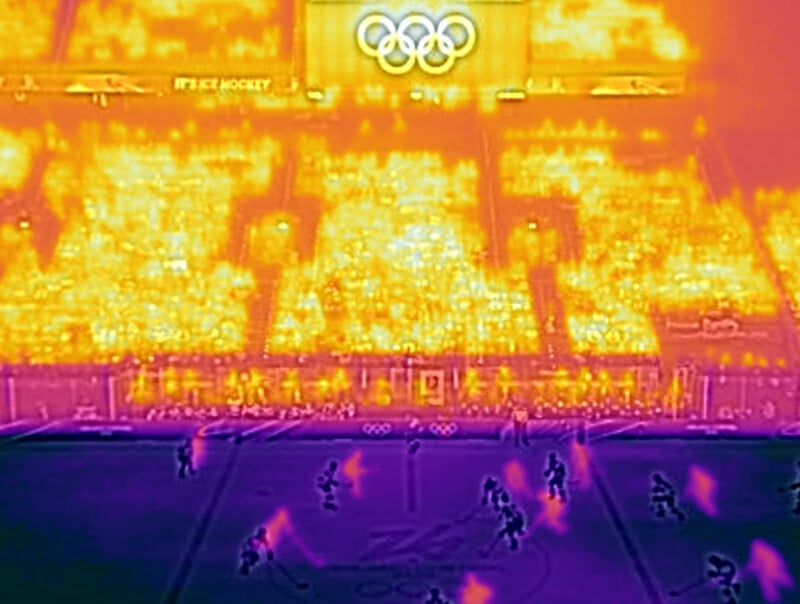 MILAN, ITALY — FEBRUARY 12: (EDITORS NOTE: A thermal imaging camera was used to create this image.) The Men’s Preliminary Group C match between Latvia and United States on day six of the Milano Cortina 2026 Winter Olympic games at Milano Santagiulia Ice Hockey Arena on February 12, 2026 in Milan, Italy. “Winter Heat” is a series of images taken using a thermal imaging camera to show the extremities of temperature experienced by athletes at the Milano Cortina 2026 Winter Olympics on February 08, 2026 in Milan, Italy. (Photo by Pauline Ballet/Getty Images)
The thermal, infrared, and vintage cameras the trio used in Milan, Cortina, and other areas lack all these modern amenities. Thermal cameras, for example, are not designed to photograph moving objects at all. They are slow, sluggish, and difficult to use. A vintage Graflex, of course, is even slower.
The cameras most closely related to the typical pro sports photographer’s kit were the infrared cameras, which were high-end mirrorless cameras modified for infrared photography. Even still, these cameras demand special filters and have different demands for lighting conditions.
“I didn’t expect any of the results I’ve seen since we got here. Something happens in the infrared process that creates something I’ve never seen before. That’s the most impressive bit for me, along with the editorial integrity that goes into capturing these images,” says Hangst.
“You could give a digital artist any photo from the Olympics and they could Photoshop a similar effect, but our photographers are pre-visualizing within the limitations of these different forms of imaging. In a way, it encapsulates what Getty Images does best: there is integrity to our imagery because it is all created in-camera.”
Vintage Déjà Vu
The vintage Graflex cameras are one of the most interesting tools Ballet, Vivas, and Pierse had in Italy.
“We’re all drawn to photography because it crystallizes a moment in time. There are certain visual styles that evoke a sense of nostalgia, and those styles are a direct result of the photographic technology that was used. That’s the beauty of the Graflex: the way it captures the images,” Gilham tells PetaPixel.
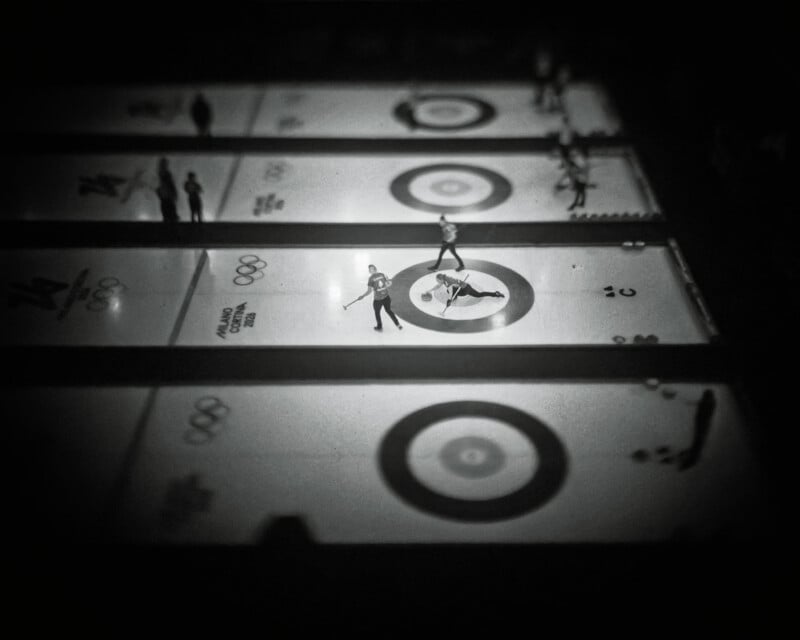 CORTINA D’AMPEZZO, ITALY — FEBRUARY 17: (EDITORS NOTE: A vintage large format camera in combination with a mobile phone was used to create this image Image has been converted to black and white. ) Team Denmark compete during Women’s Round Robin Session between Team Denmark and Team United States on day eleven of the Milano Cortina 2026 Winter Olympic games at Cortina Curling Olympic Stadium on February 17, 2026 in Cortina d’Ampezzo, Italy. “Back to the Future” is a series of images captured using vintage Graflex cameras, paying tribute to the type of camera that would have been used 70 years ago when Cortina previously hosted the games in 1956. In a modern twist, these cameras have been adapted to record images on smartphones, enabling live transmission of the content captured. (Photo by Ryan Pierse/Getty Images)
“It has this very vintage, very old feel — you look at the imagery we create using it and it immediately takes you back. It doesn’t look like it was captured today; it looks like it was captured years ago, which brings a kind of timeless element to it that you just don’t get through the really clean digital photography that we see nowadays.”
‘We’re all drawn to photography because it crystallizes a moment in time.’
It was also a way for the Getty Images team to honor photography’s rich history, which Getty has been part of since the very beginning. Gilham says that for this creative project in Milan Cortina, the team dug through Getty’s rich archives for inspiration.
The photographers were “very keen to bring that kind of archival aspect of their modern work. It brings real connection and excitement to show that this camera technology is still usable and relevant today.”
For Hangst, he loves that the Graflex camera brings “a little bit of imperfection in a perfect world.”
“There’s something quite special about that.”
To ensure that this old-school workflow still worked today, in 2026, the team developed a way to attach a smartphone to the Graflex camera and use that to capture photos.
“From the very beginning, the idea was to connect the past and the future, the 1956 Olympics with the 2026 Olympics,” Hangst says. “The answer was right in our hands: we had the Graflex, and then we had, latest device of this generation: a mobile phone.”
Capturing an Entire Game or Event In a Single Frame
“Layers of the Games” was a smash hit for the 2024 Summer Olympics and returned for the 2026 Winter Olympics. The final photos are created by compositing many layers, all captured by a single camera in a fixed location.
“The objective is to capture a moment or a day within a particular event, then bring all of those elements together in one image to tell a story — whether that’s a sequence of a snowboarder along the half pipe, or figure skaters at various points of peak action in their routines. The idea is that every time someone looks at the image, they find a new detail and get consumed by that part of the story. It’s bringing together a multitude of moments exactly as they unfolded,” Gilham explains.
The editing process can be quite complex and take several hours per shot. The photographers themselves retain full control over the edit, and they are the ones who decide which frames to include in the layering process and which ones to omit, ensuring that they get the perfect mix of action composed in a visually pleasing way that still authentically captures the story of the event.
“The goal of the composition is to feel the whole field of play. You need to find a moment of action in exactly one place of the field to fill that corner; we’re not moving figures around like pieces of a puzzle. And it needs to be interesting. It needs to be a moment that you want to show,” Hangst adds.
This would be quite the undertaking, with days or weeks to create the final composite, but Getty’s photographers sometimes do it live so they can deliver the final frames that same day, or in some cases, the day after an event.
“It requires a certain skill set to be able to do this level of work under such a tight deadline,” Hangst says.
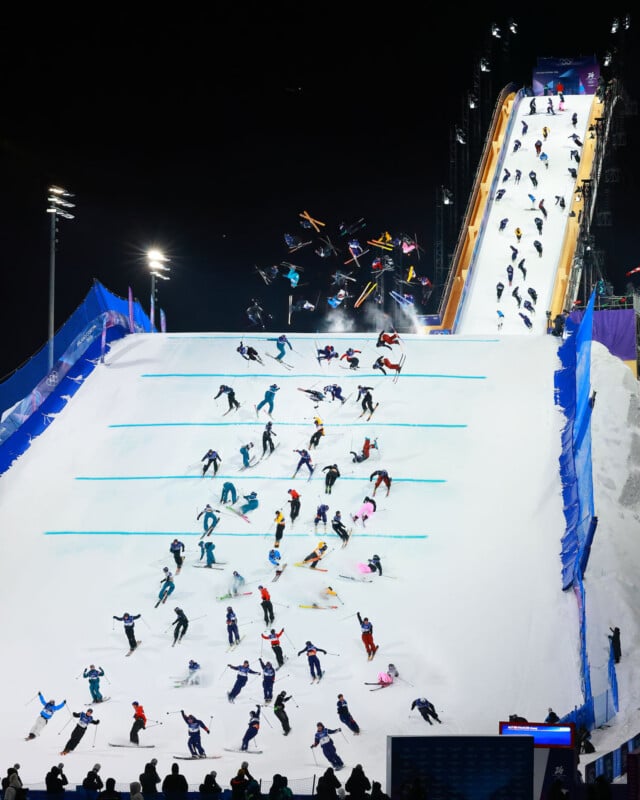 LIVIGNO, ITALY – FEBRUARY 15: (EDITORS NOTE: Image is a digital composite.) General view of the Men’s Freeski Big Air Qualification on day nine of the Milano Cortina 2026 Winter Olympic games at Livigno Air Park on February 15, 2026 in Livigno, Italy. “Layers of the Games” shows, through the combination of multiple images from a fixed camera, the quickfire drama that unfolds in a game or a day of competition during the Milano Cortina 2026 Winter Olympics Games. (Photo by Hector Vivas/Getty Images) Connecting People to Sports Through Creative Photography
Sports are special. For the many millions worldwide who tuned into the Winter Olympics this month, they get it. There is something remarkable about an athlete who has trained for many years, standing atop the podium. It’s the culmination of a lifetime of hard work and dedication.
For Getty’s photographers, their task is to capture all that emotion in individual frames and tell a story in a thousandth of a second.
“Sports photography is so powerful because so many of us relate to sport; you have a connection to it, whether as a fan, or a competitor, or maybe there’s a sport you just really love,” Gilham says. “The best sports imagery is captured by photographers who absolutely know their subject inside out, who can anticipate where the action’s going to be, but also have a deep understanding of how to use light and background to enhance an image.”
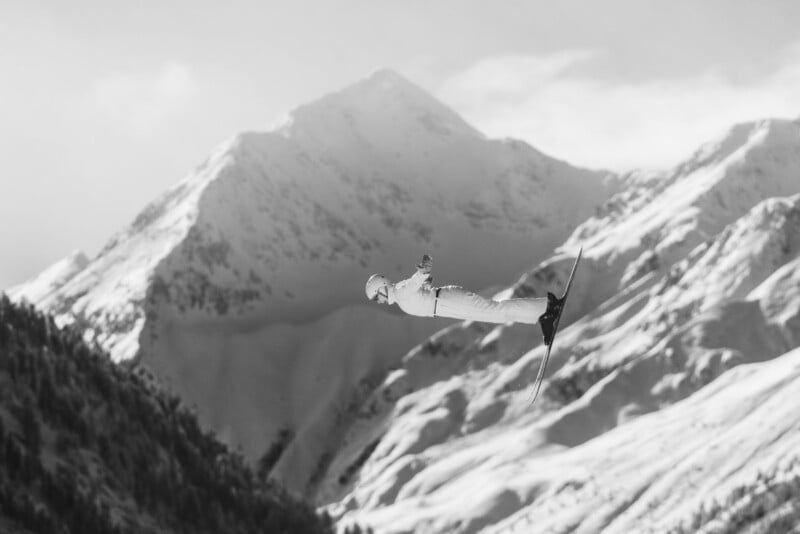 LIVIGNO, ITALY — FEBRUARY 18: (EDITORS NOTE: An infrared camera in combination with on-camera filter was used to create this image.) An athlete competes during Women’s Aerials Qualification on day twelve of the Milano Cortina 2026 Winter Olympic games at Livigno Air Park on February 18, 2026 in Livigno, Italy. “Infrared” is a series of pictures taken at the Milano Cortina 2026 Winter Olympics with mirrorless cameras that have been modified to capture the electromagnetic spectrum beyond what’s visible to the human eye. (Photo by Hector Vivas/Getty Images)
“When you bring together those technical elements with peak moments and action, you create something truly special that can really sing to an audience.”
‘When you bring together those technical elements with peak moments and action, you create something truly special that can really sing to an audience.’
For Hangst, sports photography is about that singular moment.
“You can’t plan for it. You spend years waiting for the peak moment, and then you have to execute in that one split second,” Hangst tells PetaPixel.
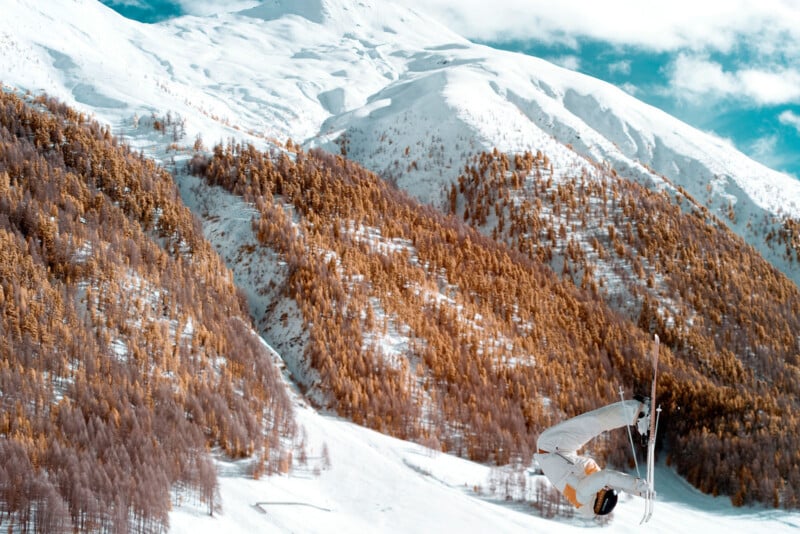 LIVIGNO, ITALY — FEBRUARY 11: (EDITORS NOTE: An infrared camera in combination with on-camera filter was used to create this image.) Yuliya Galysheva of Team Kazakhstan competes in the Women’s Moguls Final 1 on day five of the Milano Cortina 2026 Winter Olympic games at Livigno Air Park on February 11, 2026 in Livigno, Italy. “Infrared” is a series of pictures taken at the Milano Cortina 2026 Winter Olympics with mirrorless cameras that have been modified to capture the electromagnetic spectrum beyond what’s visible to the human eye. (Photo by Hector Vivas/Getty Images)
“If everything comes together, there are those rare images where if you could go back, you’d do it exactly the same. You couldn’t do it better.”
‘You can’t plan for it. You spend years waiting for the peak moment, and then you have to execute in that one split second.’
Image credits: Getty Images. Photographs by Pauline Ballet, Hector Vivas, and Ryan Pierse.