
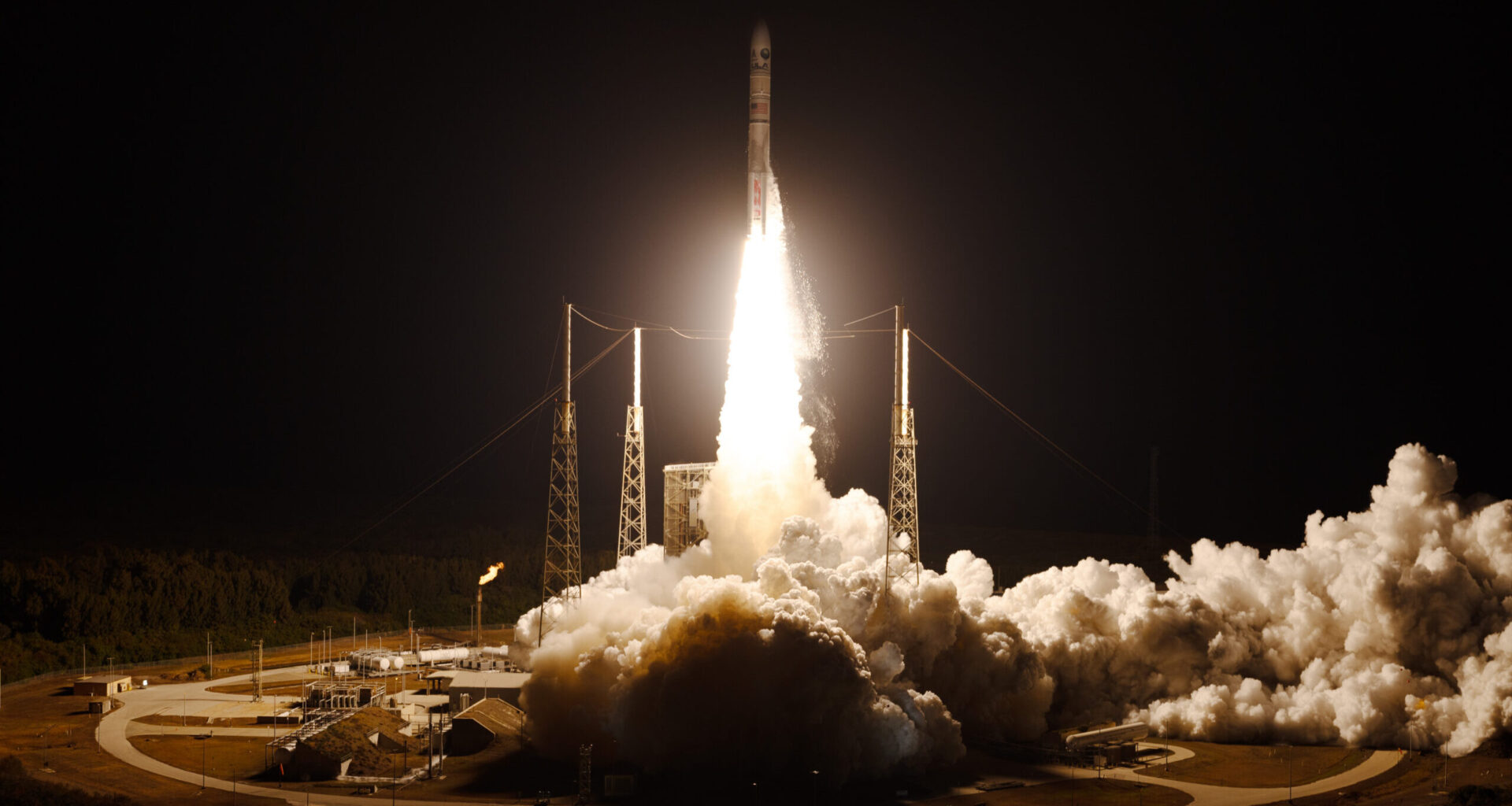
AFA WARFARE SYMPOSIUM — The Space Force is holding off on launching further national security payloads aboard United Launch Alliance’s Vulcan rocket until an anomaly observed during a recent military mission is resolved, according to a top service official.
“We are going to work through this anomaly until we launch again on Vulcan,” Col. Eric Zarybnisky, the Space Force’s portfolio acquisition executive for assured access to space, said in a media roundtable here in Colorado at the Air Force Association’s Warfare Symposium. “Until this anomaly is solved we will not be launching Vulcan missions.”
On Feb, 12, ULA launched a national security mission dubbed USSF-87 carrying two Geosynchronous Space Situational Awareness Program (GSSAP) neighborhood watch satellites.
Lt. Gen. Greg Gagnon, head of Space Force Combat Forces Command, disclosed today that the mission also included a first: a prototype of a highly maneuverable satellite to be operated by his delta responsible for orbital warfare, Mission Delta 9.
“Their job is working on their maneuvers … so that they can deliver offensive and defensive capabilities that are precise and not imprecise. So, they’re working on driving that spacecraft in a way that we couldn’t drive spacecraft before.”
Although the Vulcan successfully delivered its cargo to orbit, an anomaly was observed with one of its solid-rocket boosters. The problem had been observed on a previous launch as well, raising Space Force concerns.
“We’re still in the initial phases of that investigation, so we’ll continue to to work with the United Launch Alliance and their suppliers to make sure we’ve got the right level of insight and understand where that investigation is headed. I don’t have any details at this point,” Zarybnisky said.
“This is going to be a many-months process as we work through the exact technical issue that happened and the corrective actions we need to make sure, we need to take to make sure this doesn’t happen again.”
ULA is still officially a provider of launch for critical missions under the National Security Space Launch (NSSL) program along with SpaceX. The company is currently slated for a series of NSSL missions this year — including the launch of the final satellite in the GPS III series, GPS III SV-10, that is currently planned for no later than the end of next month.
Zarybnisky said that while there has not been a change to the manifest to switch the GPS flight from ULA to a SpaceX Falcon “at this point,” he is looking at various options should Vulcan not be cleared to lift off.
The Vulcan’s setback comes at a particularly inauspicious time for ULA, following the recent departure of long-time CEO Tory Bruno and the company’s hopes to bolster the heavy-lift rocket’s launch cadence in 2026 to meet the missions already manifested by the military and commercial customers.
Mark Peller, ULA’s chief operating officer, told reporters on Feb. 10 that the firm is targeting between 16 and 18 launches this year. In a statement to Breaking Defense after publication of this report, a ULA spokesperson said the company is working with Northrop Grumman, the supplier of the Vulcan’s rocket booster that experienced the anomaly, “to establish an investigation team, comprised of experts across the industry. Until the team has reviewed the data, inspected the spent motor assemblies, and developed and implemented corrective actions, we will not fly another Vulcan mission.”