
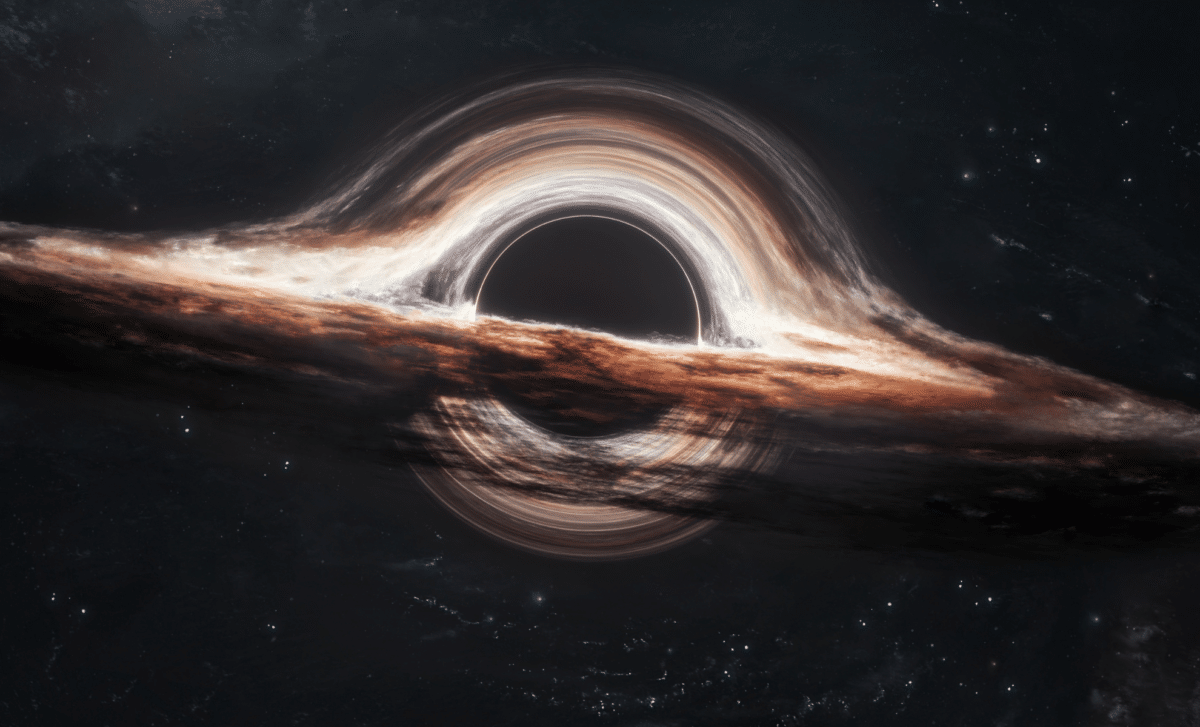
In a new study published in Classical and Quantum Gravity, researchers have revisited the concept of Einstein-Rosen bridges, the theoretical structures often associated with wormholes. This study, further discussed in The Conversation, challenges the common understanding of these “bridges” as cosmic shortcuts, instead suggesting that they may represent something far deeper: a reflection of time’s dual nature. This new perspective could not only redefine our understanding of spacetime but also offer solutions to some of the most perplexing issues in theoretical physics, such as the black hole information paradox and the mysteries of the universe’s origins.
The Einstein-Rosen Bridge: A New Perspective
The concept of an Einstein-Rosen bridge was first introduced in 1935 by physicists Albert Einstein and Nathan Rosen. These bridges were initially not envisioned as pathways for travel through space but as a mathematical model to understand how particles behave under extreme gravitational conditions. The popularization of these bridges as wormholes connecting distant points in space and time was a later development, emerging primarily from theoretical speculations in the 1980s.
This new study revisits the original work of Einstein and Rosen, arguing that their bridge concept is far more profound than previously thought. Rather than serving as a passageway for space travel, these bridges could represent a deep symmetry in time itself, illustrating how quantum mechanics and general relativity intersect. The researchers suggest that the Einstein-Rosen bridge should not be viewed as a simple tunnel but as a complex structure that connects two directions of time. This understanding could have significant implications for the way we view the flow of time and space in the universe.
Revisiting the Legacy of Wormholes: What Was Einstein Really Trying to Tell Us?
The widespread association between Einstein-Rosen bridges and wormholes emerged long after Einstein and Rosen’s original work. In fact, their work was more focused on reconciling quantum mechanics and general relativity. The notion of a wormhole as a shortcut through space-time was not their intention; instead, their bridge represented a mirror-like connection between two separate states of spacetime.
By reinterpreting the concept with modern physics, the researchers suggest that the Einstein-Rosen bridge may serve as a crucial link between two complementary components of a quantum state: one where time flows forward and another where it flows backward. This reinterpretation challenges the simplistic view of wormholes and calls for a much deeper understanding of the quantum nature of spacetime.
This study, referenced in The Conversation, offers a fresh lens through which we can re-examine the original Einstein-Rosen work. It suggests that these bridges reflect a two-directional structure of time, which could help resolve paradoxes in physics and offer new insights into the nature of the universe.
Time Reversed: Understanding the Dual Arrows of Time
A core aspect of this new study is the idea that time does not only flow in one direction. For most of us, time flows from past to present to future, and this is consistent with our everyday experiences. However, at the quantum level, the laws of physics do not inherently distinguish between past and future. This symmetry of time, the idea that time can flow in both directions, is central to the new interpretation of Einstein-Rosen bridges.
By taking this symmetry seriously, the researchers suggest that the Einstein-Rosen bridge is not a simple tunnel but rather a representation of two directions of time, one flowing forward, the other backward. This new view of time could provide a more complete picture of the universe, especially in situations involving black holes, where both directions of time may be required for a consistent quantum description.
The study, published in Classical and Quantum Gravity, explains that this duality of time is not just a theoretical construct. It is a real feature of the quantum world, where both arrows of time must be accounted for to preserve the integrity of the quantum evolution. In this view, the Einstein-Rosen bridge represents the connection between these two arrows, allowing for a more complete and reversible understanding of time.
Solving the Black Hole Information Paradox: A New Approach
One of the most famous problems in modern physics is the black hole information paradox. Proposed by Stephen Hawking in 1974, this paradox suggests that information falling into a black hole is lost forever, contradicting the fundamental principle of quantum mechanics that information must be preserved. This issue has been a thorn in the side of physicists for decades.
In their study, the researchers propose that the Einstein-Rosen bridge provides a solution to this paradox. If we consider the full quantum description of a black hole, including both arrows of time, information does not disappear at the event horizon. Instead, it passes from our time direction into the opposite one, ensuring that it is preserved.
This approach, which avoids invoking speculative new physics, offers a resolution to the black hole information paradox that aligns with both general relativity and quantum mechanics. It suggests that information is not lost but rather evolves in a different temporal direction, maintaining the consistency of quantum theory even in the extreme conditions of a black hole.
A Pre-Big Bang Universe: The Possibility of a Cyclical Cosmos
The implications of this new view of the Einstein-Rosen bridge extend beyond black holes. It also offers a potential solution to one of the most profound questions in cosmology: the origins of the universe. The study suggests that the Big Bang may not have been the beginning of everything, but rather a transition, a “bounce”, between two time-reversed phases of cosmic evolution.
In this scenario, black holes could serve as bridges not only between different regions of space but also between different epochs of the universe. The universe we observe today could be the result of a contraction and bounce from a previous, collapsed cosmos. This idea provides a novel way to think about the origins of our universe and challenges the conventional view of the Big Bang as the absolute beginning.
This cyclical model of the universe, in which time flows in both directions, suggests that what we call the “Big Bang” could be just one phase in a much larger, ongoing cosmic cycle. The idea that black holes might connect different cosmological eras adds a layer of complexity to our understanding of the universe’s evolution, and it aligns with the new perspective on the Einstein-Rosen bridge.