
Back in December, Field Gulls took a look at how the Seattle Seahawks and general manager John Schneider changed the core approach of the team in free agency, specifically signing a trio of outside free agents to multi-year deals while adding Sam Darnold, Cooper Kupp and DeMarcus Lawrence.
The signings marked a departure from statements Schneider had made in past about making outside players among the highest paid on the team, while also eschewing the long-established pattern of signing multiple players to one-year contracts to address holes on the roster.
The results of that strategy change in the second year of the Mike Macdonald and John Schneider era were undeniable.

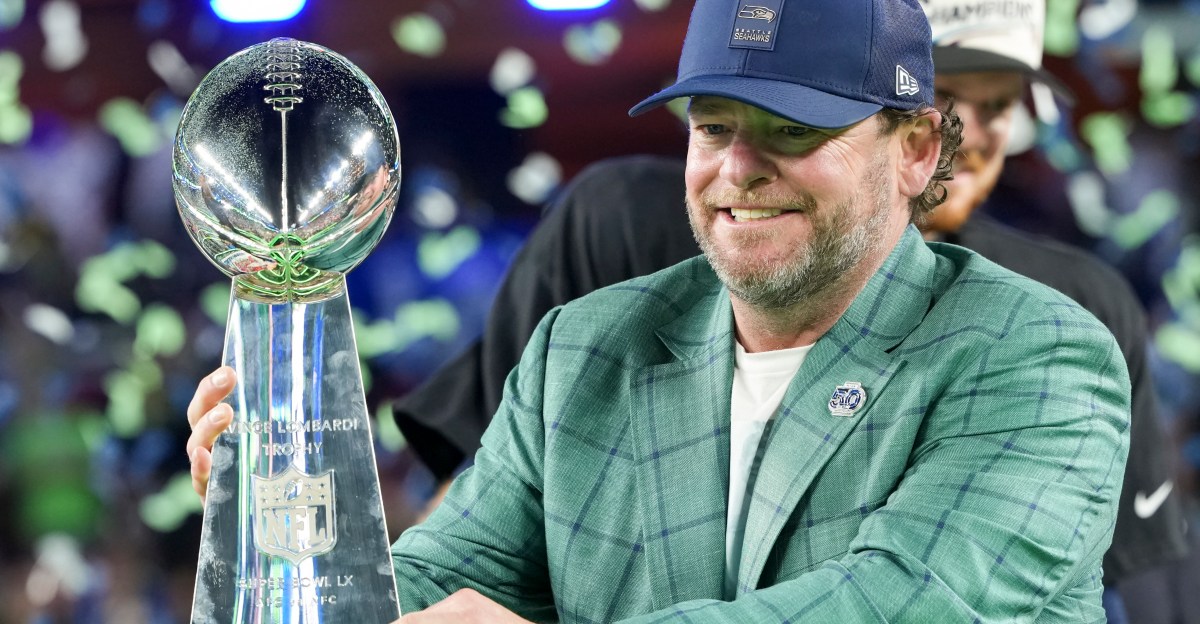
SANTA CLARA, CALIFORNIA – FEBRUARY 08: Head coach Mike MacDonald of the Seattle Seahawks looks on as John Schneider, General Manager of the Seattle Seahawks, celebrates with the Vince Lombardi Trophy after winning Super Bowl LX against the New England Patriots at Levi’s Stadium on February 08, 2026 in Santa Clara, California. The Seattle Seahawks defeated the New England Patriots 29-13. (Photo by Kevin C. Cox/Getty Images) Getty Images
Thus, with the start of free agency just a couple of weeks away, the question becomes how the Seahawks might address some of the holes on the roster this offseason. Will they again target a handful of veterans for large, multi-year contracts like they did in 2025? Or will they look to address every potential hole on the roster with a “veteran” so that they can enter the draft with a competitive roster across the board?
A short sidestep before digging into the heart of this matter, though. Just as when the change in free agency strategy in 2025 was laid out back in December, there will certainly be some readers who rush to the comments to argue that the strategy didn’t change, the team simply had more cap space available. However, that would seem a foolish thing to say after considering the free agents signed by the team over the past two seasons.
So, here’s the 2025 free agent class and their 2025 cap hits.
Seattle Seahawks 2025 free agent class
Player2025 Cap HitSam Darnold$13,400,000Cooper Kupp$9,470,000DeMarcus Lawrence$8,280,000Ernest Jones$5,283,333Jarran Reed$5,000,000Josh Jones$3,955,000Marquez Valdes-Scantling$3,000,000Josh Jobe$2,000,000Eric Saubert$1,422,500Shemar Jean-Charles$1,295,000D’Anthony Bell$1,240,000Steven Sims$1,170,000River Cracraft$1,170,0002025 Total$56,685,833
And here is the 2024 free agent class and their cap hits.
Seattle Seahawks 2024 free agent class
Player2024 Cap HitLeonard Williams$10,400,000Noah Fant$7,500,000Jerome Baker$7,000,000Connor Williams$4,000,000George Fant$3,430,000Rayshawn Jenkins$4,100,000Laken Tomlinson$3,250,000Pharaoh Brown$3,140,000Darrell Taylor$3,136,000Tyrel Dodson$3,020,000Nick Harris$2,510,000Johnathan Hankins$2,050,000K’Von Wallace$1,500,000Artie Burns$1,377,500Laviska Shenault$1,292,500Tremayne Anchrum$1,155,0002024 Total$58,861,000
So, $58.86M spent on free agents in 2024 and $56.69M spent on free agents in 2025, with as many contracts of three years or longer handed out in 2025 than in the prior eight offseasons combined? If the team spent roughly the same amount of cap space on free agents in both offseasons, but gave out contracts materially different contracts in 2025 compared to 2024, was it random? Or was it a change in strategy?
In any case, coming back to the relevant discussion of this post, the idea of filling roster holes with players on one-year contracts ahead of the draft was a great idea prior to the 2011 CBA, i.e back when John Schneider was in Green Bay learning how to become a Super Bowl winning general manager.
However, the 2011 CBA materially changed the way rosters are built. All of a sudden, a “veteran” who cost a few million dollars but was was worth signing for a single season because of their experience cost roughly the same amount for that single season as for a player locked into the rookie wage scale for four years.
For example, in the 2025 offseason the Seahawks signed MVS to a one-year, $3M deal. Then they spent a Day 3 draft pick on Tory Horton to a four-year, $4.429M contract. The first three years of Horton’s contract carry combined cap hits of $3.103M, or basically $103k more than what MVS would have cost the Seahawks, had he actually been good enough at his job to stick around for the entirety of the 2025 season.
This kind of potential cost savings is what resulted in the collapse of the middle class veteran free agency market because even if a youngster needed a season or two to adjust to the NFL, the overall value presented by the rookie wage scale effectively rendered one-year veteran contracts obsolete. Specifically, after a season or two, a youngster on a rookie contract was a veteran, except they were locked into their low-cost contract for far less than what the veteran would have cost.
In addition, because of the practice time restrictions of the 2011 CBA, coupled with the even more restrictive practice time limitations of the 2020 CBA, development curves for younger players became stunted. Effectively, the only way for those young players to get the necessary reps to improve on their craft was to be on the practice field and suited up for games. Younger players buried on the depth chart behind veteran players were not able to get the reps necessary to improve in either practice or games, meaning when the subsequent offseason arrived, the team would be in a situation nearly identical to that in which it had found itself the prior offseason, but with one less year of team control remaining for the youngster.
Laken Tomlinson is a great example of this. He was a 32-year old guard, who most certainly did not represent the future of the position for the Seahawks. What his presence did do, however, was limit 2024 third-round pick Christian Haynes and 2024 sixth-round pick Sataoa Laumea to 525 combined snaps, while also limiting practice reps for the pair.
Could either player have made a contribution in 2025 had they spent more time on the practice field and less time buried behind Tomlinson on the depth chart in 2024? Maybe. Maybe not. Probably not, but possibly. Meanwhile, the team went into the 2025 offseason not knowing exactly what it had in either player, as one of the guard spots had been occupied by someone who had long since departed once the 2025 squad reported for training camp.
Thus, to further emphasize this point, here’s another look at the 2024 free agent signings and their cap hits, along with the players who actually went on to fill the hole that the front office thought it had addressed in free agency.
Roster HolePlayer2024 Cap HitEventual FillEventual Fill Cap HitiDLLeonard Williams$10,400,000Leonard Williams$10,400,000TENoah Fant$7,500,000Noah Fant$7,500,000iLBJerome Baker$7,000,000Ernest Jones$3,116,000CConnor Williams$4,000,000Olu Oluwatimi$994,115Swing TGeorge Fant$3,430,000Stone Forsythe$1,096,656SRayshawn Jenkins$4,100,000Coby Bryant$1,186,952iOLLaken Tomlinson$3,250,000Laken Tomlinson$3,250,000TEPharaoh Brown$3,140,000A.J. Barner$1,148,777EDGEDarrell Taylor$3,136,000Derick Hall$2,071,728iLBTyrel Dodson$3,020,000Tyrice Knight$988,140CNick Harris$2,510,000Jalen Sundell$795,000iDLJohnathan Hankins$2,050,000Johnathan Hankins$2,050,000SK’Von Wallace$1,500,000Ty Okada$915,000CBArtie Burns$1,377,500Josh Jobe$985,000KR/PRLaviska Shenault$1,292,500Jaelon Darden$985,000OLTremayne Anchrum$1,155,000Michael Jerrell$835,015N/ATotal$58,861,000Total$35,392,383
Long story short, the Seahawks burned somewhere in the neighborhood of $20M of cap space during the 2024 offseason simply because they wanted to go into the draft with veterans at every spot. As laid out in December, the team materially changed its approach to free agency in 2025, and the on-field results were absolutely fantastic.
Now, it becomes a matter of seeing whether when free agency opens in March if the front office stays the course on its new strategy, or if they return to their old habit of lighting cap space on fire for the sole purpose of making sure they don’t go into the draft with holes that need to be addressed.