
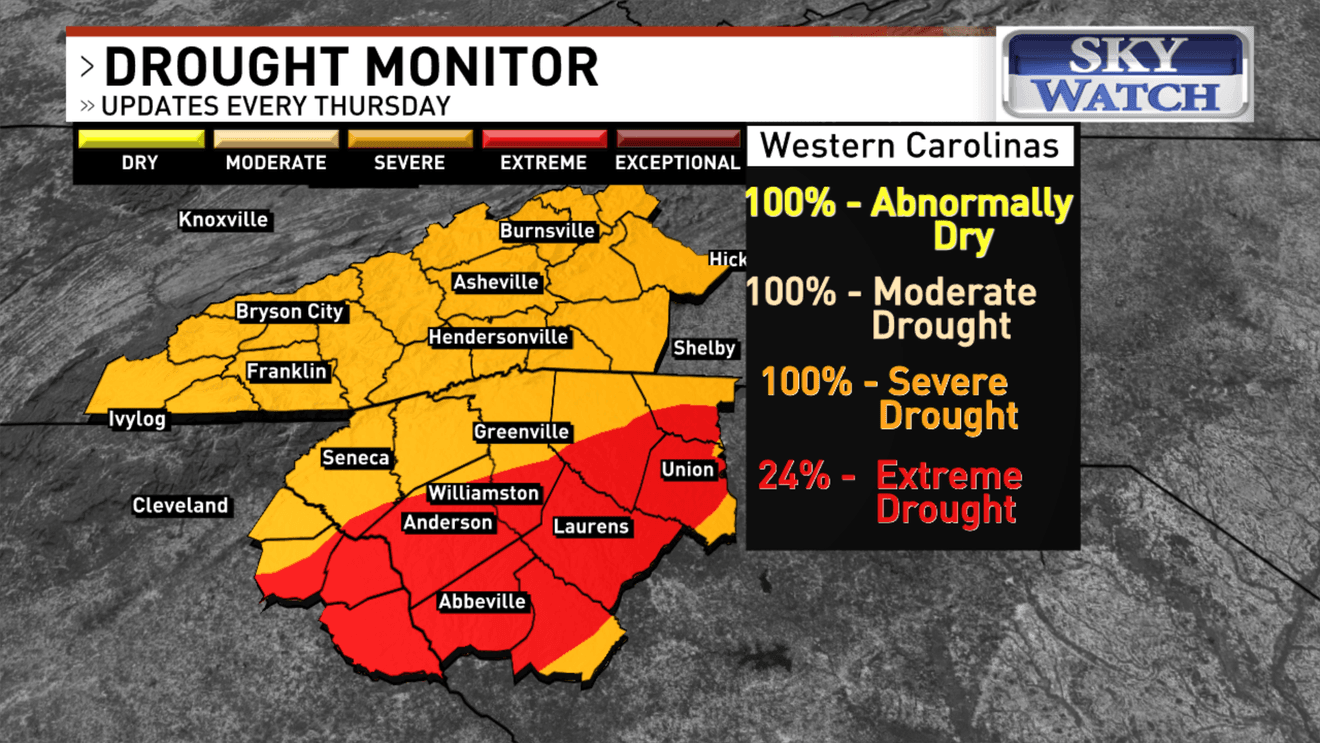
ASHEVILLE, N.C. (WLOS) — For the first time since 2008, the entirety of the western Carolinas are classified in Severe Drought, according to the latest U.S. Drought Monitor.
As of Feb. 26, 100% of the region is now in Severe Drought (D2), and approximately 24% is classified in Extreme Drought (D3).
Laurens and Abbeville counties in South Carolina are now fully in Extreme Drought. In mid-December, both counties were classified as Abnormally Dry. Severe Drought developed in early January, and conditions have since progressed into the D3 category.
In addition to Laurens and Abbeville, portions of Cherokee, Spartanburg, Greenville, Anderson, Oconee, McCormick, Greenwood, Newberry, Union, Chester and York counties in South Carolina are now in Extreme Drought.
In Buncombe County, the progression has been gradual but consistent. The county has been 100% Abnormally Dry since mid-November 2025, moved into Moderate Drought in early January, and is now entirely in Severe Drought.
Statewide, 100% of North Carolina remains in drought. Severe Drought covers nearly 87% of the state. In South Carolina, 100% of the state remains in drought, with Severe Drought covering about 65% and Extreme Drought accounting for just over 12%, primarily in the Upstate.
Seasonal rainfall deficits remain significant. Since Dec. 1, Greenville-Spartanburg has been 6.06 inches below normal. Asheville is 5.22 inches below normal.
DROUGHT CONDITIONS DEEPEN ACROSS THE CAROLINAS, DESPITE RECENT RAIN
Although the region has experienced multiple rain, snow, and ice events this winter, much of that precipitation has been limited in liquid equivalent. Many systems delivered around an inch of moisture or less, which has not been sufficient to significantly reduce seasonal rainfall deficits.
The Carolinas remain part of a broader Southeast dry pattern. The National Drought Summary notes that recent storms have provided “only localized improvement.” It also states that “showers bypassed many areas, leading to slowly worsening drought conditions,” and that pockets of extreme drought now extend “as far north as the Carolinas.”
Widespread, sustained rainfall will be required to meaningfully reduce the seasonal deficit.
The U.S. Drought Monitor updates weekly on Thursdays.