
Despite only tepid job creation by the private sector, unemployment remains historically low.
By Wolf Richter for WOLF STREET.
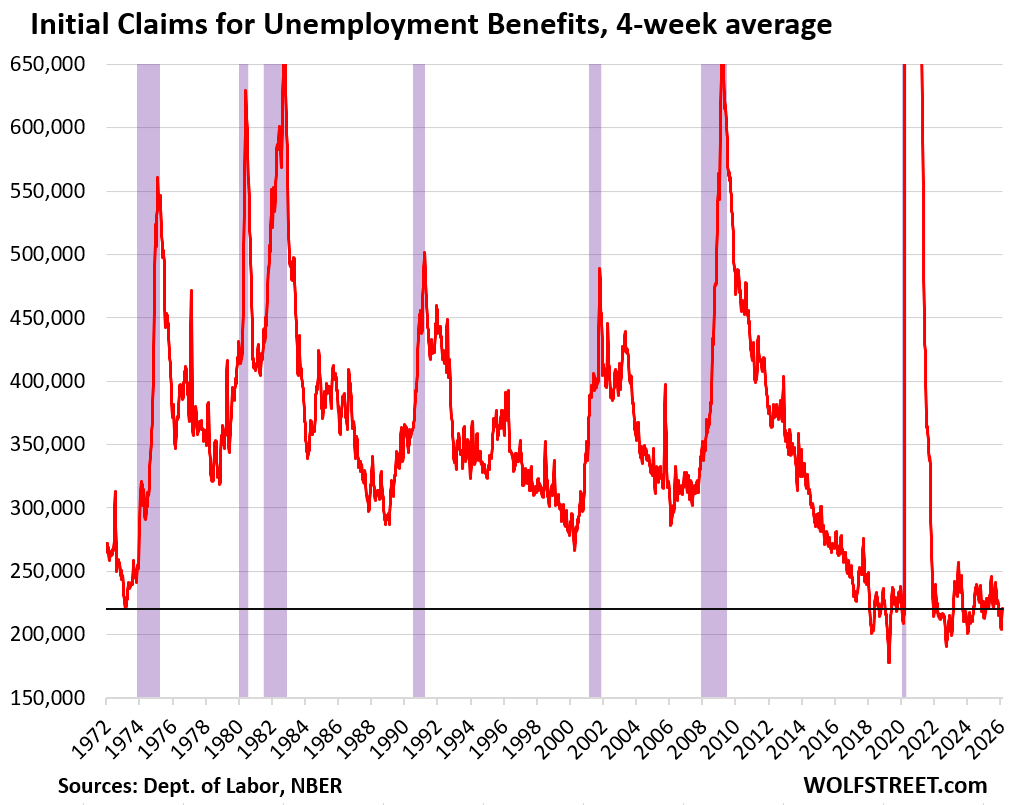
So another piece of the puzzle today: Initial applications for unemployment insurance benefits in the week through Saturday, at 212,000, were historically low. The four-week average, which largely irons out the week-to-week squiggles, at 220,250 and roughly unchanged for three weeks, was also historically low. There were only a few weeks in the decades from the 1970s till the pandemic when the four-week average was even lower.
Freshly discharged people filed these unemployment insurance claims at their state unemployment agencies, which then report them to the US Department of Labor by the weekly deadline, which then publishes it. This is not survey-based.
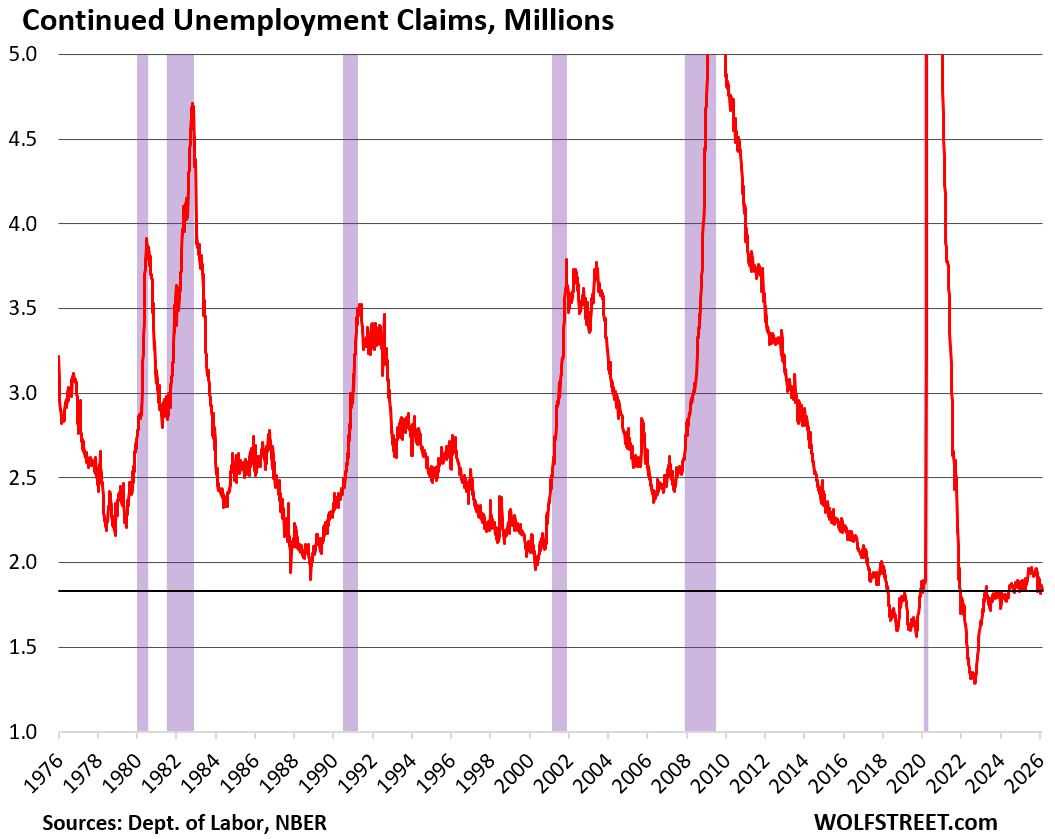
Continued weekly claims for unemployment insurance benefits fell to 1.833 million. Since their recent high in July 2025 (1.968 million), they have dropped by 135,000.
This reflects the total number of people who’d initially applied for unemployment insurance at least a week earlier and are still claiming unemployment insurance because they still haven’t found a job.
Over the past five decades, it’s only during the tight labor market in 2018 and 2019 and in the years of the labor shortages in 2022 through early 2023, that the level was ever lower.
It indicates that people remain on unemployment insurance rolls a little longer than in 2022 through early 2023 during the labor shortages, and in 2018-2019 during the tight labor market, but less long than in the prior decades.
This is one more indication that overall, employers are hanging on to their workers despite some global layoff announcements by some big companies.
These announced layoffs don’t all happen in the US. And some of these announced layoffs don’t lead to actual layoffs, but to workers finding different jobs in the same company. And some of these layoffs hit remote jobs as companies are cracking down on workers resisting RTO policies, while workers for in-office jobs are getting hired.
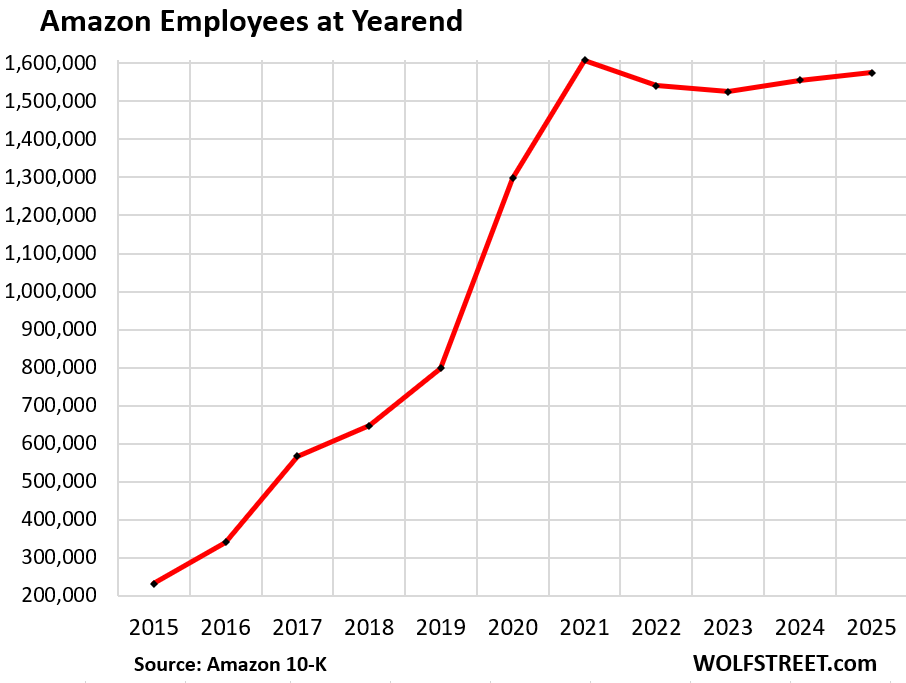
Amazon is the biggest example. It has announced shockingly huge waves of layoffs starting in 2022. But it also hired during that time, and its gigantic headcount – a mix of fulfillment center & distribution workers and tech workers around the globe – has barely changed, and at 1.576 million at the end of 2025, was down by only 2.0%, or by 32,000, from the peak year 2021.
But in 2020 and 2021, in one of the most astounding binges ever of helter-skelter overhiring, Amazon added over 800,000 workers, and its headcount had more than doubled. In the seven years 2015 to 2021, its headcount had multiplied by 7.
And since 2022, it has been trying to clean up the effects of this overhiring. Automation has also increased.
Alphabet is another big example. It also announced big waves of layoffs starting at the beginning of 2023, but its headcount actually still rose that year. It showed a lot of people out of one door, including 35% of its managers that had been overseeing small teams, while it hired a lot of people through the other door. And at the end of 2025, its headcount was just a hair below the 2023 peak. But in 2020 and 2021, its headcount had exploded by 60%.
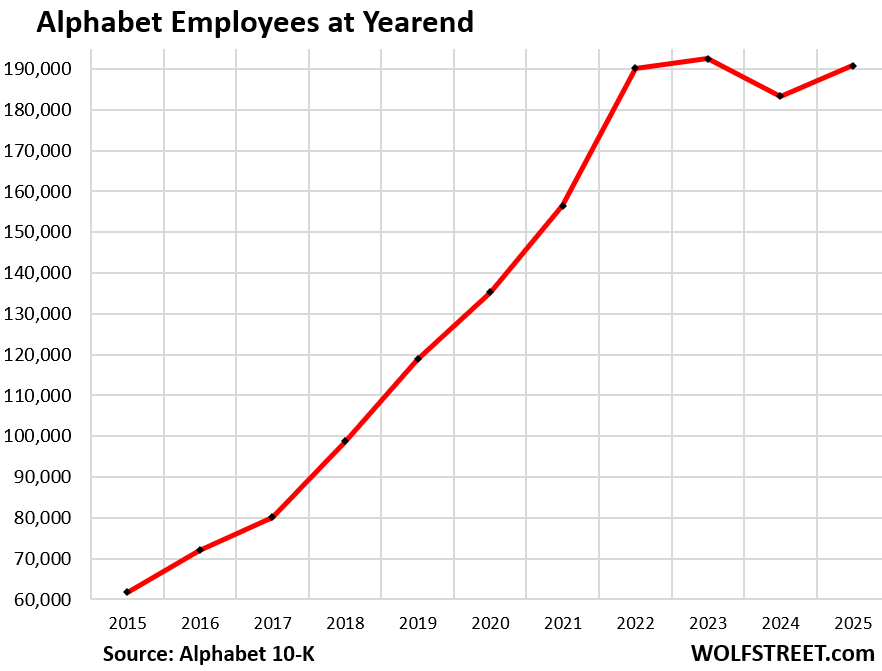
What these two examples, Amazon and Alphabet, show is that job creation has stalled at these two companies, after exploding in 2020 and 2021.
And they’re not alone. In the private sector, job creation was tepid in 2025, while the federal government and state governments have shed nearly 400,000 jobs combined.
Tech workers, white-collar workers, and recent college graduates looking for work in tech and other white-collar jobs are getting tripped up by corporate decisions to deploy AI to do more and more things, adding to the productivity of the existing workers and thereby requiring fewer new workers. This is now playing out everywhere.
Maybe it will trigger a day of reckoning at these companies, just like the overhiring had triggered a day of reckoning in the other direction, but for now, it has become corporate dogma.
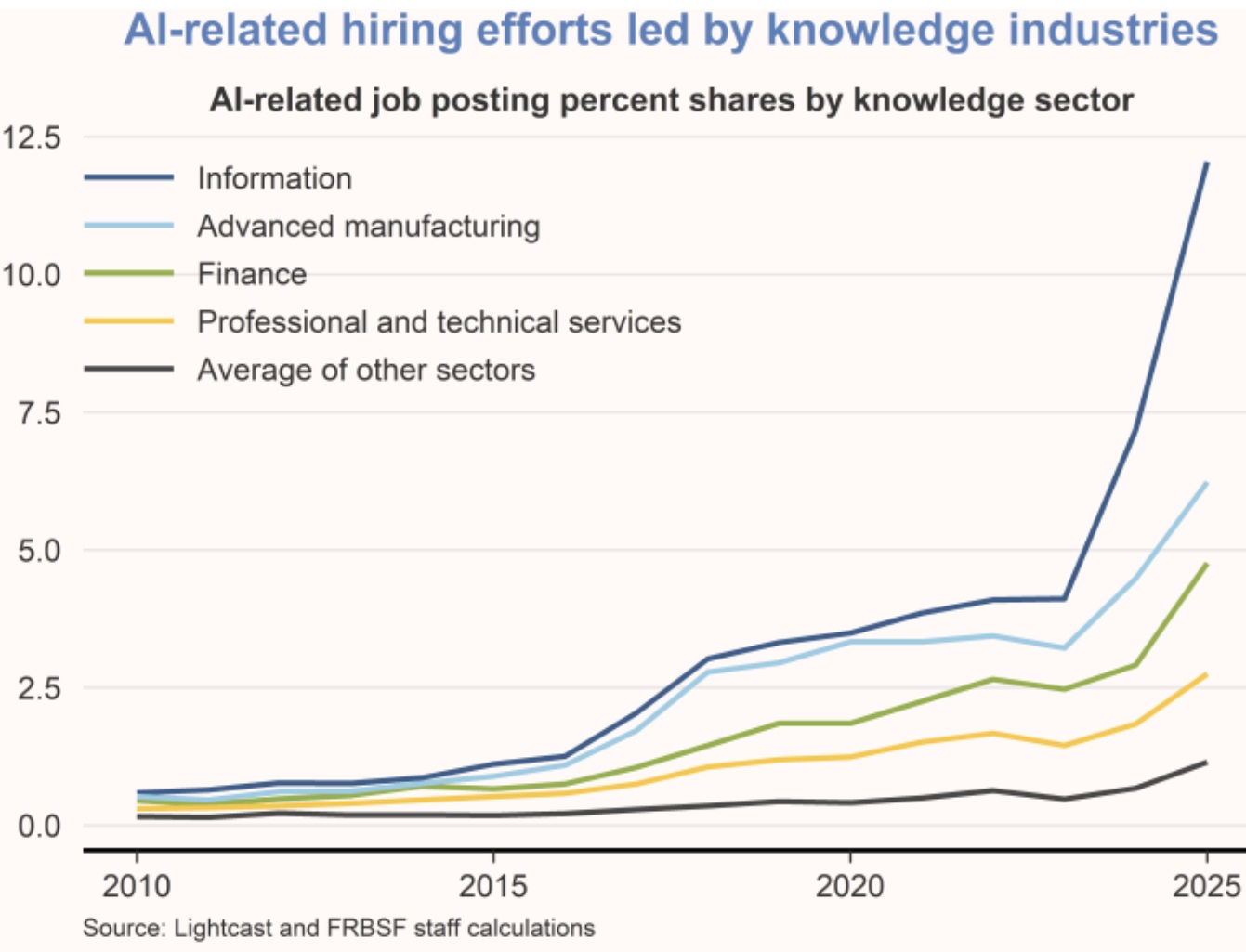
At the same time, they’re scrambling to fill AI-related jobs. Companies in all kinds of industries are scrambling to hire AI workers: In information, advanced manufacturing, finance, and professional and technical services, and AI-related job postings over the past two years have tripled in those sectors, according to data from Lightcast and San Francisco Fed calculations. And some companies are trying to attract them with mind-blowing compensation packages. There are also labor shortages in other parts of the economy, particularly in the trades.
At the same time, the supply of labor is being throttled back. Net migration to the US – immigration minus emigration – has slowed to a crawl and may turn negative in a year or two, according to Census Bureau estimates: The crackdown on illegal immigration, the tightening up of legal immigration, the substantial outflow of immigrants (self-deporting, getting deported, and legal immigrants leaving), and Americans moving to foreign countries in record numbers – that confluence of factors has changed the dynamics of labor supply, resulting in low unemployment despite slow job growth.
Enjoy reading WOLF STREET and want to support it? You can donate. I appreciate it immensely. Click on the mug to find out how:


WOLF STREET FEATURE: Daily Market Insights by Chris Vermeulen, Chief Investment Officer, TheTechnicalTraders.com.