

 The Ramsey Show / YouTube
Moneywise and Yahoo Finance LLC may earn commission or revenue through links in the content below.
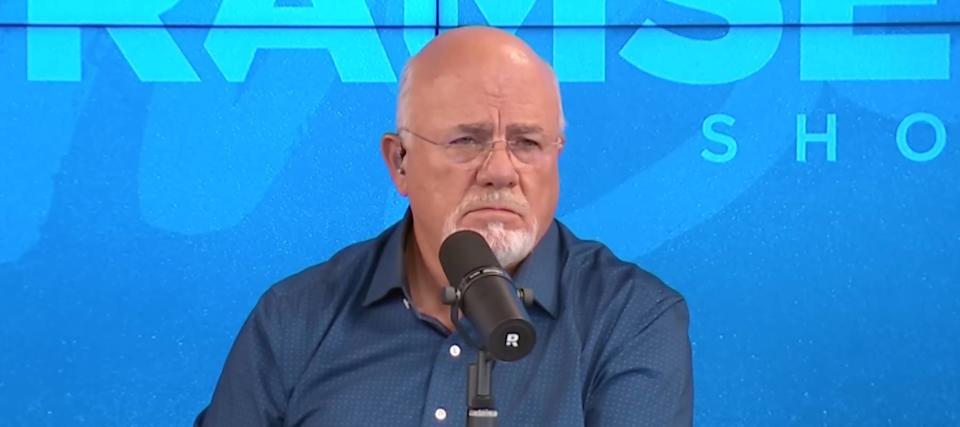
How would you feel if you called into The Ramsey Show while living paycheck to paycheck in spite of a family income of $300,000 a year?
A school psychologist named Maria knows the answer.
“I’m walking into the bear cage,” she told the hosts.
Then she started explaining her family’s money problems. Despite having minimal debt and a combined yearly income of nearly $300,000, she and her husband could not seem to stick to their budget (1).
Ramsey and cohost Jade Warshaw were visibly frustrated as Maria, who sounded nervous, waffled through the call and struggled to explain why her family couldn’t keep their spending on track even though the couple’s debts were relatively small.
They owe $17,800 on credit cards, have $8,000 on a car loan and pay $2,700 per month for their mortgage. Maria also shared that the recent deaths of her mother and brother had forced the family to cover combined funeral costs to the tune of $21,000. But even those one-time costs could hardly explain all of their financial woes.
“Where do you think the rest of the money is going?” Ramsey finally asked.
Maria couldn’t explain.
If you’re not sure where your money’s going each month, here are some ways to break out of living paycheck to paycheck — straight from Dave Ramsey.
While it may be difficult to believe that a family making a healthy six-figure income could feel broke, a recent study from Goldman Sachs shows that Maria and her husband are far from alone (2).
According to the survey, a quarter of workers who earn $100,000 or more per year say they’re living paycheck to paycheck. But what’s surprising is that those who made triple that much, like Maria, were even more cash-strapped: 41% of respondents who make between $300,000 and $500,000 reported living paycheck to paycheck.
Ramsey’s response to the problem?
“It sounds like you’re circling around the airport and refuse to land.”
“It’s not an intellectual circus. It’s not that hard,” he added. “You’re living drama to drama, crisis to crisis, and you’re letting that stuff dictate your life rather than you dictating to that stuff.”
He went on to advise Maria to re-evaluate their retirement contributions, given her husband’s take-home pay is lower than expected, and to focus on aggressively paying down their debt.
And that’s just the start. There’s still a lot more to learn from him about getting out of the paycheck-to-paycheck lifestyle once and for all.
Read More: I’m almost 50 years old and don’t have retirement savings. Is it too late to catch up?
Read More: Non-millionaires can now invest in this $1B private real estate fund starting at just $10
Speaking of financial advice, if you’re in sore need of some, like Maria, you don’t necessarily have to phone into The Ramsey Show.
You can also find personalized advice by matching with an advisor through Advisor.com — the platform connects you with an expert near you for free.
Their financial advisors are vetted based on track record, client ratios and regulatory background. Plus, their network comprises fiduciaries, who are legally required to act in your best interests.
Just enter a few details about your finances and goals, and Advisor.com’s AI-powered matching tool will connect you with a qualified expert best-suited for you based on your financial goals and preferences.
Plus, Advisor.com lets you set up a free initial consultation with no obligation to hire to see if they’re the right fit for you.
Once you’ve got the right financial advisor in your corner, the next step is getting a clear picture of where your money’s actually going. That starts with the basics — budgeting and tracking your spending.
Another option, and one tailored to high net worth individuals, is Range, which offers white-glove financial services for those with sophisticated needs. For example, Range’s CFP-backed and AI-driven platform can help high-net-worth investors minimize their tax exposure, grow their portfolio and optimize their investment strategies — potentially freeing up money you didn’t even know you had.
Even better, unlike many high end advisorial services, Range offers flat-fee pricing and 0% AUM fees. By comparison, traditional advisors typically charge 0.5% to 2% AUM fees.
To find out more, you can book a complimentary demo with the Range team to see if they’re right for you and your portfolio.
Even with a financial advisor, life will always come with unexpected emergencies — and expenses.
If an emergency does push you into debt, it’s worth reminding yourself that you’re still in the driver’s seat. Then, take action.
Start by reviewing everything you owe, along with your essential monthly expenses. Once you know what’s left over, set a realistic monthly goal of paying off debt.
That may mean trimming discretionary spending for a while. But your long-term financial health — and peace of mind — will benefit from a few months of simpler living while you work things out.
Emergencies will also be a lot more manageable, financially speaking, if you already have an emergency fund in place. Having an emergency fund helps prevent credit card debt or other borrowing from spiraling out of control.
Ramsey recommends starting with a $1,000 fund if you don’t have one, then building up three to six months’ worth of expenses after you’ve paid off debt (3). However, some experts recommend at least a year of funds
That will give you a nice cushion in case you’re hit by rough times.
There’s no one way to set aside savings in an emergency fund, but some ways are better than others.
The two things you’ll want to look out for are liquidity and earning power. Liquidity makes sense; you need to be able to quickly access your money after all, but earning power might need a small explanation. In short, inflation and cost of living increases are a fact of life. As such, you probably want to be beating these hikes when you set aside money — otherwise you might as well be stuffing cash in a shoebox.
A high-yield account like a Wealthfront Cash Account can be a great place to grow your emergency funds, offering both competitive interest rates and easy access to your cash when you need it.
A Wealthfront Cash Account currently offers a base variable APY of 3.30%, and new clients can get a 0.75% boost during their first three months on up to $150,000 for a total APY of 4.05%. That’s ten times the national deposit savings rate, according to the FDIC’s January report.
With no minimum balances or account fees, as well as 24/7 withdrawals and free domestic wire transfers, your funds remain accessible at all times, including emergencies. Better yet, Wealthfront Cash Account balances of up to $8 million are insured by the FDIC through program banks.
Getting out of living off the next paycheck is not just about you and your habits.
Rachel Cruze, another cohost on The Ramsey Show, frequently talks about how high earners live paycheck to paycheck simply because they earn more.
Cruze says it’s more than just the lifestyle creep, or the idea that spending rises with income. It’s also who you surround yourself with. As you climb income brackets, your social circles may create a new “normal” where higher spending feels expected (4).
She also warns that “debt steals your income.” Every dollar spent on interest payments is money you can’t put toward savings or goals. If you assume that earning more justifies taking on more debt, Cruze urges you to think again.
Pay it off, and you might be surprised how much breathing room it creates.
If you’re looking for some much-needed breathing room, a good place to start could be putting together a budget. However, it’s not always easy to know how and where to start — even in Maria’s case.
If managing a budget feels overwhelming to you, apps like Rocket Money can simplify the process by flagging recurring subscriptions, upcoming bills and unusual charges and pulling in transactions from all your linked accounts.
This can help you cut unnecessary costs, and then you can manually redirect savings straight into your emergency fund. No spreadsheets, no guesswork, no stress. Small habits like this can make a big difference over time.
Rocket Money’s intuitive app offers a variety of free and premium tools. Free features include subscription tracking, bill reminders and budgeting basics, while premium features — like automated savings, net worth tracking, customizable dashboards and more — make it easier to stay on top of your retirement contributions and overall financial goals.
Finally, there’s somebody else Maria should turn to — her partner.
Ramsey and cohost Warshaw noted that Maria and her husband didn’t appear to be aligned when it came to money. If you’re working to get out of debt as a couple, you need to have regular, honest conversations — not just about a plan, but about each other’s financial values and attitudes.
Before you bring your concerns to your spouse, however, it can help to reflect on your own habits and mindset. That way, you’ll be better equipped to have calm, productive discussions that stay focused on shared goals.
Cruze acknowledged that inflation is straining many budgets. For those, like Maria, who live in expensive cities, the cost of living has been unsustainable. In such cases, Cruze suggests exploring a job change or moving to a more affordable area to stretch your income further.
One way to find some room in a tight budget is to look at your insurance spending. Many people think of the cost of their car or home insurance as inevitable, and don’t consider shopping around for the best deal.
Taking some time to find the best deals can help you put one provider against another to negotiate good rates. Plus, if you build a reputation for being willing to change policies to save money, you might be able to develop a stronger negotiating position. Still, managing to set aside the time to chase down insurance providers for quotes can itself be a challenge.
With OfficialCarInsurance, you can find new deals on insurance in minutes and cut down on monthly costs to as low as $29.
Their policy search includes trusted names like Progressive, GEICO and Allstate. To get started, just fill in your information and OfficialCarInsurance.com will provide a list of the top auto insurers in your area.
But car insurance is just the beginning when it comes to managing monthly recurring expenses. Another big ticket item is homeowners’ insurance.
This is where OfficialHomeInsurance.com, which helps you look for low rates for free, might be able to help.
In under 2 minutes, OfficialHomeInsurance.com makes it easy to compare offers tailored to your needs from a list of over 200 reputable insurance companies.
Simply fill in a bit of information, and you can quickly find home insurance coverage at the lowest cost for you. On average, OfficialHomeInsurance.com users save $482 a year.
Join 250,000+ readers and get Moneywise’s best stories and exclusive interviews first — clear insights curated and delivered weekly. Subscribe now.
We rely only on vetted sources and credible third-party reporting. For details, see our editorial ethics and guidelines.
@TheRamseyShow (1), (4); Goldman Sachs (2); Ramsey Solutions (3)
This article provides information only and should not be construed as advice. It is provided without warranty of any kind.