
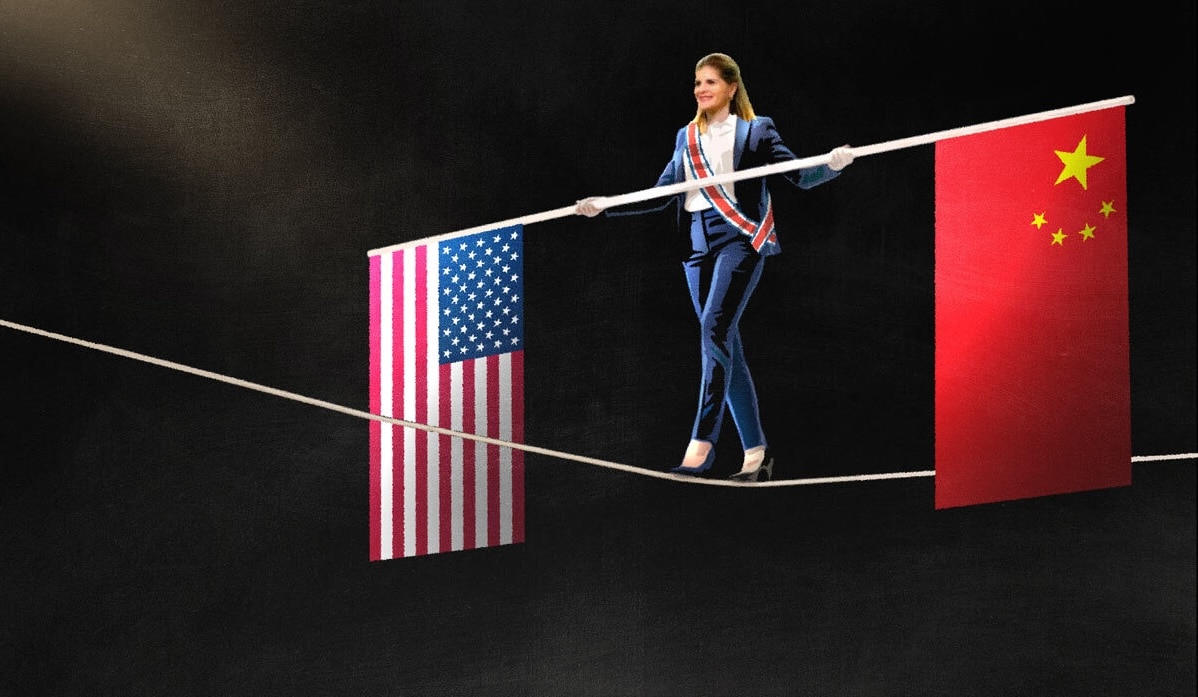
In October 2007, 18 years before Donald Trump turned international politics upside down, fanned the flames against China as America’s enemy, and revoked Óscar Arias’s entry visa, the now-former president of Costa Rica was received with honors in Beijing as the architect of a new diplomatic alliance. This relationship provided the Asian giant a gateway into a Central America dominated by Taiwan’s partners and, naturally, by the United States with its recent regional free trade agreement, CAFTA.
Bilateral expectations regarding trade, cooperation, and politics were enormous. Diplomatic legend has it that someone even proposed bringing a panda bear to exhibit in San José as a symbol of the momentous occasion.
“Luckily they didn’t bring it, because it would be dead by now,” a former diplomat joked bluntly on a Thursday in February 2026, when interviewed about the current state of relations with China. This comes as Costa Rica declares Trump’s United States its “favorite partner,” while simultaneously seeking a new balance to avoid projecting an image of submission to the White House and, at the same time, showing it is capable of maintaining a serious relationship with Beijing beyond mere formalities. Costa Rica is attempting a highly difficult maneuver, one that many consider an impossible mission.
With bilateral cooperation at a bare minimum, meager levels of Chinese investment, and bilateral trade dominated by massive imports of consumer goods into Costa Rica, the numbers show that the expectations and promises made by Arias and Hu Jintao when they secretly signed diplomatic relations in mid-2007 were indeed exaggerated. Taiwan lost the first of several Central American allies in the ensuing years, leaving only Guatemala by 2025, but George W. Bush’s administration didn’t look unfavorably upon that nascent relationship right after signing the US trade agreement with Central America and the Dominican Republic.
Those were times of multilateralism, faith in international law, and ambitions among Latin American countries to reel in the opportunities offered by the East. This was led by a China whose GDP jumped 14% that year, according to the World Bank, the highest growth in its three prosperous decades.
China remains a giant, the world’s second-largest economy, and some believe (fear or desire) it will soon be the first. But for Costa Rica, it is now a distant country beyond mere geography. “The bilateral relationship suffered a cooling off for various reasons, but now it has gone further,” said Carlos Cascante, an international relations analyst at the National University (UNA), referring to a process that deteriorated before Trump’s arrival in 2025 and left Rodrigo Chaves’s government with almost zero options to play both sides, even if it had wanted to.
Cascante explains that a common term in international relations today is hedging, which refers to a state’s foreign policy strategy to navigate between two or more powers using tactics of cooperation and competition, without falling into excessive dependence on any of them. In relationship terms, it could be called an “open relationship,” but Washington now demands a monopoly over critical aspects of every country in the region.
“Brazil and Peru can hedge, but for Central American countries, the margin is very limited. The pressure from the United States is extremely high. Costa Rica is going to have to keep its relations with China low-profile, cold, and limited to trade in consumer goods, without scaling up to major projects,” Cascante explains.
The 5G Network: A Thorny Issue
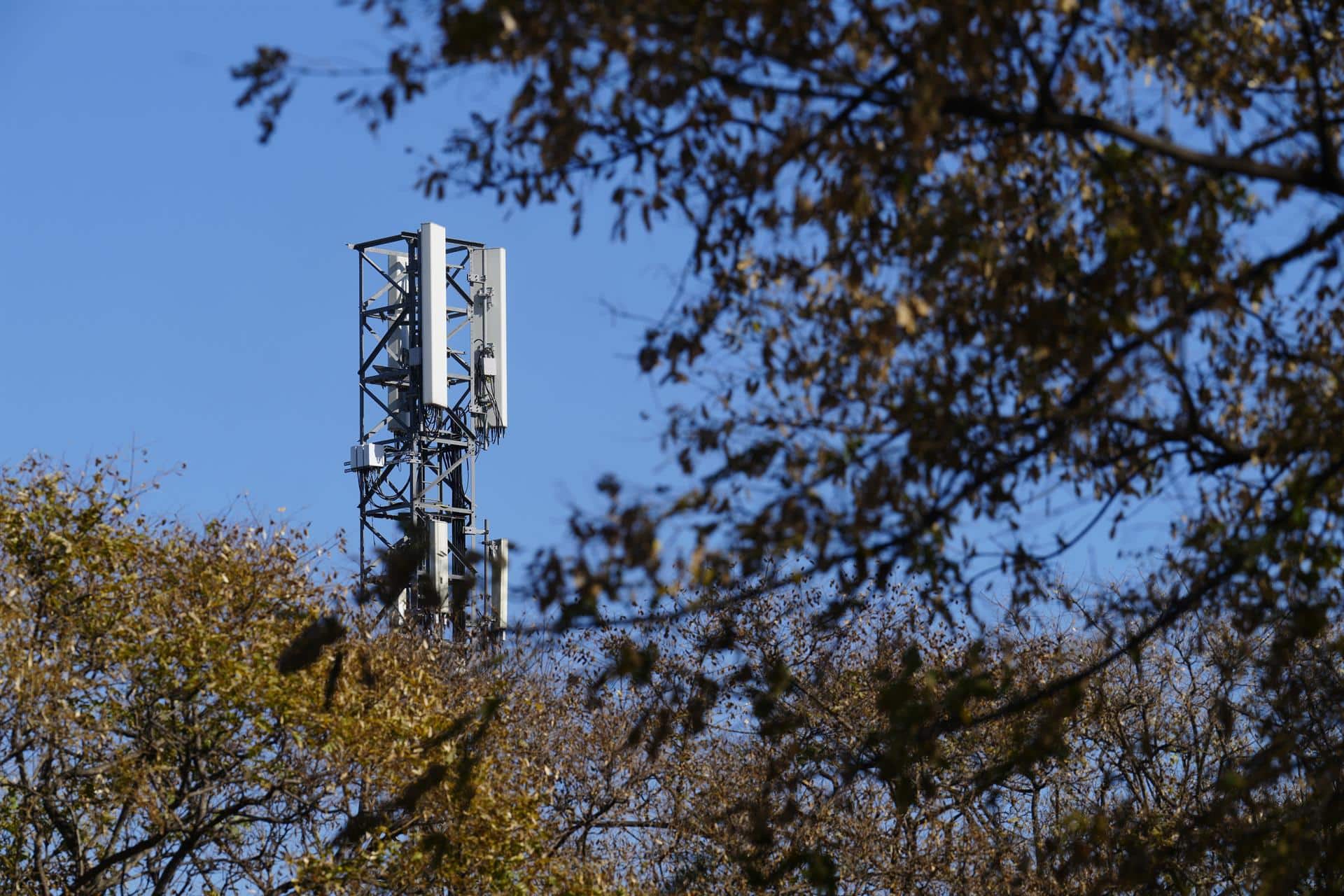 Mobile phone antennas in an urban area, illustrating the debate in Costa Rica over the development of 5G networks and restrictions on certain international providers. Credit: EFE / Enric Fontcuberta
Evidence of this abounds in recent news and current data. Rodrigo Chaves’s government is trying to develop its 5G technology network and, catering to explicit messages from various US authorities, has left Chinese companies out. The argument is that they haven’t signed a decree ensuring compliance with international cybersecurity conventions. For some domestic sectors, this was merely a pretext to satisfy Washington’s warnings.
“That decree was a product of the government’s creativity, but it’s a shot in their own foot because it prevents the entry of highly competitive and affordably priced technology,” Marco Vinicio Ruiz, a businessman who was Minister of Foreign Trade when Costa Rica opened diplomatic relations with China and later served as ambassador to Beijing, told DIVERGENTES.
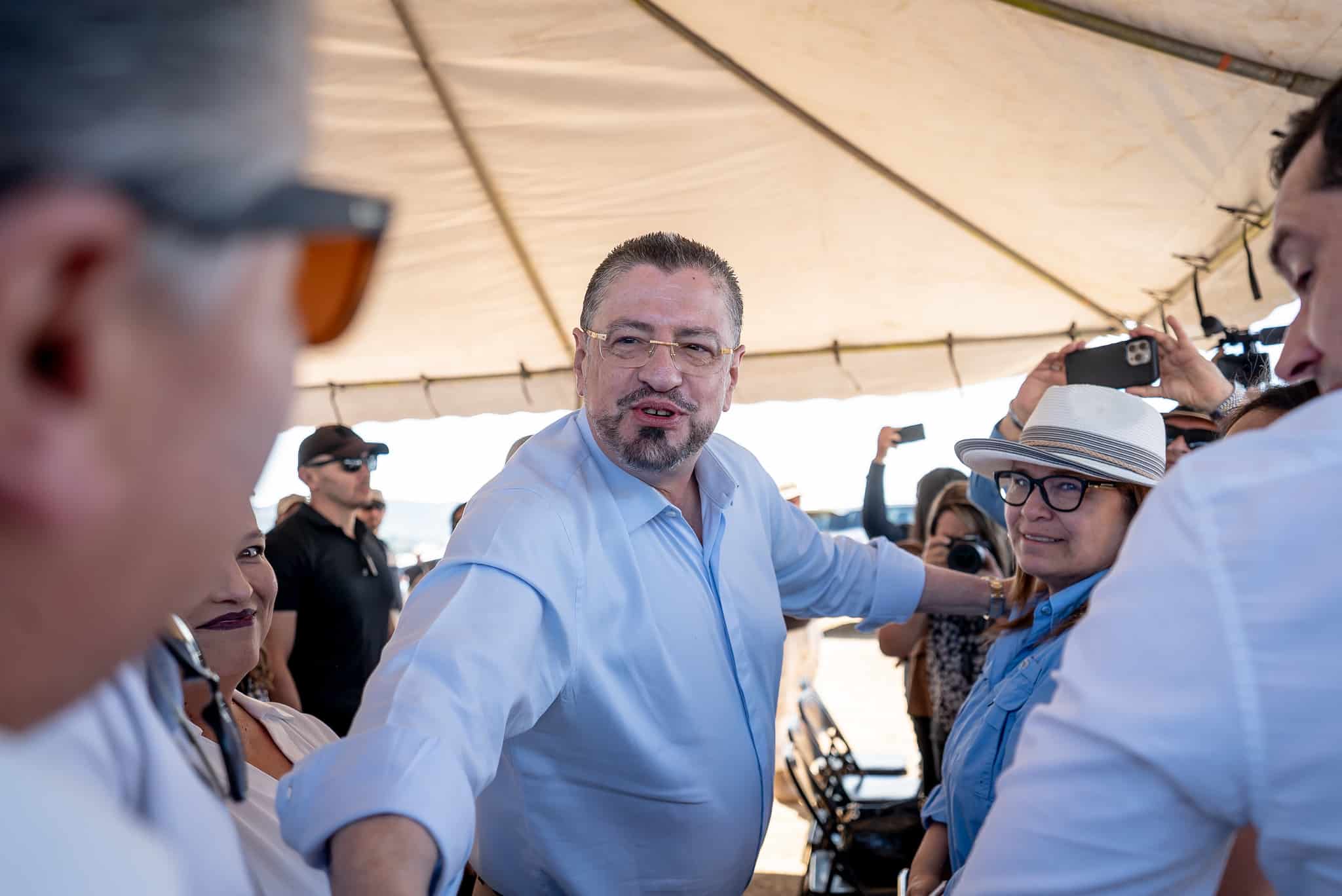
 Laura Fernández, President-elect of Costa Rica. Credit: Miguel Andrés | Divergentes
Telecommunications networks are among the critical sectors in Washington’s eyes, alongside ports, airports, or the exploitation of key raw materials that Costa Rica lacks. No one can claim a lack of clarity in the messaging. Secretary of State Mike Pompeo said as much in 2020 during a visit to San José (“the Chinese government only offers debt, dependence, and erodes sovereignty”), as did General Laura Richardson, head of Southern Command, alongside President Rodrigo Chaves in 2023, even before Trump arrived with policies based on the “America for Americans” doctrine.
“I am concerned about the dual-use of this [Chinese] capability in deep-water ports, in cyber technology, in the space domain, in 5G networks, and its use in military applications if they needed it. That is my concern […] If another country is here to invest in the region for the people of Latin America and the Caribbean, that’s fine if it’s with good intentions; but I leave it to you to decide. Why so much investment in critical infrastructure throughout the Western Hemisphere? That is what concerns me,” Richardson said in San José, while her hosts took clear note.
“Love is Repaid with Love”
 File photo of a Chinese New Year celebration in San José, reflecting the cultural ties between Costa Rica and China. Credit: EFE / Jeffrey Arguedas
“Love is repaid with love,” was the phrase Rodrigo Chaves used in February 2025, just two months after Trump’s return to the White House, to justify accepting flights from the United States carrying migrants from third countries. That “love” therefore implies distancing oneself from other temptations, especially a China that has also not prioritized Costa Rica. It is no longer Beijing’s only ally in Central America, the agricultural export supply faces major logistical hurdles crossing half the globe, and Costa Rica has no deposits of valuable materials.
Goods exported by Costa Rica to China in 2024 represented less than 3% of its sales, compared to 47% to the United States, according to the National Institute of Statistics and Census (INEC). The value of exports to the massive Chinese market was $370 million, but that is only a tenth of its imports from China, which are heavily dominated by consumer goods. Electronic devices, metalworking, and transport goods dominate Chinese sales in the Costa Rican market.
On the streets, the influx of Chinese-brand vehicles imported by local companies is evident; however, these businesses do not currently foresee a jump in Costa Rican tariffs due to any pressure from the United States.
Chinese investments are not significant either. They barely exceeded $10 million in a single year (2014), and the annual average over the last 20 years is less than $3 million, according to official data from the Ministry of Foreign Trade (Comex). “They are extremely modest figures,” noted Minister Manuel Tovar in an interview with DIVERGENTES from California, where Costa Rica recently opened a new “commercial embassy” in Silicon Valley focused on the US tech sector.
“North American companies generate 250,000 jobs in free trade zones [an income tax-exempt regime], whereas Chinese companies generate around 300 jobs… We do not have lithium, copper, or gold to mine. In infrastructure, they don’t participate in relevant projects either, except for the Route 32 ordeal,” Tovar adds. That “ordeal” is the expansion project for the main highway to the Caribbean, a contract with the Chinese company CHEC that was initiated in 2007 and has still not been fully completed.
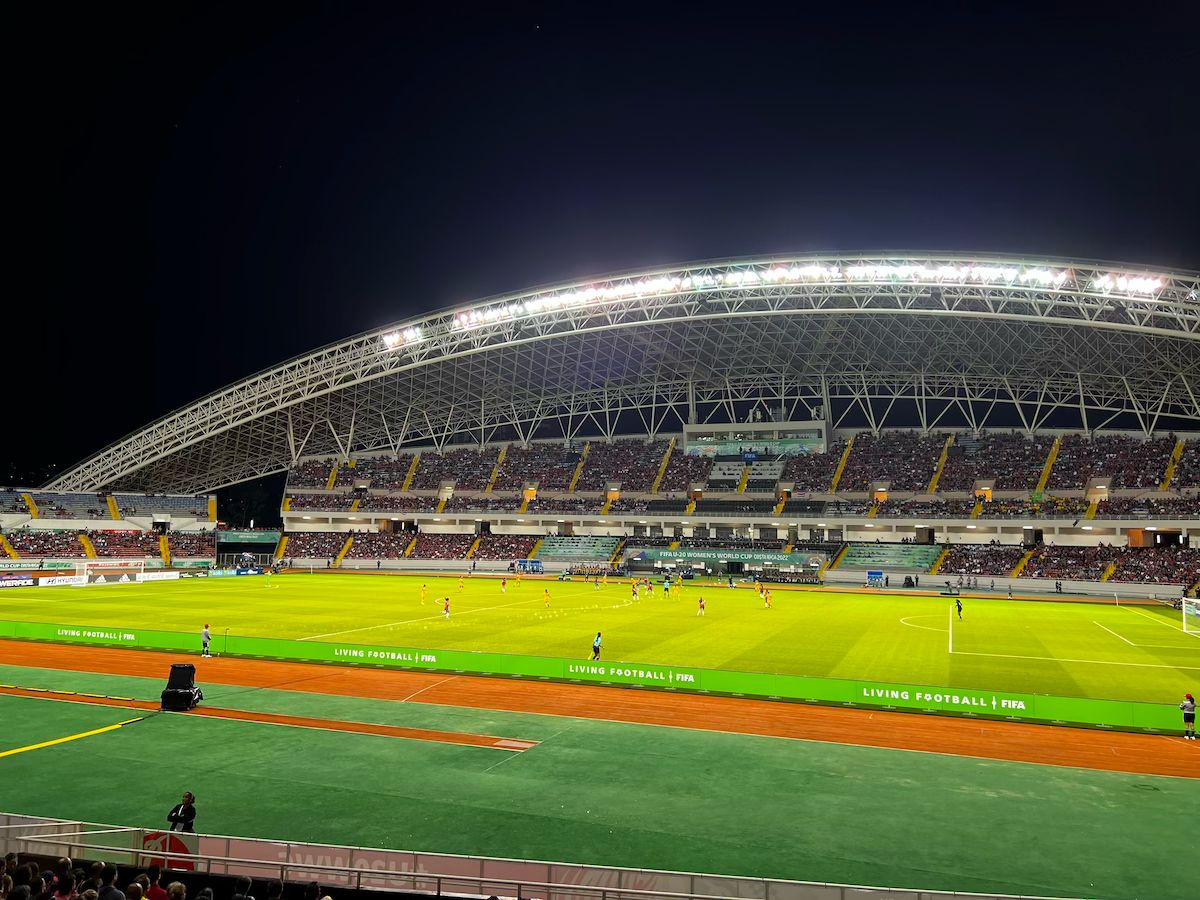 File photo of Costa Rica’s National Stadium, donated by China. Credit: Wilfredo Miranda Aburto | Divergentes
It is not the first complicated project. Intentions to develop a business hub in the Pacific region remained on paper, plans for a joint oil refinery ended up in international arbitration, and dreams of developing binational tourism never materialized. The laws and practices of one country were not necessarily compatible with the other’s, as became clear in 2008 when the Costa Rican Constitutional Court forced the disclosure of details of a $300 million financing contract signed in secret a year earlier as part of establishing bilateral relations.
“In trade and investment, we fell far short of meeting the expectations set by authorities when they promoted that rapprochement [in 2007],” emphasizes Minister Tovar, who ventures that perhaps Costa Rica simply has a value proposition that isn’t attractive to China. Furthermore, he maintains that while accessing that market can always be appealing, ultimately, it is “cumbersome.”
In terms of investments and economic cooperation, there are no major ambitions laid out either, but the Minister denies that there is pressure from the United States on issues like the 5G network. “What does exist is a shared understanding of the risks involved and the certainty that those who come to invest in critical national security sectors must play fair and not engage in practices that leave much to be desired.”
The Chinese Embassy and its Pronouncements
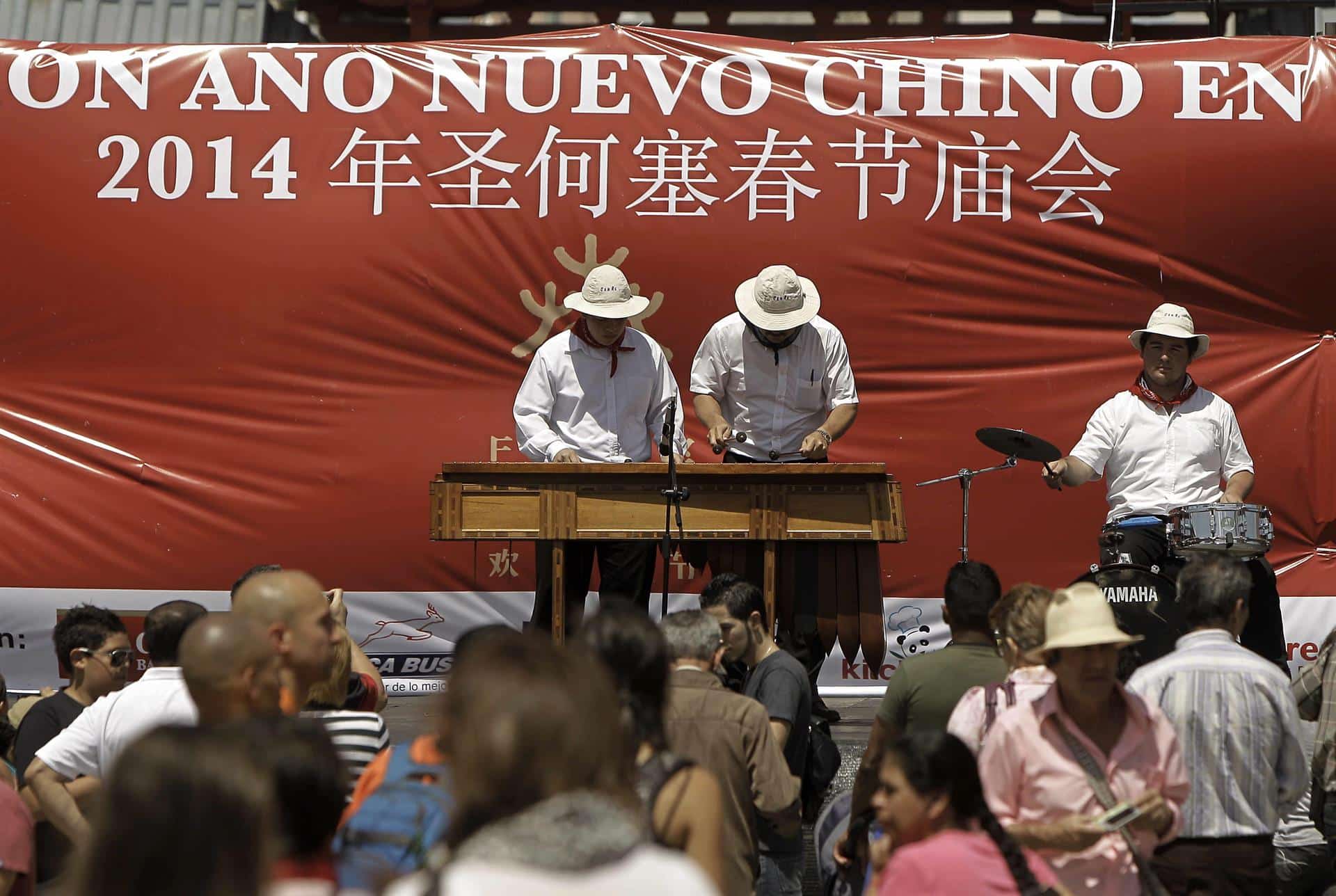 File photo of a Chinese New Year celebration in San José, reflecting the cultural ties between Costa Rica and China.
The Chinese embassy in Costa Rica frequently issues statements responding to remarks by the United States or Costa Rican political actors who question Chinese companies’ respect for cybersecurity norms, or when they are accused of being used by Beijing to obtain user data or key intellectual property.
They are constantly on the defensive, though there is no shortage of diplomatic speeches praising cooperation projects executed years ago, such as the National Police Academy and the National Stadium. They also highlight cultural exchanges, the increase in trade volume over the 18 years of bilateral relations, and promises of closer ties in the future.
“China is willing to work with Costa Rica to continue consolidating mutual political trust, strengthening the alignment of development strategies, and exploring the potential for practical cooperation,” Ambassador Wang Xiaoyao said at a formal event. An interview was requested with her for this report, but it was not possible to secure one before March.
Formalities aside, this does not appear to be the same Costa Rica that Hu Jintao envisioned when he hosted Arias in Beijing, nor when he visited a year later to agree on the Free Trade Agreement (FTA), not even the one his successor, Xi Jinping, encountered five years later.
“This visit sends a message to the entire world regarding the importance China places on its relations with Costa Rica as a strategic partner in Latin America,” then-Costa Rican Foreign Minister Enrique Castillo said in 2013. It is a phrase that, come this May 8, surely no one will repeat when President Chaves hands over the presidential sash to his minister, Laura Fernández, during the special inauguration ceremony… held in the National Stadium, a gift from China to mark the start of their relationship in 2007.
The information we publish in DIVERGENTES comes from contrasted sources. Due to the situation in the region, many times, we are forced to protect them under pseudonymity or anonymity. Unfortunately, some governments in the region, including the Nicaraguan regime, do not provide information or censor independent media. For this reason, despite requesting it, we cannot rely on official, authorized versions. We resort to data analysis, anonymous internal sources, or limited information from the official media. These are the conditions under which we exercise a profession that, in many cases, costs us our safety and our lives. We will continue to report.
Relacionado