
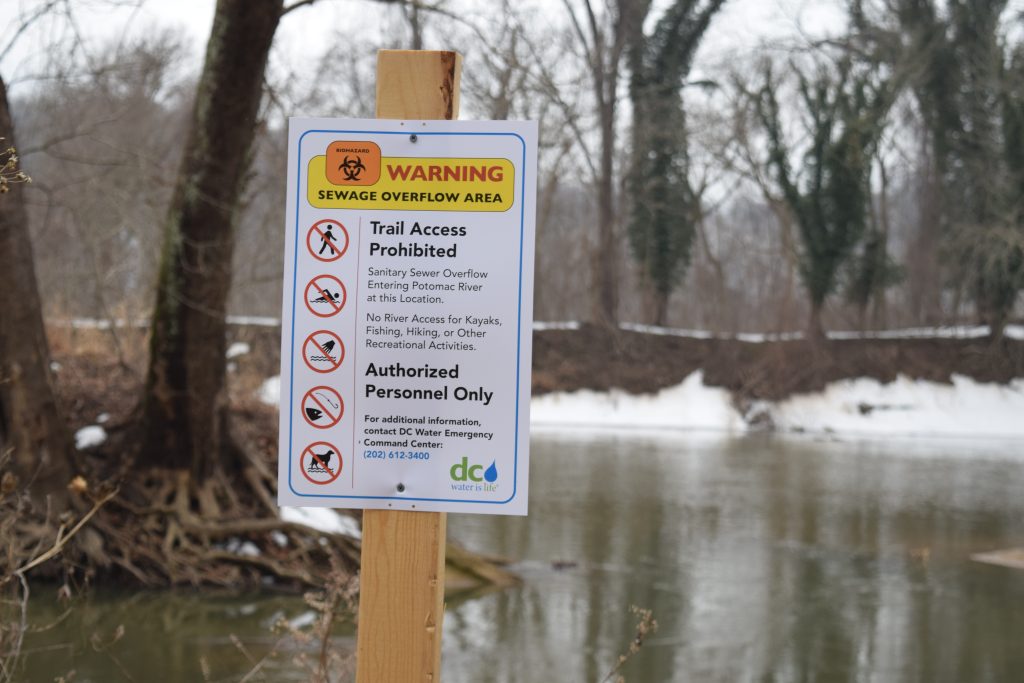
Montgomery County residents peppered officials representing DC Water, the county and state on Thursday night with questions about the massive January sewage spill into the Potomac River after a Jan. 19 pipe collapse, saying they were concerned that aging infrastructure could fail again and worried about the impact on the waterway’s ecosystem and recreation.
More than 150 people attended the meeting at Walt Whitman High School in Bethesda, which lasted nearly two and a half hours. Many of the residents who posed questions to the panel of officials said they live in the county’s Cabin John and Glen Echo communities. Those neighborhoods border the Potomac River and are near the location of the Potomac Interceptor sewer line, where the collapse and subsequent raw sewage spill occurred.
One of those Cabin John residents was Robin Patt-Corner, who said he has been kept up at night by the noise of construction work at the sewage repair site on Clara Barton Parkway. Though he thanked DC Water because his lost sleep meant the utility was working to fix the issue, he raised a concern about the Potomac Interceptor’s aging infrastructure.
“We have been saddled with, it seems to me, a genuinely terrible design from 1965 and the people that did it are long dead, and it’s not your fault, but it’s your problem,” Patt-Corner said. “And as we fix it … we need to talk about a parallel conduit, as you say, and I think we need to challenge the very 1965 assumption that the way you do stuff is to collect [waste] all together in one place in Blue Plains by piping it under the river that we live in and by. That’s a terrible idea.”
Patt-Corner said it was critical for officials to not only fix the issue but also ensure that a collapse and sewage spill does not happen again.
“Frankly, it’s a miracle it hasn’t happened earlier,” he said.
The Potomac Interceptor collapse occurred just outside of Cabin John and off of the Clara Barton Parkway near I-495. DC Water, the utility that manages the line, estimates a total of 243.5 million gallons of wastewater spilled onto the banks of the Potomac River in Montgomery County and into the waterway known as the “nation’s river.”
U.S. Rep. Jamie Raskin (D-Dist. 8) of Takoma Park attended Thursday night’s meeting and noted that his office and the office of Glen Echo Mayor Dia Costello had requested DC Water host the forum in the community.
DC Water officials, including CEO David Gadis, Chief Operating Officer Matt Brown and Senior Public Outreach Coordinator and Environmental Oversight Manager Amanda Zander also attended and provided background and updates on the Potomac Interceptor, the repair process and plans for environmental rehabilitation.
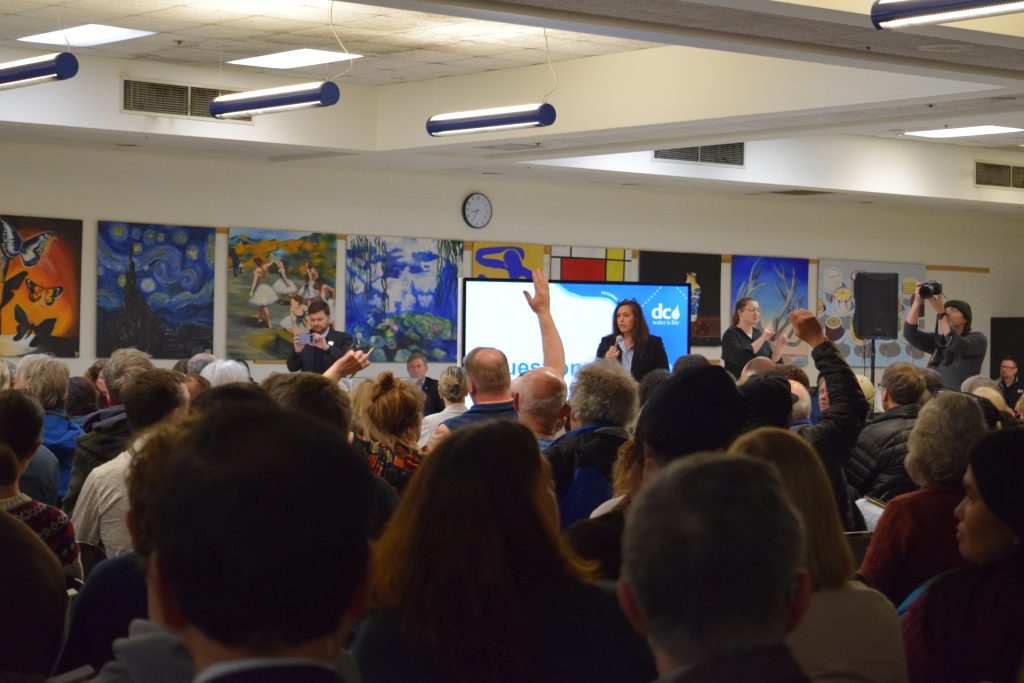 Montgomery county residents expressed concerns about the Potomac Interceptor’s aging infrastructure and impacts the sewage spill would have on recreation and the river ecosystem at a DC Water forum held at Walt Whitman High School in Bethesda on Thursday night. Photo credit: Elia Griffin
Last week, repair crews reached the collapsed pipe, a milestone that DC Water has called a “critical step” in the repair process. This will allow crews to conduct damage assessments on the pipe and accelerate repair efforts. Currently, crews are making progress removing the rock and debris dam blocking the pipe and cleaning the pipe to allow for emergency repairs.
Those repairs are expected to be completed by mid-March, according to the utility.
WSSC Water CEO Kishia Powell, Deputy Secretary of the Maryland Department of the Environment Adam Ortiz, along with county officials including Jennifer Macedonia, the director of the Department of Environmental Protection, and Chief Health Officer Kisha Davis, also provided updates and answered questions from attendees.
The interceptor normally carries about 60 million gallons of sewage per day to the Blue Plains Advanced Wastewater Treatment Plant in southeast D.C., the largest treatment plant in the world.
While the cause of the interceptor’s collapse has not been determined, Gadis provided insight into the utility’s theories about what happened. In addition to noting the wear on an aging pipe over the years, he said that when the 54-mile sewer line was built, it is believed that crews filled the space around the pipeline with large rocks and boulders. That combination may have caused the collapse, he said.
DC Water was already planning to rehabilitate the Potomac Interceptor before the collapse occurred through a $625 million, 10-year project focused on the most “vulnerable” sections of the sewer line, according to spokesperson Sherri Lewis. The collapsed segment was part of a 10,000-linear-foot section that was scheduled for rehabilitation this summer.
“We are now planning to accelerate part of that work,” Lewis said Monday in an email to Bethesda Today. “Once the emergency repair is complete, we will begin work to rehabilitate more than 2,700 linear feet of the Potomac Interceptor, including this section, which is expected to take 9 to 10 months.”
Environmental advocates also shared concerns and questions during Thursday night’s meeting about the spilled sewage causing eutrophication, the over-enrichment of a water body, resulting in oxygen depletion and algal blooms. They also asked about whether water quality testing would be expanded and about cleanup plans.
Bethesda resident Vicki Judson, president of the Montgomery Sycamore Island Club, asked DC Water officials to expand the water quality testing areas to include Sycamore Island. Judson noted that when the sewage spill reached the island, dropping temperatures caused the sewage to freeze in the water around the island.
The Sycamore Island Club is a private club for local outdoor enthusiasts who like to canoe, kayak, paddle board and want to protect the Potomac River, Judson says.
According to Judson, the club has scheduled events on the island in the spring. Without testing results, she said she is cannot make the decision to allow members to return.
“We also think that the river does a great job at cleaning [itself] but we don’t know the impact of the frozen sewage. We think we need sediment testing and we think we need testing now of these other areas,” Judson said. “Without testing, we don’t know if we’re an impacted area.”
Tyler Westfall, a coach and athlete with the Potomac Whitewater Racing Center in Brookmont, also advocated for additional testing in the area where kayakers train near Lock 6 of the C&O Canal National Historical Park. Lock 6 is downstream from the spill.
“This section of the river is, for kayakers, one of the most used sections of the river … and it’s an extremely popular area,” Westfall said. “It’s very accessible, would be really easy to test, and would have a really massive impact on recreational users of the river, being able to be safe and so that we could get our kids back on the water training.”
The center has produced U.S. National team athletes, including Westfall. Some are hoping to compete at the 2028 Summer Olympic Games in Los Angeles. A livestream of the entire meeting can be viewed on YouTube at this link.