
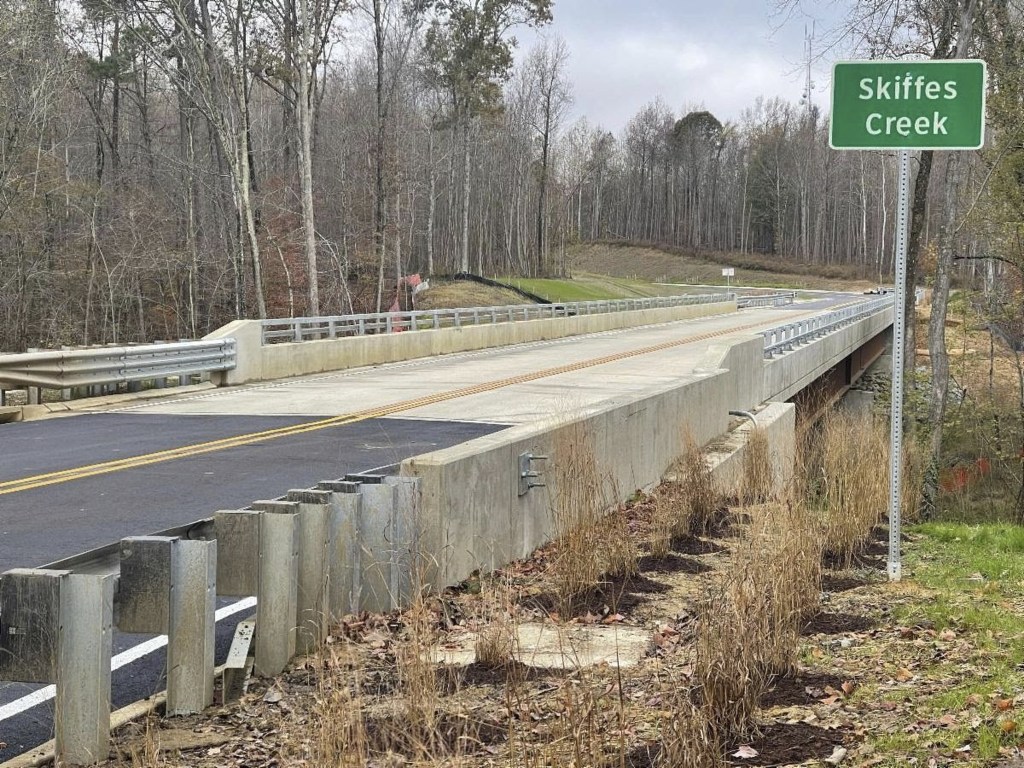
Newport News Waterworks is undertaking a dam removal project that will transform the body of water separating the city and James City County.
Newport News Waterworks has commissioned Texas-based Resource Environmental Solutions LLC to remove the Skiffes Creek dam and restore the habitat that existed more than a century ago. Planners estimate that the project, which will bring back more than 6,000 feet of stream and create 39 acres of wetlands, will take place in phases through 2029.
The regional utility, which is owned by the city, provides drinking water to more than 400,000 people in Newport News, Hampton, Poquoson, York County and part of James City County. Five reservoirs hold water for use by Newport News Waterworks: Lee Hall, Harwood’s Mill, Diascund, Little Creek and Skiffes Creek.
Skiffes Creek Reservoir currently can hold as much as 5% of the regional water supply, making it the smallest of the utility’s reservoirs with a 100 million gallon capacity. Nearly all of the boundary that separates Newport News and James City splits Skiffes Creek and the reservoir.
Rob Ostermaier / Daily Press
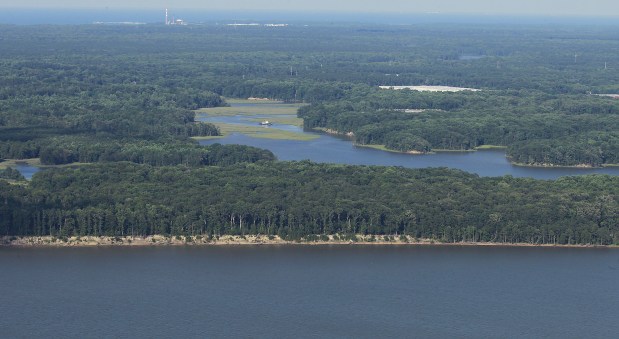
Skiffes Creek, seen here running to the James River, will look like a construction site immediately after the dam removal, but restoration efforts will prompt vegetation to establish within a few months. (Daily Press file)
The 108-year-old dam is deteriorating and does not meet modern safety standards, according to Newport News Waterworks officials. Repairing the dam would cost between $14 million and $20 million. Instead of making those repairs, the utility will decommission the dam, remove a pump station and restore the acreage to a landscape resembling its appearance before the dam was built.
Over the last century, Newport News Waterworks “has successfully undertaken many dam projects that are more complex and costly than the work planned for the Skiffes Creek restoration project,” utility spokeswoman Cyndi Masterstaff said.
In late 2023, RES, a national firm specializing in habitat restoration, submitted a bid for the work that Newport News Waterworks accepted.
The Skiffes Creek restoration is typical of the size and scope of projects that RES undertakes around the United States, according to Kathy Hoverman, the firm’s project engineer. “Nationwide, we’ve completed thousands of these projects, restoring 690 miles of streams and 77,000 acres of wetlands across 25 states,” she said.
While wetland restoration is RES’s primary business, the company also has extensive experience in dam removal, sediment and habitat management and revegetation of former reservoirs, Hoverman said. The Skiffes Creek restoration project will provide significant ecological benefits to the lower James River watershed, she said.
The initial phase of the project — design and permitting — is already underway and will continue through 2027. Removal of the dam and pump station and restoration of the wetlands are scheduled to occur between 2027 and 2029. Plans then call for a decade of monitoring to ensure the project has met its objectives.
Staging and construction activities will take place on James City’s side of Skiffes Creek on property owned by the utility. Immediately to the west of the reservoir and its wooded surroundings is the county’s Green Mount Industrial Park. To the east amid a forested buffer is Newport News Behavioral Health Center and the city’s Carleton Falls neighborhood.
Utility officials do not anticipate any major disruptions, neither on the county nor the city side of the reservoir.
Toni Small, director of James City County’s stormwater division, said that the county is aware of the restoration project, and that “we anticipate there will be no impact to stormwater management in James City County as a result of this project.”
Newport News Waterworks held a public meeting Feb. 12 at Hope Church in Lee Hall to discuss the project. Several residents of Carleton Falls attended. Masterstaff said project staff and attendees had a constructive and respectful dialogue that touched on several issues, including the new viewshed and the long-term maintenance of a raw water pipe that runs under the neighborhood.
The presentation indicated that Skiffes Creek will look like a construction site immediately after the dam removal, but that the restoration efforts will prompt vegetation to establish within a few months. Other restoration projects suggest that within roughly eight months, plants will have fully taken hold of the former reservoir bottom.
Ben Swenson, ben.swenson05@gmail.com