
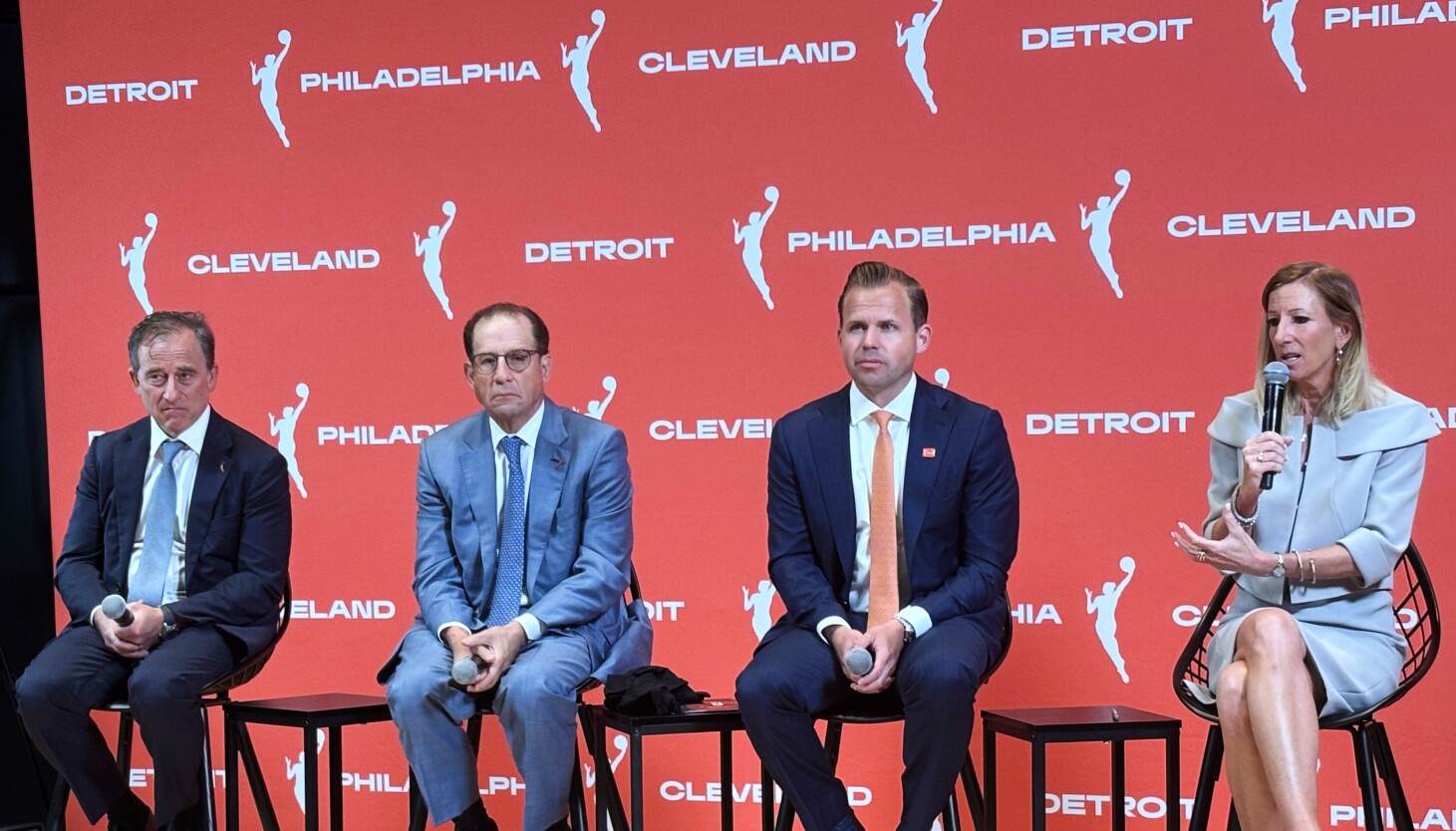
The Women’s National Basketball Players Association will meet with the WNBA during All-Star weekend in Indianapolis, with player pay at the heart of the negotiations. Both sides want to avoid a lockout, and the vibes seem good going in.
Union president Nneka Ogwumike expressed optimism about meeting in person, and vice president Napheesa Collier said she thinks they’ll be able to make strides.
“Sending contracts back and forth — a lot can get lost in translation,” Collier said Monday at Wintrust Arena.
It’s true — it’ll be nice to avoid the Zoom lags, maybe even share a pastry or two. But whether the league and union meet in person, by telegram or tweet, two little words still stand in the way:
Ownership structure.
Riveting stuff, huh? Bear with me.
Imagine running a business where, every time money came in, 58% of it went somewhere else. Doesn’t matter how well you perform, how much you grow or how many new fans you pull in, you’re not keeping most of it.
That’s the setup in the WNBA, where 58% of the league is owned by two outside groups: the NBA and a separate investment group that joined in 2022 (we’ll call it Group B).
For WNBA insiders, it’s just the air we breathe: Only 42% of revenue flows back to the league itself.
But to newcomers — or even longtime fans who haven’t done the math — it’s absurd.
In every other major U.S. sports league, teams split 100% of league revenue. But the WNBA’s “parent company” structure changes the math. Dramatically.
Take the WNBA’s new media deal, worth around $200 million annually. At first glance, it looks like a win.
On a per-player basis, the WNBA’s deal is within striking distance of the NHL’s and MLB’s:
MLB: about $2.3 million per player annually.
NHL: about $1.8 million.
WNBA: about $1.1 million (on paper).
That’s the kind of money players are aiming for. As union secretary Elizabeth Williams put it in June: “Nothing short of transformational change will do for the future we see.”
But here’s where those two little words come back.
Because the WNBA only owns 42% of itself, it doesn’t receive $200 million annually in the deal. It receives $84 million. The rest goes to the NBA and Group B.
With that kind of funky ownership structure, how are players supposed to get a fair share?
“It’s going to be really hard,” Collier told the Sun-Times. “When an outside source owns the majority of your league, it’s either not going to get there, or it’s going to take a very long time for [us to be] making the kind of money we want to make.”
Players are pushing for a revenue-share agreement where their pay would grow in proportion to the league’s.
But even if they win that fight — securing, say, half of the WNBA’s revenue — that’s still just 50% of 42% of the total pie.
So how about an outside-the-box solution?
What if some of the nearly $1 billion in upcoming expansion fees were used to buy out the NBA and Group B — so the WNBA could finally majority-own itself?
When the Sun-Times floated that idea to Williams, she laughed out loud.
She’s probably right that it’s a long shot. According to Ogwumike, the league isn’t even considering using expansion revenue for the players, let alone to restructure ownership.
And that’s just the league side. The NBA isn’t likely looking to give up control, either. Sure, it has spent 28 years complaining that the WNBA is a money loser, but now that its own viewership is stagnating and the W’s popularity is exploding, what a lovely little side investment it is.
And Group B? It bought in low, and now team valuations are climbing by the day. Why would it give that up?
So back to that meeting during All-Star weekend. Maybe some progress gets made. Maybe the vibes are good.
But those two little words still loom. Because when you’re talking about “ownership structure,” what you’re really talking about is control.
And a negotiation between two sides that aren’t fully in charge?
Well, hopefully the pastries are good.

The Sky’s 2026 season remains one giant question mark. Here’s what we know so far.
[month] [day], [year], [hour]:[minute][ampm] [timezone]
read
In her second game back, Reese helped Rose BC clinch a playoff spot. She said the league has been calling her the whole season to return.
[month] [day], [year], [hour]:[minute][ampm] [timezone]
read

As franchise valuations surge, early investors, longtime fans and players from the inaugural season reflect on what the Sky mean, and what they could become.
[month] [day], [year], [hour]:[minute][ampm] [timezone]
read