
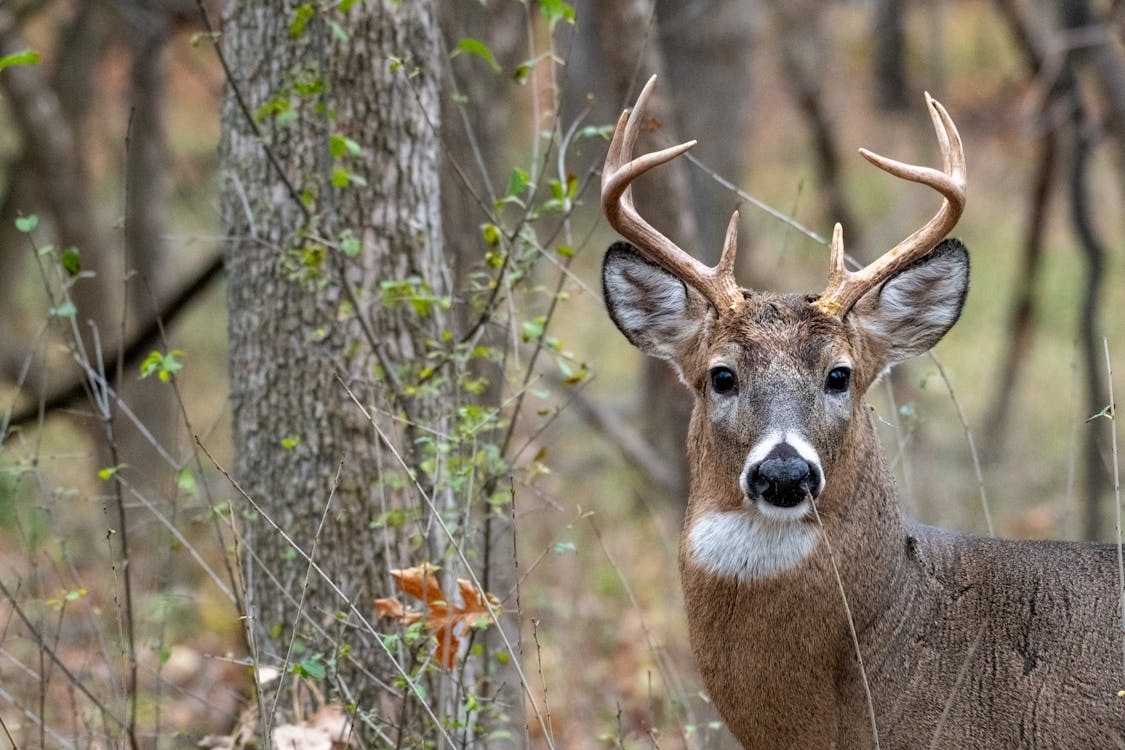
 White-tailed deer. Photo via Pexels
Each year, biologists from the Vermont Fish & Wildlife Department turn to a strange source to understand the health of the state’s deer population: teeth.
The state’s biologists have to balance maintaining the health of Vermont’s deer herd with the priorities of hunters as they draft hunting regulations for the following year. Understanding the age of the deer population is key to how the regulations are written, and the internal structure of the deer’s teeth produces precise age estimates.
“It gives us at least really good trend information and a pretty accurate picture of our deer population,” said Nick Fortin, the moose and deer project leader with the Fish & Wildlife Department.
The state’s White-Tailed Deer Tooth Collection Project relies on hunters to pull the teeth from their kills and mail them in, giving the biologists a record from across the state. Last year, more than 3,000 tooth samples were collected from the stations in the field and mailed in to Vermont Fish & Wildlife.
The teeth are sent to a lab in Montana, where they are sliced into thin segments and looked at under a microscope.
Hidden inside the microscopic structure of the roots of a deer’s front incisors is a record of that deer’s life. Like counting tree rings, biologists can accurately estimate the age of a deer, tracking its growth and health over its life span.
The technique produces an accurate age estimate 85% of the time, with a narrow margin of error. While deer age estimates have been tracked since the 1960s, the tooth sampling program that began in 2015 is far more accurate, according to Fortin.
That data is fed into projection models, adding in factors like hunting effort, deer sighting rates, winter severity and trends in the number of road-killed deer, to come to an estimate of the state’s total deer population. According to state biologists, from 2016 to 2025, annual statewide deer population estimates ranged from 130,000 to 155,000 deer.
The health and size of the deer population in the state have significantly improved in the last 10 years, according to Katy Gieder, a biometrician with the Fish & Wildlife Department. The overall health of the deer stock can be measured using metrics like weight, antler size and reproductive rates, in addition to the populations and age data. Gieder points to successful population management and less severe winters as reasons the deer population has improved.
Extended cold winters often kill off a portion of the deer population, and as winters have become less intense, the deer have benefited. Gieder said that this year’s unusually cold winter may cause a more significant die-off compared to recent years.
How external factors are affecting the deer population is hard to parse from the data, according to Gieder and Fortin. Yet quality habitat loss, disease, predation rates and climate change all affect the tenuous balance that Vermont Fish & Wildlife tries to maintain.
Land development trends can be seen in the population data, especially when comparing specific regions, according to Fortin.
The vast majority of bucks and does measured in the data provided by Vermont Fish & Wildlife were only a few years old when they were killed. The oldest bucks recorded in the deer teeth record were 12 years old, and the oldest doe was 20 years old, killed in the 2018 season.
Data from last year’s hunting season will be used to set the number of antlerless deer hunting permits for 2027, which will be released in April and May.
The state says that the health of the deer population in the state has steadily improved in recent years, yet some hunters have been disappointed in the quality of hunting in Vermont.
Chad Eaton, a hunter from Chittenden County, says that many Vermont hunters leave the state for New York and New Hampshire to find better deer hunting conditions. Hunters are looking for bigger, more mature deer, with large-antlered bucks being the prize for many.
Eaton said the limited amount of available hunting land, much of which is privately held, has diminished the quality of hunting in the state. He also pointed to regulatory changes that could improve things.
Some hunters, especially those with access to private land, have called for limiting the number of does allowed to be hunted, Eaton said.
The state has already released guidelines for the upcoming hunting season. One change that may have been informed by tooth data is this year’s restriction on hunting young bucks in a single wildlife management unit in the Northeast Kingdom, D1, which includes much of Orleans County. According to the state guidance, too many young bucks were being harvested in the unit, which resulted in a decline in mature bucks in the area.
Eaton acknowledges that the state is making its decisions based on science and that the average hunter is not thinking in terms of population health the way the state is. But he hopes that the state would make more of an effort to compromise with hunters.
“The state says there’s a deer epidemic in the state, but then every hunter I talked to, they could sometimes hunt the whole day and not see a deer,” said Eaton, referencing state officials’ assessment that there are too many deer in areas of Vermont. “So it’s hard for a hunter to hear there’s a deer epidemic, you know, when they’re not successful in their hunt.”