
The U.S. and Israel on Saturday launched sweeping attacks on Iran in an operation that killed Iranian Supreme Leader Ayatollah Khamenei, according to multiple media reports citing Israeli officials. Iran denied the reports.
President Donald Trump said he believed reports that Iran’s supreme leader was killed by airstrikes from U.S.-Israel attacks on Saturday are “correct,” contradicting Iran’s claim that Ayatollah Khamenei is still alive.
“We feel that that is a correct story,” Trump told NBC News. Israeli Prime Minister Benjamin Netanyahu earlier also said in a televised address that “signs are growing” that Iran’s supreme leader was killed, according to The Associated Press.
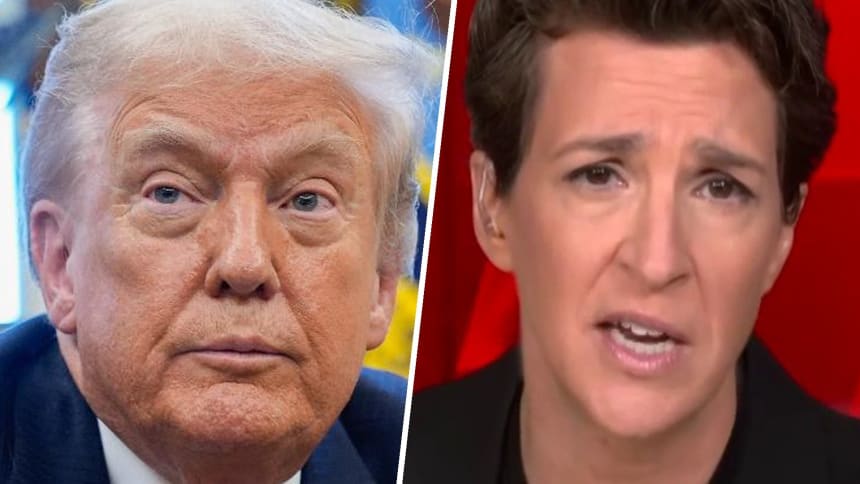
But Iranian Foreign Ministry spokesperson Esmaeil Baghaei told MS Now that both Iranian President Masoud Pezeshkian and Khamenei are “safe and sound.”
But Iranian Foreign Ministry spokesperson Esmaeil Baghaei told MS Now that both Iranian President Masoud Pezeshkian and Supreme Leader Ayatollah Ali Khamenei are “safe and sound.”
Play
Iran responded by firing retaliatory missile strikes on Israel and against U.S. bases in the Middle East region.
More than 200 people in Iran have been killed by Israel-U.S. strikes, according to the Iranian Red Crescent Society, and Iran’s state-run IRNA news agency reported that at least 57 students from a girls’ school in southern Iran were killed. U.S. Central Command spokesperson Capt. Tim Hawkins said in a statement officials are looking into “reports concerning civilian harm resulting from ongoing military operations.”
Central Command said the U.S. has so far fended off “hundreds of Iranian missile and drone attacks,” and that there are no reports of casualties or combat-related injuries among U.S. forces, with minimal damage to U.S. installations.
Trump announced “major combat operations” in Iran in a Truth Social post early on Saturday, which he said was aimed at stopping Iran from developing a nuclear weapon and protecting American personnel and interests abroad and at home.
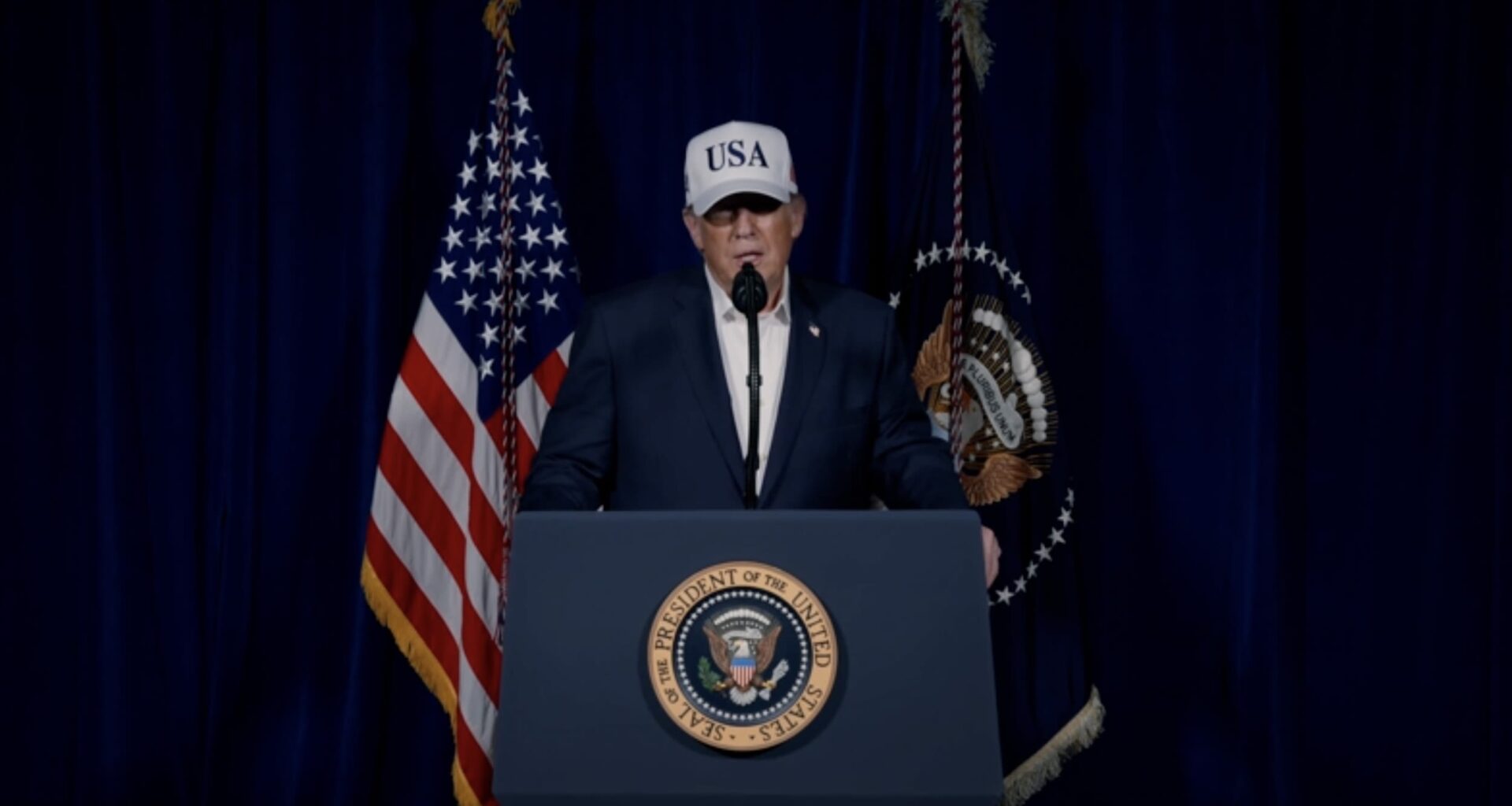
“Our objective is to defend the American people by eliminating imminent threats from the Iranian regime, a vicious group of very hard, terrible people,” Trump declared from behind a podium dressed in a navy suit and wearing a baseball cap emblazoned with “USA” on it.
Israel announced it was also participating in the military offensive, and The Associated Press reported that Israel had launched a daylight attack on Tehran, Iran’s capital, on Saturday. Israel Prime Minister Benjamin Netanyahu said the joint attack with the U.S. was aimed at ending “the threat of the Iranian ayatollah’s regime.”
Trump acknowledged there may be American casualties as a result of the U.S. military intervention labeled “Operation Epic Fury,” but said the mission was necessary to protect America and its allies in the future.
Trump acknowledged there may be American casualties as a result of the U.S. military intervention labeled “Operation Epic Fury,” but said the mission was necessary to protect America and its allies in the future.
Play
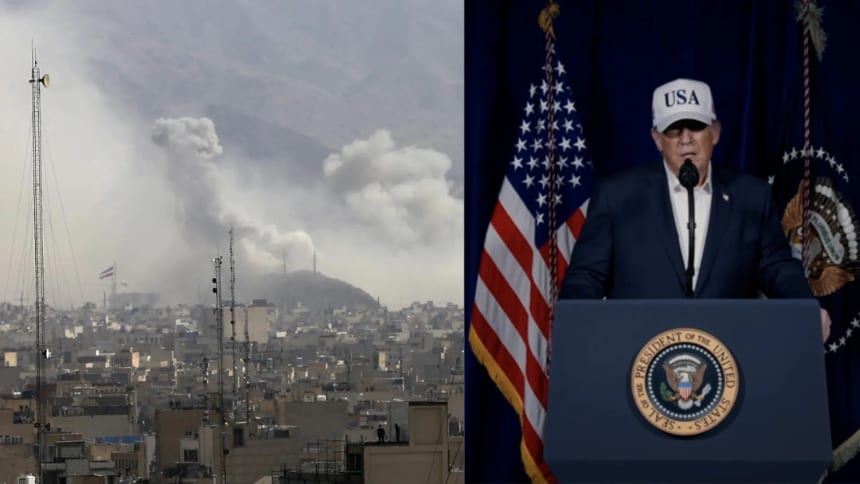
“The lives of courageous American heroes may be lost, and we may have casualties. That often happens in war,” Trump stated. “We’re doing this not for now. We’re doing this for the future and it is a noble mission.”
Trump told the Washington Free Beacon later on Saturday that he believed the operation was “going very well” and that he felt “fine” following the strikes against Iran.
Iran’s foreign minister, Seyed Abbas Araghchi, denounced the attack, saying, “Netanyahu and Trump’s war on Iran is wholly unprovoked, illegal, and illegitimate. Trump has turned ‘America First’ into ‘Israel First’—which always means ‘America Last’.”
White House press secretary Karoline Leavitt said the president “monitored the situation overnight” at Mar-a-Lago and had spoken with Netanyahu. “The President and his national security team will continue to closely monitor the situation throughout the day,” she said in a statement.
In an early morning interview with The Washington Post after announcing the strikes, Trump said he wanted “freedom” for the Iranian people.
This is the eighth military intervention of Trump’s second term in office and runs counter to his campaign promise to end costly foreign wars. The president set broad goals in his video address and called for the Iranian Revolutionary Guard and Iranian military forces to lay down their arms, making clear this was not a limited U.S. attack. Indeed, he called it “massive” in the video statement.
“We will ensure that Iran does not obtain a nuclear weapon…this regime will soon learn that no one should challenge the strength and might of the U.S. Armed Forces,” Trump said.
The airstrikes began at the start of Iran’s workweek. The country’s foreign ministry claimed the U.S. and Israel had targeted “defensive and civilian facilities” and that the offensive occurred while Iran was “engaged in a diplomatic process” with the United States.
Strikes were reported in Dubai and Kuwait. Officials from Qatar, the United Arab Emirates and Bahrain, where the U.S. has military bases, said separately that missiles were intercepted in their airspace.
Play
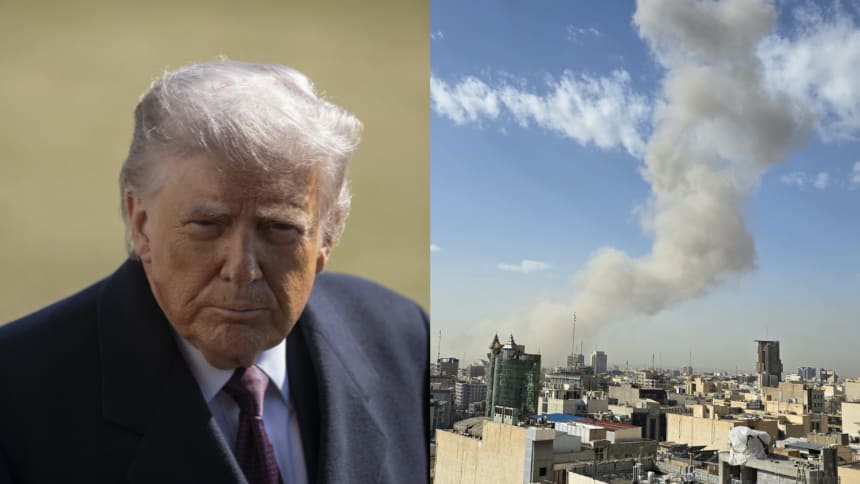
Iranian-backed Houthi rebels in Yemen announced that they would resume strikes on shipping in the Red Sea, which drove up shipping prices in the past.
Iran’s Tasnim News Agency reported that the Strait of Hormuz, a narrow waterway through which roughly 20% of the world’s oil supply passes, has closed amid strikes. Only 21 miles wide at one point, the strait’s closure, or the limiting of oil tankers passing through it, could increase oil prices globally.
The United Nations Security Council will meet at 4 p.m. ET to discuss the developing situation in Iran and the Middle East, according to an advisory.
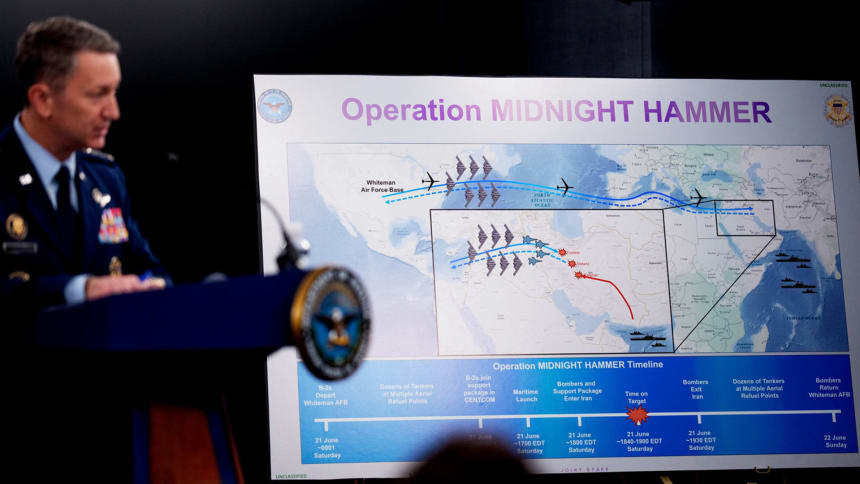
Trump pointed to the on-again-off-again nature of negotiations with Iran over its nuclear operations, and said the government had “rejected every opportunity to renounce their nuclear ambitions.” He stated the country had attempted to rebuild its nuclear industry following U.S. attacks on its nuclear facilities in Operation Midnight Hammer.
“We can’t take it anymore,” Trump said, warning that Iran was continuing to build long-range missiles that could not only threaten U.S. allies in Europe but “could soon reach” U.S. shores.
Recommended
The attack caught diplomats who had been involved in negotiations over the past several weeks off guard.
“I am dismayed,” Omani Foreign Minister Badr bin Hamad Al Busaidi said Saturday, after just a day earlier expressing optimism that the talks he had mediated between the U.S. and Iran had made significant progress. “Active and serious negotiations have yet again been undermined. Neither the interests of the United States nor the cause of global peace are well served by this. And I pray for the innocents who will suffer. I urge the United States not to get sucked in further. This is not your war.”
Trump called on the Iranian people to take action, describing the U.S. military offensive as “their moment for action” and “probably your only chance to act for generations.” The operation comes in the wake of a brutal crackdown by the Iranian regime on civilians after nationwide protests against the government.
“Bombs will be dropping everywhere. When we are finished, take over your government. It will be yours to take,” Trump declared.
Democrats condemned Trump’s unilateral decision to attack Iran without consulting the American public, lawmakers or seeking congressional authorization. “The president owes the country clear answers: What is the objective? What is the strategy to prevent escalation? And how does this make Americans safer?” Sen. Mark Warner, D-Va., the ranking member on the Senate Intelligence Committee, said in a statement Saturday, noting that Trump himself acknowledged that “American heroes may be lost.”
“That alone should have demanded the highest level of scrutiny, deliberation, and accountability, yet the president moved forward without seeking congressional authorization,” Warner said. “The Constitution is clear: the decision to take this nation to war rests with Congress, and launching large-scale military operations – particularly in the absence of an imminent threat to the United States – raises serious legal and constitutional concerns.”
But Warner was among members of the so-called Gang of Eight congressional leaders from both parties who were contacted by Secretary of State Marco Rubio in the hours before the strikes, according to multiple sources familiar with the calls. Rubio was unable to reach at least one of the leaders who did not answer the call, but he spoke to House Speaker Mike Johnson, Senate Majority Leader John Thune, House Intelligence Committee Chairman Rick Crawford, R-Ark., and Rep. Jim Himes, D-Conn., the ranking member on that panel.
Rubio also consulted the Gang of Eight during an hour-long briefing on Tuesday, one U.S. official said.
Still, key congressional members were outraged by the action, including Sen. Tim Kaine, D-Va., sponsor of a War Powers Resolution that had been set for a vote this week aimed at reigning in the administration’s ability to undertake such actions.
“Has President Trump learned nothing from decades of U.S. meddling in Iran and forever wars in the Middle East?” Kaine said in a statement Saturday morning. “Is he too mentally incapacitated to realize that we had a diplomatic agreement with Iran that was keeping its nuclear program in check, until he ripped it up during his first term?“
Mounting tensions
Trump and Khamenei, Iran’s supreme leader, had each threatened the other with military action in recent weeks. Trump had called for regime change and signaled plans for a second direct attack on the Islamic Republic to be carried out by what the president promised would be a “massive armada.”
Play
The second offensive in eight months comes after Trump repeatedly and publicly urged Iran to accept his terms for a nuclear weapons agreement and threatened retaliation if it did not. At the first meeting of his new “Board of Peace,” Trump warned “bad things will happen” if Iran did not agree to a nuclear program deal.
In the first strikes, Trump directed U.S. forces to bomb three nuclear sites in Iran in June 2025. A U.S. intelligence report said Iran’s nuclear program was set back only a few months — not “completely and fully obliterated” as Trump had claimed.
The U.S. government issued a security alert on Jan. 12, directing Americans to leave Iran by land immediately on the heels of the government’s bloody crackdown on demonstrators amid a worsening economic crisis. Several foreign embassies in Tehran, including the British embassy, have since temporarily closed or reduced operations.
This is the Trump administration’s second major foreign intervention. Earlier this year, U.S. forces captured Venezuelan President Nicolás Maduro and his wife, Cilia Flores, in an operation that killed nearly 40 people. The U.S. has also struck dozens of boats it accused of illegal narco-trafficking in the Caribbean Sea and eastern Pacific Ocean, killing 144 people, according to a MS NOW tally based on U.S. government figures.
Ian Sherwood contributed to this report.
This is a developing story. Please check back for updates.

Clarissa-Jan Lim is a breaking news reporter for MS NOW. She was previously a senior reporter and editor at BuzzFeed News.

David Rohde
David Rohde is the senior national security reporter for MS NOW. Previously he was the senior executive editor for national security and law for NBC News.

Erum Salam is breaking news reporter for MS NOW, with a focus on how global events and foreign policy shape U.S. politics. She previously was a breaking news reporter for The Guardian and is a graduate of Texas A&M University and the Columbia University Graduate School of Journalism. Follow her on X, Bluesky and Instagram.

© 2026 Versant Media, LLC
