
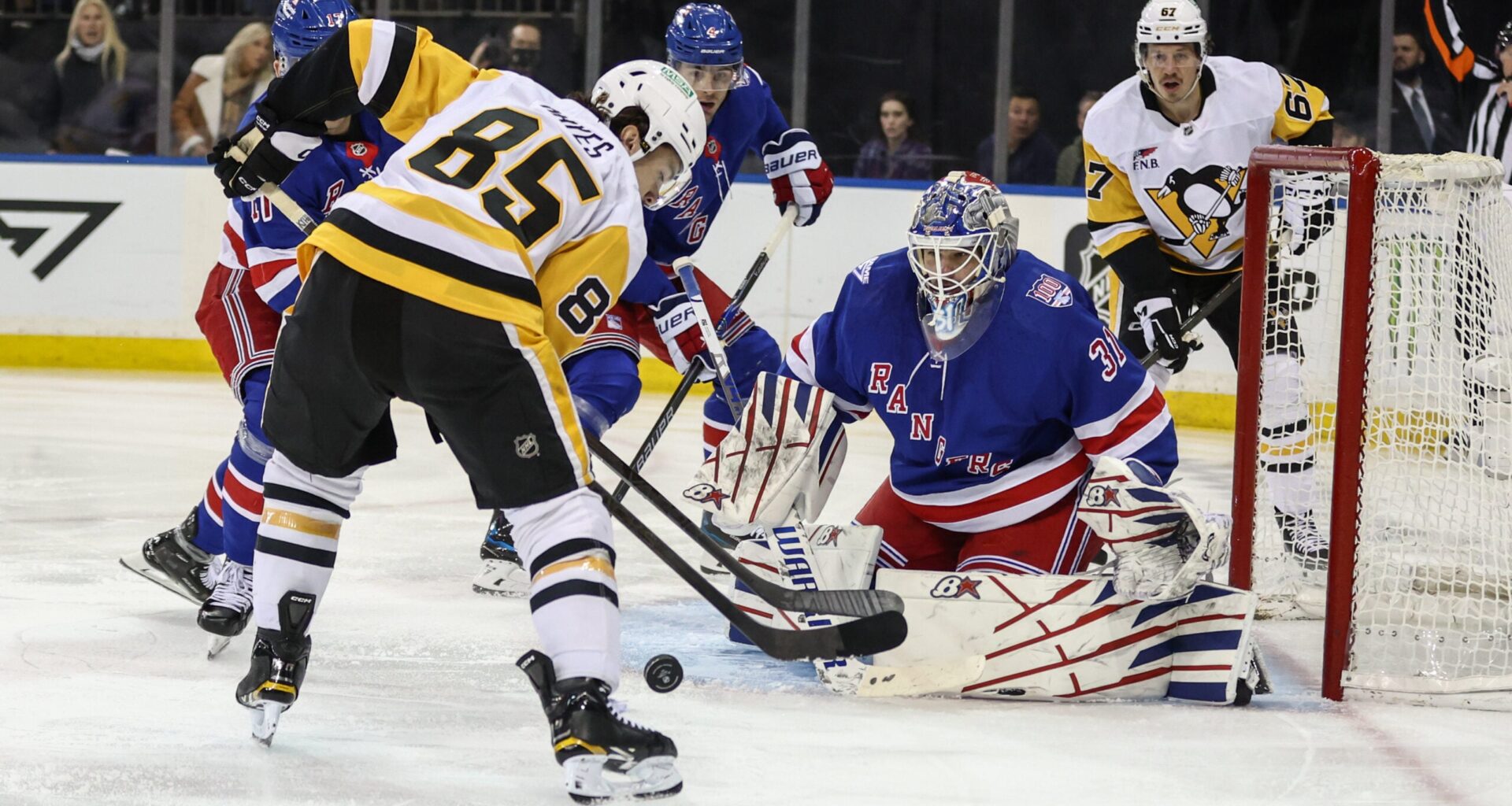
What exactly is goaltender interference? The Pittsburgh Penguins are not only 0-for-6 on challenges, but Saturday, they had one taken away on a gooey soft call that was the hockey equivalent of the goodness inside an Atloona-made Mallow Cup. And it cost them dearly.
Ultimately, the Penguins needed the goal taken away as they lost to the New York Rangers 3-2 in a shootout Saturday at Madison Square Garden.
“Yeah, I’m not sure what to make of it anymore,” Penguins coach Dan Muse said.
It was not that Anthony Mantha and New York Rangers goalie Igor Shesterkin didn’t ever so slightly tangle at the wrong moment, but it was more about consistency. The Penguins were on the wrong side of another goalie interference challenge as New York had a Bryan Rust goal overturned in the first few minutes of the game, and the call proved to be crucial in the loss.
The Penguins were dominating and the Rangers were flat. Perhaps flat would have been a compliment. They were lifeless, and the goal would have been the Penguins’ second within the first few minutes of the game, likely sending the Penguins on a run and New York on a tailspin.
The Penguins eventually got a 2-0 lead, but the Penguins were denied the additional early goal in what likely would have been a fatal dagger.
And it all came apart later as the Penguins needed to hang on for an extra time point. .
“I thought we got away from what was working the first period for us. I thought we did a good job in terms of supporting pucks. When we’re doing that, we’re getting out of the zone; we were ending up in the offensive zone. I thought we extended the time in the offensive zone. I thought we did a good job in terms of our gaps, tracking back,” Muse said. “And we got away from what was working. And I thought a lot of those elements, I just said that worked well in the first period, they weren’t there in the second and third.
“And so that’s on us. There’s going to be momentum swings in the game. We just didn’t react the (right) way … So it’s can’t happen.
In fairness, the game did go to a shootout, where the Penguins are now 1-8 this season. Goalie Stuart Skinner stopped two of three, but in what has been a too frequent occurence in the situation, the Penguins failed to score.
However, a shootout is a shootout. It’s not hockey. It’s a separate competition to end the game and has little resemblance to the game itself. Having lost eight of nine shootouts, it is fairly definitive that the Penguins stink at them, but that has no bearing on their viability as a team.
Equally bad is the Penguins’ record with challenges. Not only are they 0-for-6, but they even lose ones that seem much less than goals they’ve had taken away (See also: Rickard Rakell being called for GI this season, despite not being in the crease and making great effort to avoid the goalie before a contacting defenseman’s stick hit the goalie).
“Yeah, it feels like whenever something like that does happen to us, it’s called a goal, and we’re back in the (penalty) box,” Skinner said. “But I mean, when things like that happen, it always comes back, and you get favor later on. So if that works our way in the playoffs, then, I mean, we’ll take that over a regular season.”
Penguins Analysis
Beyond the goalie interference nonsense, the Penguins were great. And then…terrible for most of the final 40 minutes. Actually, they didn’t deserve a point, but Skinner made a bevy of beauts.
The first period was the best of the Penguins, even without injured captain Sidney Crosby.
Pittsburgh native and gold-medal winner Vincent Trocheck delivered another Penguins power play early in the first period due to Abuse of Officials. Conversely, the Penguins could have been penalized for abuse of a corpse.
The Rangers were a zombified blue-clad version of themselves, watching the Penguins escape the zone with easy breakout passes and available stretch passes, which kept the possession on the Penguins’ sticks and in the Rangers’ zone.
Their attacks focused on the strong side, then evolved to precision passing and skill passes that made the Rangers spectators.
However, the Penguins did not take advantage of their significant 10-2 shot advantage, goaltender interference notwithstanding.
And the second period devolved quickly after Ryan Shea was twirling, twirling, twirling toward freedom from a defender near the blue line. Shea earned his fourth goal of the year at 1:59 of the second period, and it appeared the Penguins were firmly in control of the afternoon tilt.
But then it was the Penguins’ nap time, and those easy breakouts became passes that were too cute, scrambly defensive zone coverage, and the Rangers suddenly controlled play.
“I mean, yeah, when we lead, 2-0, you know, we start playing a little bit too cute,” Malkin said. “But they have a good team. They play hard. I mean, they play physical, and Igor (Shesterkin) played well, you know, it’s like we have a chance to win and–that goal. Why is it interference? Sometimes it’s interference. Sometimes not.
“I’m not understanding the rule.”
The Penguins did just enough to survive with sticks in lanes, good defensive body position, and battles to hamper moments when the Rangers were threatening, but rarely did they thrive.
In a nod to both the Penguins’ puck possession through the first 25 minutes and their struggles thereafter, the team had just seven hits after the second period. By comparison, Connor Clifton had seven hits Thursday.
No Penguins player had more than two hits Saturday.
Penguins Report Card
Team: D
They avoided an F with a good first period. Their breakouts were good and generated speed. They were holding onto pucks and pressuring the Rangers’ defense around the net. And then, they were sloppy wreck with passes through traffic, trying one too many passes, and not playing with aggression.
Best Performances
Stuart Skinner: A
“He’s the reason we got a point,” said an angry Muse. Skinner said he felt out of sorts for the first part of the game, but had his legs back by midway through the second. He made a few dandies, especially in the third period.
He also allowed only one shootout goal. That’s a solid performance because two out of three ain’t bad.
Evgeni Malkin: B+
A few too many errant passes and a couple shots passed up. Otherwise, he was by far the best Penguins forward. By far.
Malkin charged the net in overtime. He created pressure during his shifts in the third period, but the Penguins were badly on their heels and failed to sustain the offensive attack, thus forcing Malkin to start his shifts in the defensive zone and limiting his time in the fun zone.
Needs Improvement
Top Line: D
With Rickard Rakell at center, the line had a couple of good shifts early. Avery Hayes chased pucks like a hungry dog (that’s a good thing), but the line again failed to generate consistent offensive pressure.
Girard-Letang
It’s early for the pairing, but they are confirming the worries that they’re poorly matched. Kris Letang had a mere 23% Corsi Saturday, the worst of all of the defensemen. The second worst was Girard at 33%.
The pair significantly lagged behind their peers.
Tags: Penguins Analysis penguins goaltender interference Pittsburgh Penguins
Categorized:Penguins Analysis