
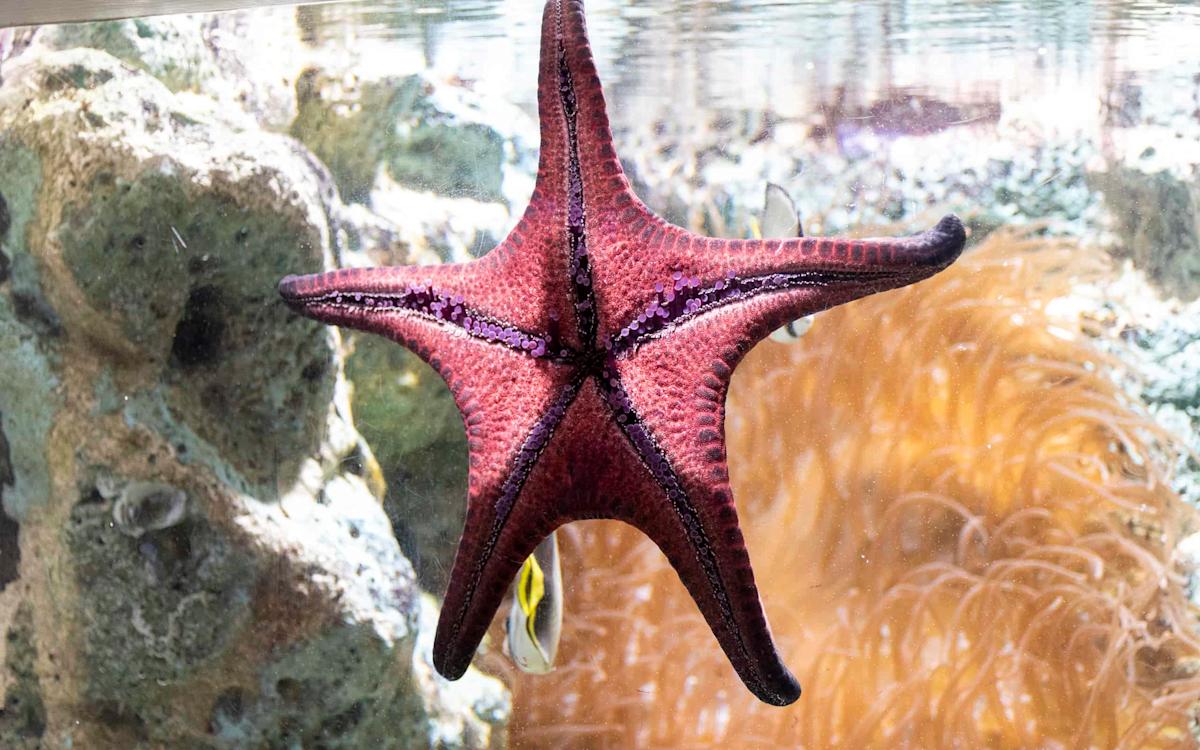
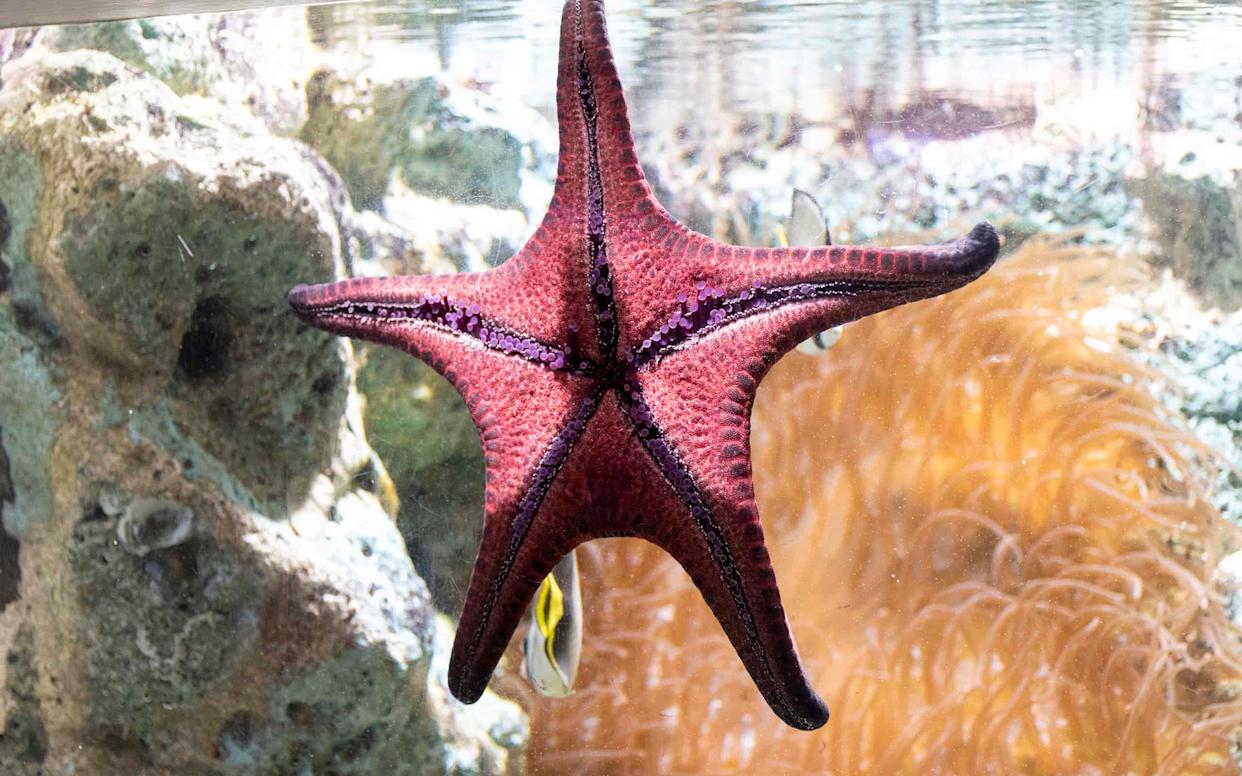
Red starfish in the aquarium© Ratchapon Supprasert/iStock via Getty Images
Quick Take
Most animals have a bilateral body plan (two sides, a clear head, and a tail), but the starfish has a unique radial symmetry that has confused scientists for generations.
Recent discoveries of the 500-million-year-old Atlascystis acantha show that starfish slowly evolved from bilaterally symmetrical ancestors.
Having a five-sided body helps starfish sense their surroundings and crawl in any direction quickly.
A starfish’s body is organized so that its mouth, stomach, and senses are all packed into one central hub.
Imagine waking up to find your entire body gone — no torso, no limbs — just a head that has expanded, split into five distinct sections. That sounds like a horror film or a scene from science fiction. It’s also, biologically speaking, a fairly accurate description of a starfish.
For centuries, these five-pointed marine animals baffled scientists. Nearly all animals on Earth follow a bilateral body plan: two sides, a clear head, and a tail. But starfish — with their radial symmetry and seemingly limb-like arms — don’t fit the mold.
Now, thanks to recent fossil discoveries and cutting-edge genetic mapping, researchers have uncovered something extraordinary: starfish don’t have five arms, at least not in the traditional genetic sense. Genetically, starfish are composed almost entirely of head-like tissue; essentially, one massive, circular head.
The Genetic Discovery: Where Did the Body Go?
Most animals develop according to a familiar blueprint: head at one end, tail at the other, torso in between. This organization is controlled by Hox genes — genetic “zip codes” that tell an embryo where to build specific body parts.
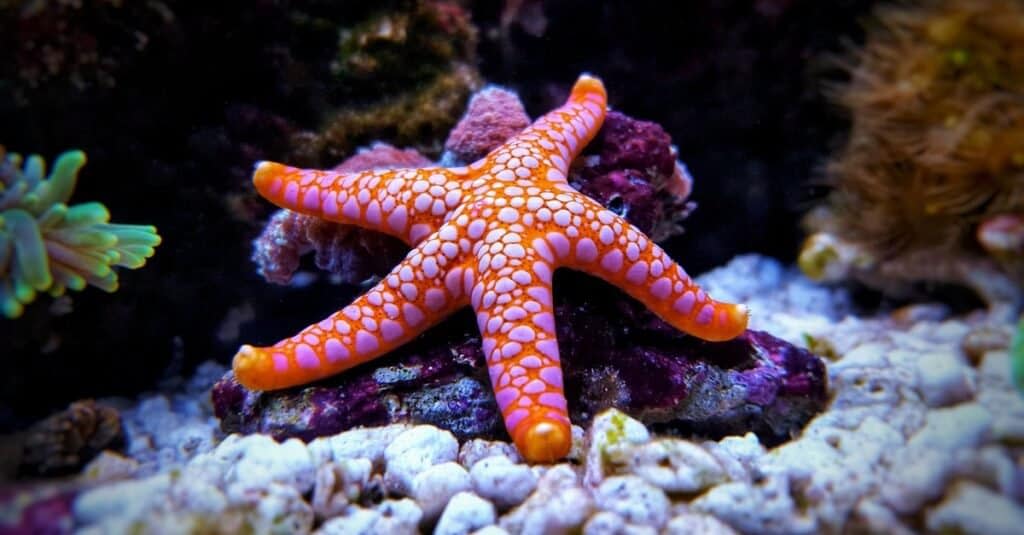
A starfish’s “arms” are actually extensions of its head, called ambulacra.
©Vojce/Shutterstock.com
(Vojce/Shutterstock.com)
In a 2023 study published in Nature, researchers used spatial transcriptomics to create a 3D map of gene activity in developing starfish. They expected to find the usual boundary between head genes and trunk genes — but they didn’t.
The genetic signatures associated with a torso and tail were largely absent. Instead, the outer body of the starfish expressed genes typically associated with the front and midbrain in bilaterally symmetrical animals. Each of the starfish’s “arms” carries head-related genetic markers rather than limb markers. These animals lack a clear genetic torso, and the body plan appears to be almost entirely head tissue.
The tube feet lining each arm function as extensions of the expanded head, allowing the animal to move, sense, and hunt. Rather than evolving by adding limbs to a body, the starfish seems to have expanded its head region outward into a five-pointed circle.
Essentially, from a genetic perspective, the starfish doesn’t have arms; instead, it is a single, five-pointed head that walks along the sea floor. Instead of growing arms, it simply grew more head tissue.
The Missing Evolutionary Steps
The recent discovery of Atlascystis acantha — a 500-million-year-old fossil from the Cambrian period — has helped solve a major piece of the starfish’s evolutionary puzzle. Preserved in remarkable detail, this fossil acts as a “missing link.” It reveals transitional anatomy linking early worm-like ancestors to modern echinoderms.
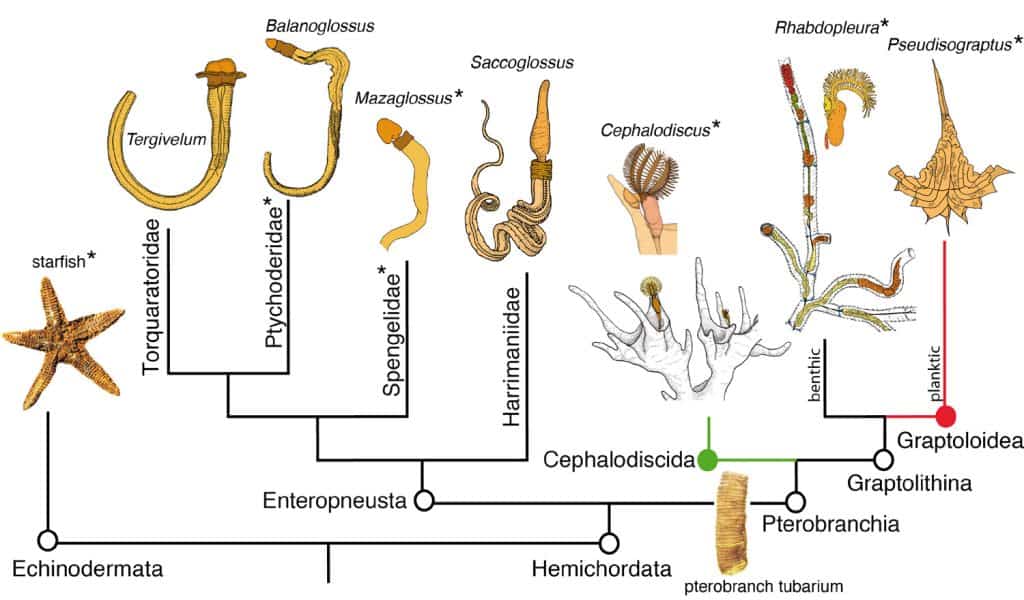
The new fossils were discovered in Morocco.
©Published by Maletz, J., & Cameron, C. B. / CC BY 4.0 / Wikimedia Commons – Original / License
(Published by Maletz, J., & Cameron, C. B. / CC BY 4.0 / Wikimedia Commons)
Scientists discovered that the five-pointed “arms” of a starfish (known as ambulacra) did not appear all at once. Instead of suddenly jumping from two sides to five-way symmetry, the starfish’s body plan shifted through a specific series of anatomical changes.
Evolution began with an ancestor that had two symmetrical arms on a two-sided body. Over time, this plan was reduced to just one dominant arm. This single arm then duplicated into three and eventually expanded into the five-fold arrangement seen in modern starfish.
Rather than springing into existence as five-pointed stars, these animals gradually reshaped an originally two-sided body plan into something radically different. The fossil record confirms that starfish share a common bilateral ancestor with other animals. They didn’t “skip” evolutionary stages — they radically modified them.
Rethinking Complexity Through Subtraction
For generations, biologists assumed complexity meant adding more parts. But the starfish challenges that assumption. Instead of building new structures onto a standard head-torso-tail framework, its lineage appears to have reduced or eliminated the trunk while expanding head tissue into a circular form. Evolution didn’t simply add new features; it reorganized them.
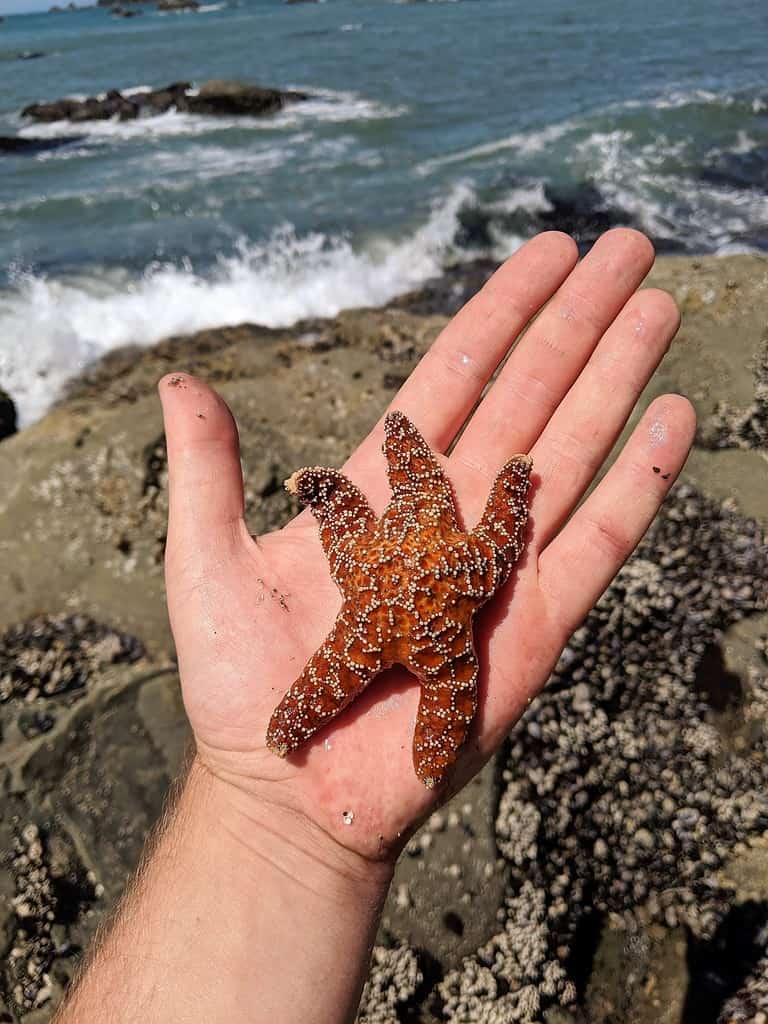
Starfish are carnivorous animals and eat oysters, clams, mussels, and coral.
©Aaron Telesz/Shutterstock.com
(Aaron Telesz/Shutterstock.com)
This insight is reshaping how scientists understand the entire echinoderm family. If starfish are essentially expanded heads, researchers are now investigating whether sea urchins might be spherical heads protected by spines, or whether sea cucumbers represent elongated versions of the same basic plan.
Why Five Arms?
Understanding how this body plan evolved still leaves an important question: how would losing a torso give the starfish an advantage?
Five-fold radial symmetry offers distinct ecological advantages that a traditional two-sided body plan cannot match. Because a starfish is circular, it can sense its surroundings and move in all directions immediately. Unlike animals with a clear front and back, a starfish never needs to turn around to reach food or escape a predator. It simply shifts its leading arm toward or away from the target.
Each of the starfish’s arms acts as a sensory outpost. At the tip of every arm sits a light-sensitive eyespot that helps the animal navigate its environment. Additionally, specialized sensory structures located along the tube feet constantly monitor the water for chemical cues. This allows the starfish to “taste” or “smell” its way toward a meal from any direction.
This unique body design is highly effective for life on the turbulent ocean floor, where strong waves and currents often threaten to sweep marine life away. While a long, two-sided body might catch the current like a sail, the flat, multi-pointed shape of a starfish allows it to hug the ground securely. To stay anchored, starfish use specialized tissue that can quickly switch from flexible to rigid. This allows them to lock their bodies firmly in place without continuously exhausting their muscles.
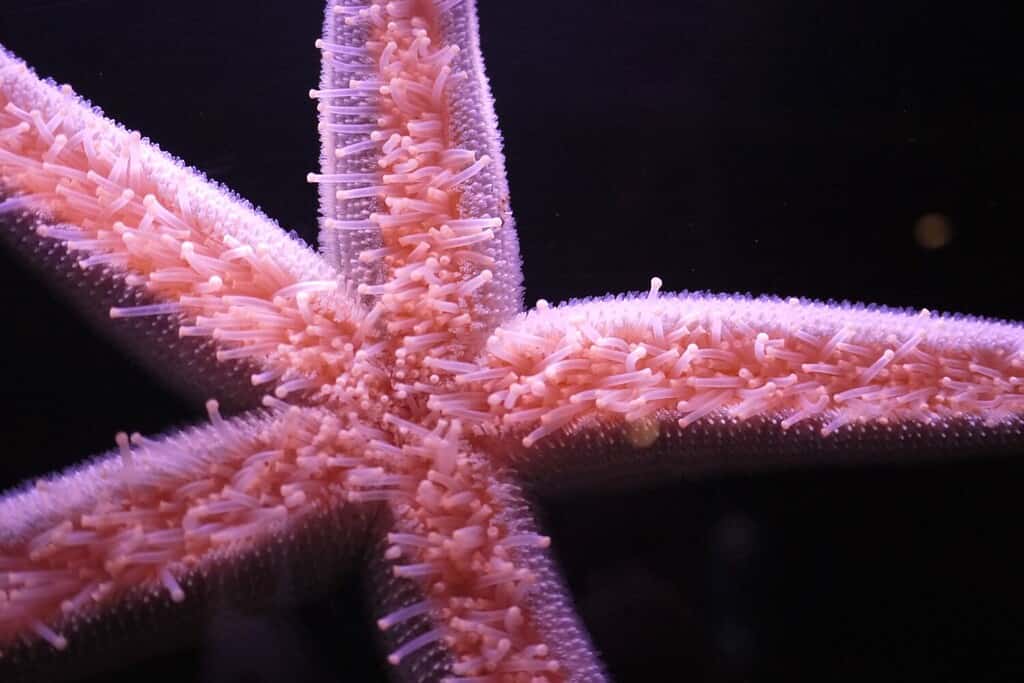
A single starfish can have hundreds and even thousands of hydraulic tube feet.
©LifeisticAC/Shutterstock.com
(LifeisticAC/Shutterstock.com)A Radical Success in Design
The starfish’s body is essentially a mobile feeding system. Because its mouth is located directly in the center of its underside, the animal can use its entire body to overpower prey. When it finds a clam, it wraps its body around the shell and uses hundreds of hydraulic tube feet to apply steady, relentless pressure. As soon as the shell cracks open slightly, the starfish pushes its stomach out through its mouth and into the prey. It then digests its meal outside its body before pulling the nutrients back in.
Instead of a central brain, a starfish operates using a decentralized nervous system. A thick ring of nerves encircles the mouth, with individual radial nerves extending along each arm. Information moves through this circular network rather than coming from a single command center. If one arm detects a chemical scent from food, it sends signals through the nerve ring. These signals then coordinate the rest of the body to move toward the meal.
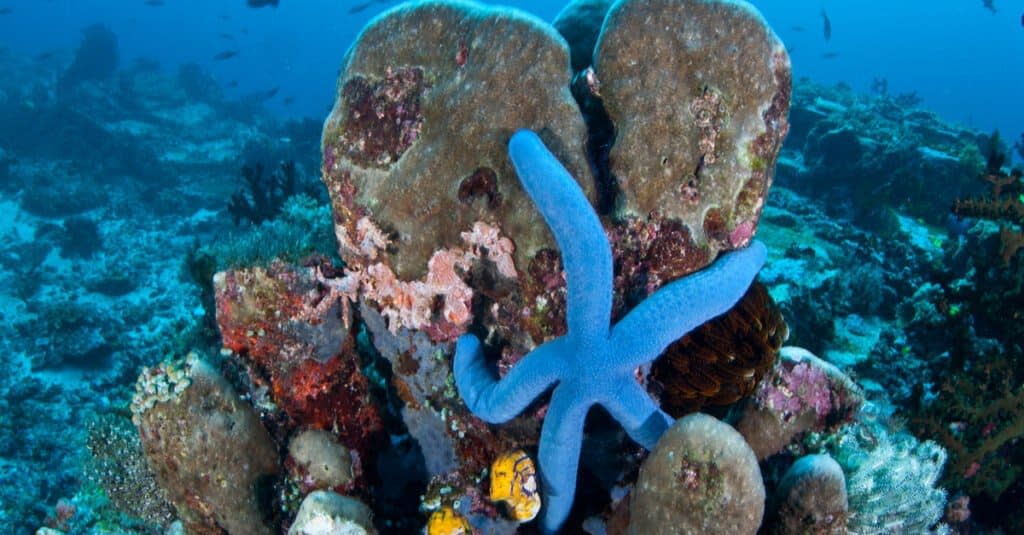
Starfish are also commonly called sea stars.
©Ethan Daniels/Shutterstock.com
(Ethan Daniels/Shutterstock.com)
This uniquely distributed organization also makes the starfish incredibly resilient. Because vital functions are spread throughout the body rather than concentrated in one head, losing an arm is rarely a fatal injury. Most species can fully regrow damaged limbs, and some can even regenerate an entirely new body from a single severed arm.
The starfish challenges our traditional understanding of how animal bodies work, proving that evolution doesn’t always involve adding new parts; sometimes, it involves shrinking, expanding, or completely repurposing existing structures. While the starfish may look like a biological oddity, it is actually a highly successful experiment in survival — an ancient head that moved on from its body and thrived.
The post The Evolutionary Mystery of Starfish Arms appeared first on A-Z Animals.