
Scent is essential to ant society: every ant within a colony wears the badge of membership in the form of smelly hydrocarbons. Human air pollution, a new study from Max-Planck Institute researchers suggests, is wreaking havoc on ant society by interfering with these characteristic scents.
Each ant species’ perfume is formed from stable alkanes, plus a colony-specific mix of alkenes. Unfortunately, these alkenes very easily react with ozone, an oxidant pollutant that has increased in the air thanks to human activity.
Outside urban areas, ozone levels usually only reach concentrations of around 10 parts per billion, while city air can contain anywhere from 30 to 200 parts per billion, depending on pollution levels.
“We wanted to know if exposure to increased ozone levels would alter the ants’ odor signature, resulting in aggression upon their return to the colony,” the study’s lead author, Nan-Ji Jiang, says.
Indeed, it did. The team exposed ants from six different species to ozone-polluted air at a dose of 100 parts per billion, on par with polluted cities during summer.
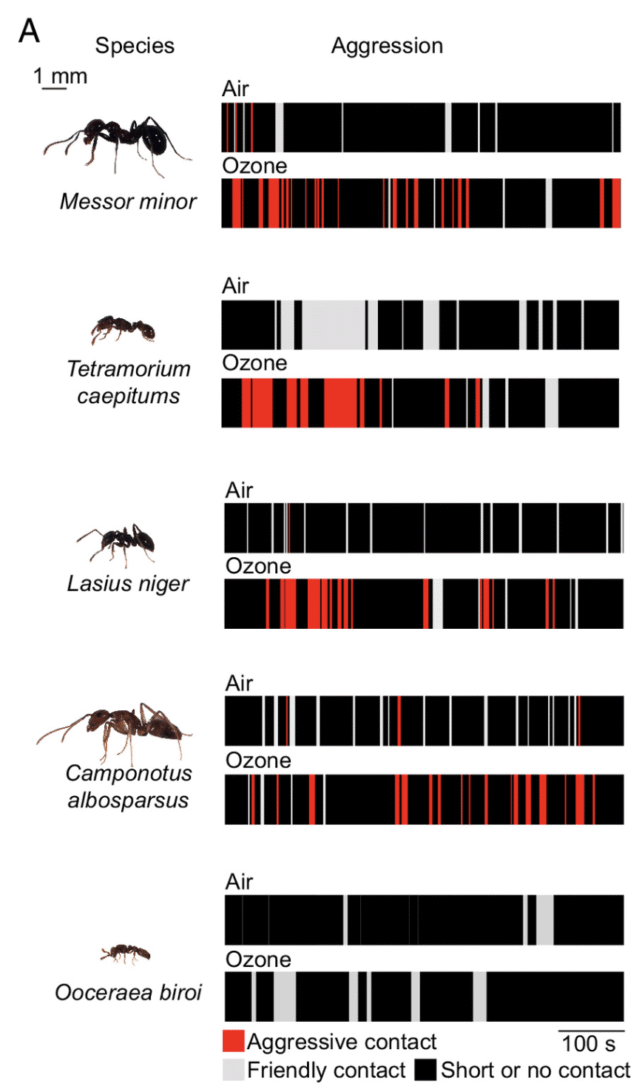 Tested ant species and example traces of friendly or aggressive contacts toward reintroduced ants that were exposed to air containing 100 ppb of ozone. (Jiant et al., PNAS, 2026)
Even just 20 minutes of exposure to urban levels of ozone had a major impact on the ants, degrading the alkenes that help them recognize friend from foe.
Alkene degradation occurred in the cuticular hydrocarbons of all six ant species investigated; in five of those species, it compromised nest-mate recognition so much that ants from the same colony threatened and attacked their ozone-exposed peers.

“We had expected that ozone exposure would affect the recognition of nest mates, as we knew that ants carry at least small amounts of easily degradable alkenes on their body,” chemical ecologist Markus Knaden says.
“However, we were surprised by the dramatic change in behavior after ants had been exposed to ozone. Apparently, despite their small quantity, alkenes are extremely important for the specificity of the colony odor.”
In a separate experiment, small but functional ant colonies and the broods of larvae they were caring for were exposed to urban-level ozone. This pollution “corrupted brood care behavior within ant colonies, resulting in the death of larvae,” the authors report.
There are around 30,000 ant species in the world, and scientists estimate they make up about the same amount of biomass as all birds and mammals combined. They till our soils, disperse seeds, and clean up the environment. And their societies are so complex, we could stand to learn a thing or two from them.
Related: Ant Queens Produce Offspring of Two Different Species, Stunning Scientists
While global insect decline is often associated with pesticides, climate change, and habitat loss, this study is a reminder that we may be interfering with insect societies in ways we haven’t even considered.
“The oxidizing pollutants like ozone have already been shown to corrupt interactions of flowers and their pollinators as well as sex pheromone communication in multiple species of flies,” the authors write.
“Our data suggest that the detrimental effects of oxidant pollutants may be even more far-reaching by jeopardizing the functionality of eusocial colonies.”
The research was published in Proceedings of the National Academy of Sciences.