
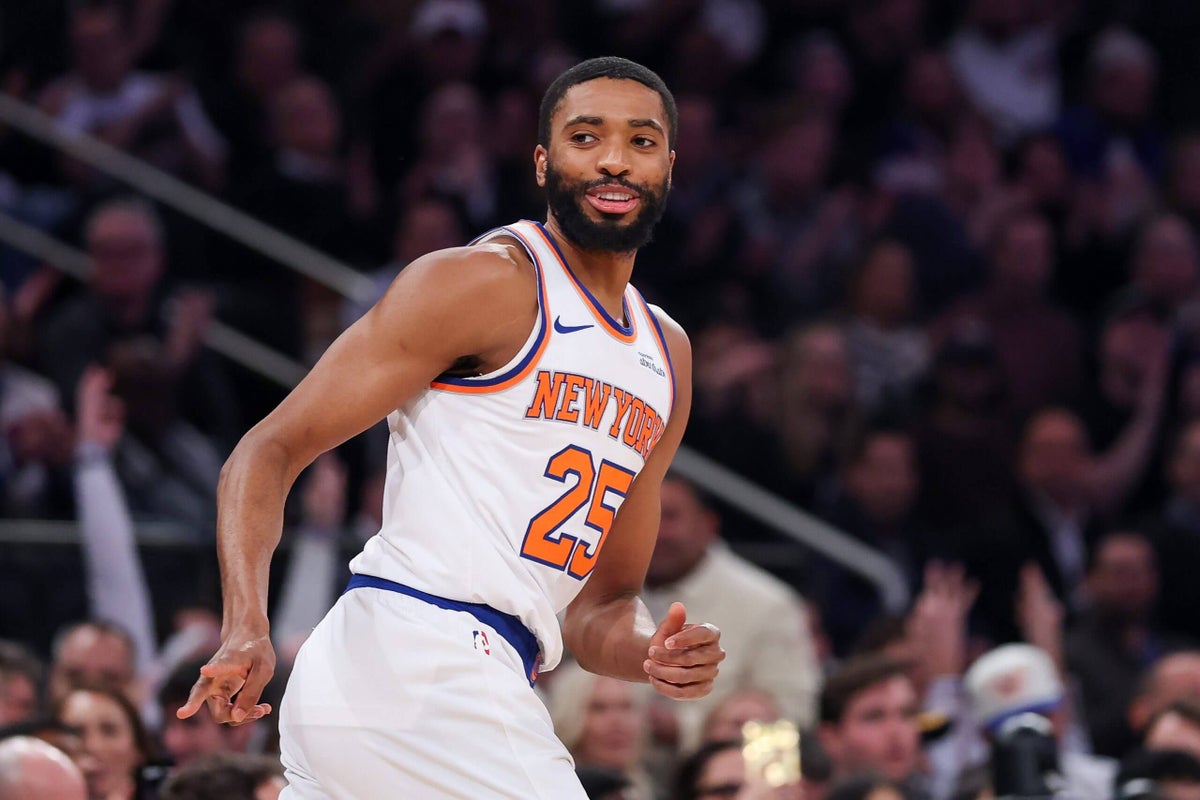
NEW YORK — If hypotheticals about what could have been are a good dream for New York Knicks fans, then Mikal Bridges is the alarm clock that startles them awake.
If New York didn’t trade five first-round picks for Bridges, who has never been an All-Star, maybe Giannis Antetokounmpo is already a Knick. If New York didn’t mortgage its assets last summer to get Bridges, maybe a slightly-flawed roster is a little less creaky.
Instead, the Knicks and their fans live in a reality where, when that alarm sounds, Bridges is here and has to work out. Winning a title is the only way to justify such a trade — a trade that, on a surface level, is nearly impossible to rationalize for Bridges or roughly 434 other NBA players who don’t fall into the elite category of players who might vindicate trading lock, stock and barrel for them.
All things considered, dreams versus reality is what makes Bridges’ season so complicated. To the naked eye, Bridges is having a solid season: He’s shooting nearly 50 percent from the field, 39 percent from 3 and averaging 1.5 steals per game, which is the second-best mark of his long career. There are games when it’s clear where the best version of Bridges can take New York, as made obvious in Sunday’s dominant 114-89 victory over the red-hot San Antonio Spurs, a game in which he scored 25 points and had five steals in 33 minutes. He jumped a Victor Wembanyama post-up attempt and took off the other way like a bandit. Bridges had a one-pass-away denial that he converted into a steal.
Then, to the trained eye, there are nights when you forget he’s playing. There are games when you wonder if his minutes should be limited. Then you remember it took five first-round picks to get him.
“It’s just a process — new coach, new system, both offensively and defensively,” New York head coach Mike Brown said of Bridges’ season following Sunday’s win. “Not only that, but a new team and more guys behind him. Landry (Shamet) didn’t play much last year. (Miles) McBride didn’t play much last year. We got Jose (Alvarado) and we can move Jalen (Brunson) to the two-guard. There’s different ways we can go, and whether it’s Mikal or this guy or that guy, if we need to make a change over the course of the game because we need something different, it’s there.
“Again, guys don’t always get the minutes or shots that they want, but our first standard is about sacrificing, and everyone in that room is willing to sacrifice to make sure we achieve one common goal.”
There are reasons within Bridges’ control and reasons outside of it as to why his presence on the court can, at times, feel underwhelming. To be clear, there is a lot that Bridges brings to the table. He’s an elite corner 3-point shooter. He runs the floor in transition like he stole something, and he often does steal something when he’s able to be more of an off-the-ball defender and jump passing lanes.
Bridges is best as a defender off the ball as opposed to at the point of attack. However, because the bulk of Bridges’ minutes come as part of a starting lineup that has an elite off-the-ball defender in OG Anunoby and a roamer in Josh Hart, who is best at mucking things up for offenses, Bridges often takes on the role of guarding the primary ballhandler to fill the gap as the premier on-ball defender. That responsibility can highlight some of Bridges’ weaknesses, such as asserting himself as a physical presence while teams look to initiate their offense on that end of the court.
It’s that aspect of Bridges’ game where you often wonder if someone like Shamet could just step into the starting lineup and maximize the starters. Shamet, too, is a top-notch 3-point shooter but is better at getting through screens and makes ballhandlers feel his presence. The same could be said for a healthy McBride.
Then there’s the other side of the floor, where too often Bridges has a maddening inclination to turn down drives to the basket and potential trips to the free-throw line so that he can shoot a midrange jumper. Per NBA.com, nearly four of Bridges’ 12 shots per game come between eight feet and 24 feet from the basket. His 47 percent conversion rate on those attempts isn’t quite high enough to warrant turning down layups that could lead to three-point plays and put opponents into foul trouble.
Bridges took a career-low 118 free throws last season, and he’d be lucky to reach 100 this year. That approach, though, helps make him available. It’s harder to miss games when you avoid situations that could cause injury. With that said, as Bridges’ NBA-leading streak of 617 consecutive games played continues to grow, his inconsistencies make me wonder if he’d benefit from taking a game or two off here and there to rest his body.
The best version of Bridges is what we saw against San Antonio, when his jumper was automatic and he was able to roam the passing lanes. But when the jump shot isn’t falling and the team needs him to primarily be on the ball, that’s when the frustration presents itself. You look around, waiting for someone else to come in and try to get the job done.
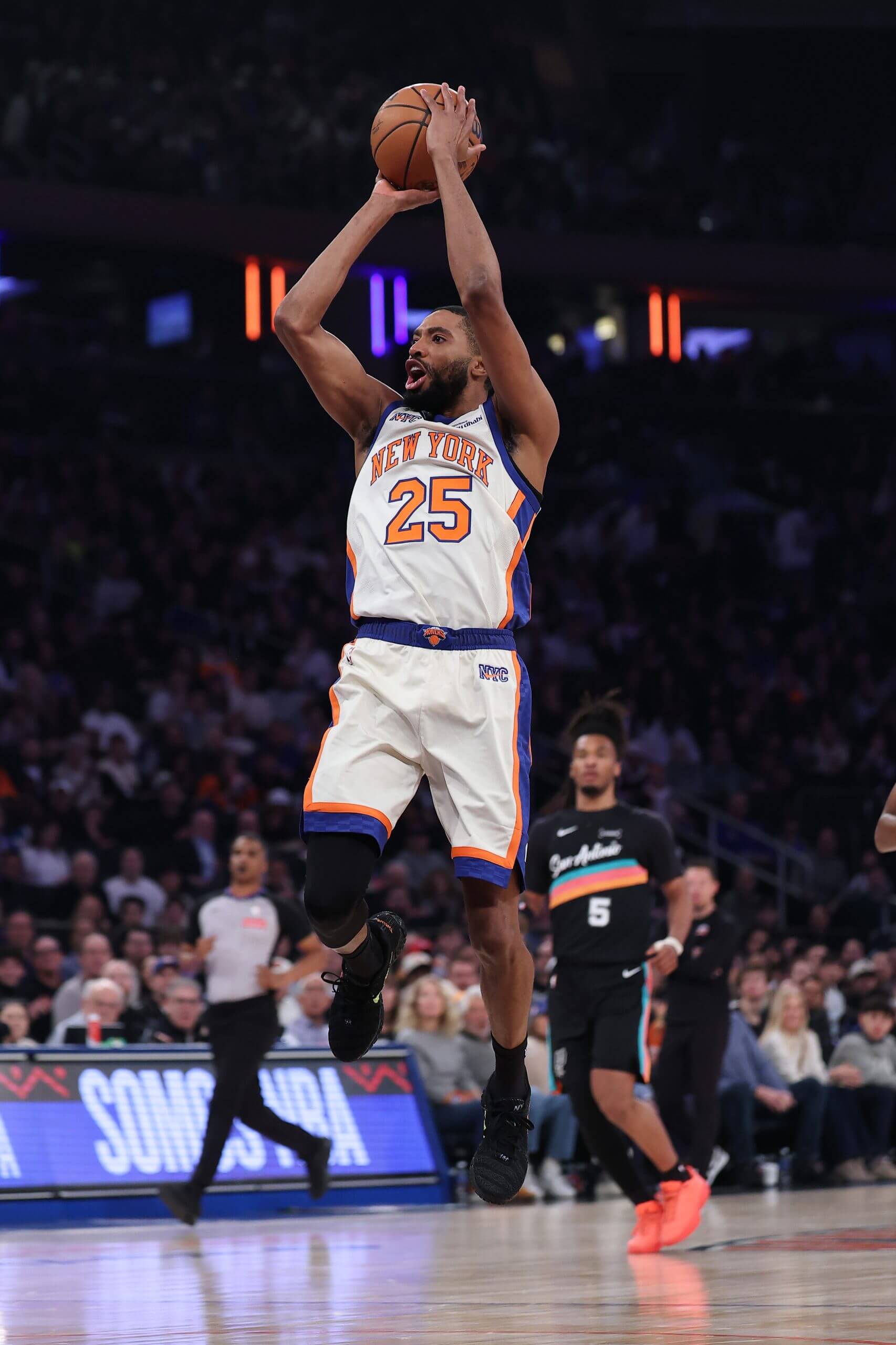
Mikal Bridges (25) and Jalen Brunson combined for 49 points and nine rebounds in New York’s win over the Spurs.
The word “sacrifice” has been a buzzword among the Knicks players since last season, when this roster of individual talents was assembled. Hart has talked about it ad nauseam. Brunson, too. Bridges emptied his heart just before the deadline during a postgame interview with MSG Network, saying he hadn’t been coachable enough and “maybe I felt too much entitlement.”
To be fair to Bridges, he has spent time on each end of the spectrum over his career. He went from being a role player on a promising Phoenix Suns team to a No. 1 option for a Brooklyn Nets squad that wasn’t going anywhere, only to get traded across the bridge. Suddenly, he found himself needing to find a balance between his previous basketball life and his new one on a team with championship aspirations.
Bridges has had to learn to sacrifice with the Knicks, just like all of his other talented teammates have, and that has been a work in progress.
“You come here and have Jalen and (Karl-Anthony Towns) and, offensively, might have to take a step back,” Hart told The Athletic about his viewpoint on Bridges’ relationship with sacrifice. “Sometimes that’s difficult. Sometimes that’s tough. You go from getting 15-20 play calls to getting three or four play calls. Mentally, it can take time to adjust to that. I think that’s something he’s worked with and getting more comfortable with it. He’s able to not worry about that or focus on that and play his game.”
New York doesn’t need Bridges to be the player we saw against the Spurs every night. He’s not going to always get 17 shots. The Knicks need Bridges to be willing to make the most of every opportunity he gets when shooting the ball. They need him to be more physical defensively when guarding the ball. They need him to be more willing to put his body on the line.
Bridges complicates his own game at times, which is why his season has become so complicated.