
If the NHL trade deadline sneaked up on you this year, you’re forgiven.
One moment, it was the first week of February, a whole month out from the March 6 fireworks. Just two Detroit Red Wings games later, after the Olympic break ate up nearly all of February, it’s deadline week already. And that means it’s decision time for general manager Steve Yzerman.
This year, the decision doesn’t seem to be whether to buy at the deadline. The Red Wings sit in a playoff spot as March begins, and though that position got a bit more tepid with Saturday’s 5-2 loss in Carolina — dropping Detroit from a divisional seed into a wild-card position — the Red Wings have been in the playoff picture all year long and have made a clear case their general manager should add.
The question, then, is just about the particulars: How much should Detroit add? Where? And in a suddenly more crowded market of viable sellers, who are the right fits?
With deadline week here, let’s sketch out what the ideal deadline would look like.
1. Add a top-four right-shot D
This is the true “must” of the week. A top-four D was an unmet need last offseason, and remains one 60 games into this Red Wings season.
Detroit has gotten by to this point, leaning heavily on its top pairing of Moritz Seider and Simon Edvinsson, plus veteran Ben Chiarot on the penalty kill and in late-game situations. But as the games get harder down the stretch, the need to solidify the second pairing next to Chiarot is only growing.
For most of the season, the Red Wings have looked to rookie defenseman Axel Sandin-Pellikka in that spot, and in many ways, the 20-year-old righty has already surpassed expectations by sticking in Detroit this long. But it’s been impossible not to notice the recent trend: Sandin-Pellikka went from averaging nearly 20 minutes a night through the first two months of the season to less than 16 since the start of December. His last two games have hovered around 12. And he has just 1 point in his last 15 games.
Sandin-Pellikka still has all kinds of runway and the potential to be a long-term offensive difference-maker in Detroit. But the recent results (and deployment) have made clear the Red Wings need to find another answer in their top four for this year (and maybe next season, too).
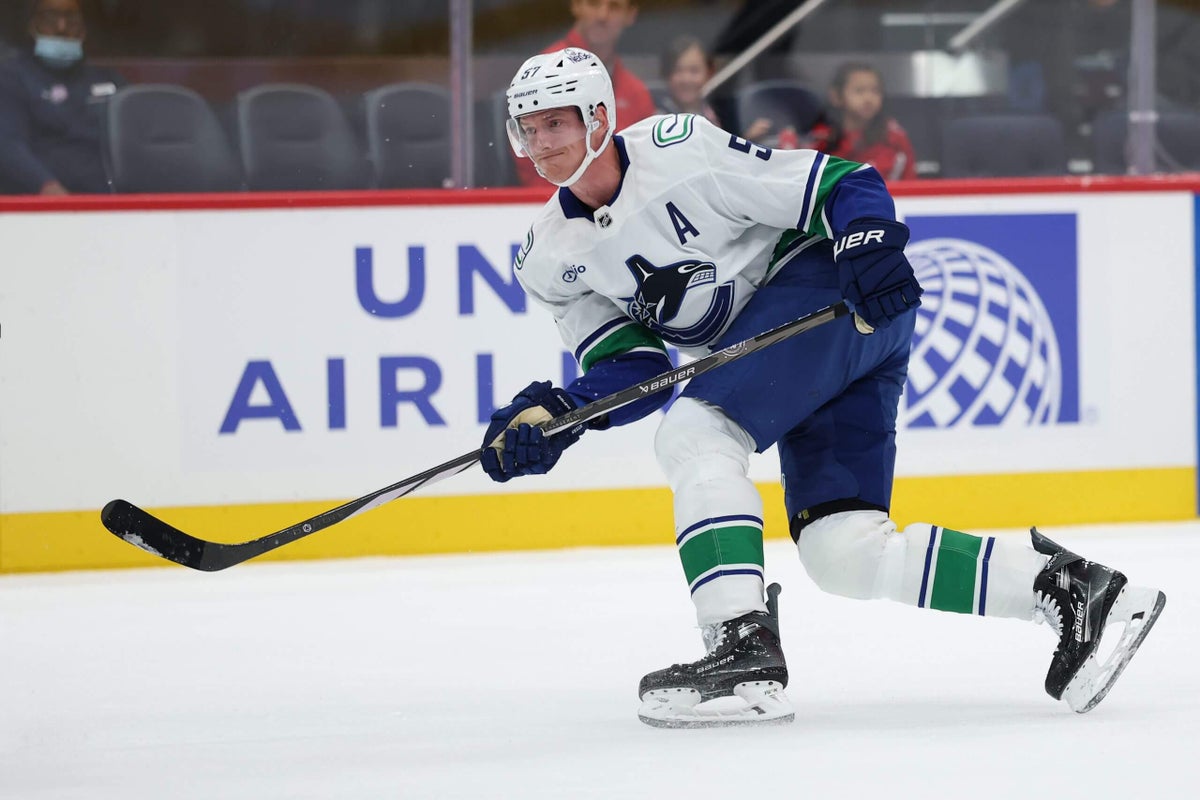
Multiple reports have linked the Red Wings to the Vancouver Canucks’ Tyler Myers, saying Detroit has an offer on the table for the 6-foot-8 blueliner. But Myers has a full no-move clause, and it remains to be seen whether he will waive it for Detroit.
If that deal were to come to fruition, Myers would certainly bring more size and experience to the Red Wings blue line. The 36-year-old is a 20-minute staple for the Canucks, and he can block shots and help clear the front of the net. He would be one of Detroit’s best six defenders right away and possibly one of its four best.
Playing him with Chiarot on the second pair, though, would still come with its share of questions. Though the pair would be physically imposing and able to withstand heavy forechecks, breakouts could still be a legitimate question. Myers’ underlying defensive numbers have been rocky this year, too, although that is true of the Canucks blue line as a whole.
If it doesn’t turn out to be Myers, there are still plenty of right-shot D names on the market of varying profiles and prices. Three stand out as ideal fits for Detroit: the St. Louis Blues’ Justin Faulk, the New Jersey Devils’ Dougie Hamilton and the Philadelphia Flyers’ Rasmus Ristolainen.
Ristolainen is a big, mobile defensive stopper who looks a lot like what the Red Wings have targeted in defenders under Yzerman. He’s 31 and signed through 2027 with a $5.1 million cap hit, which is easily manageable for the Red Wings, even though he wouldn’t bring much offense.
Hamilton carries the highest cap hit but should also be the cheapest to acquire for that reason. The Devils’ blue line is crowded, giving them incentive to shed his $9 million cap hit (through 2028). He’s more of a puck-mover than a defensive ace, but he still brings size and experience and would upgrade the second pair in the short term even if the final years of that contract could become an issue.
Faulk splits the difference in the profiles. He’s not as big as either, listed at 6 feet, but he’s 208 pounds and has steady underlying defensive numbers, and his 32 points in 59 games entering Sunday are by far the most of this group. He’s signed through 2027 at a $6.5 million cap hit and figures to be the most expensive option in terms of trade price, likely costing at least a first-round pick. But he could very well provide the most well-rounded upgrade, and for that reason stands out as the best realistic option.
All three would be credible second-pair fits for this season and at least one more, helping Detroit now without blocking Sandin-Pellikka from the top-four too far into the future.
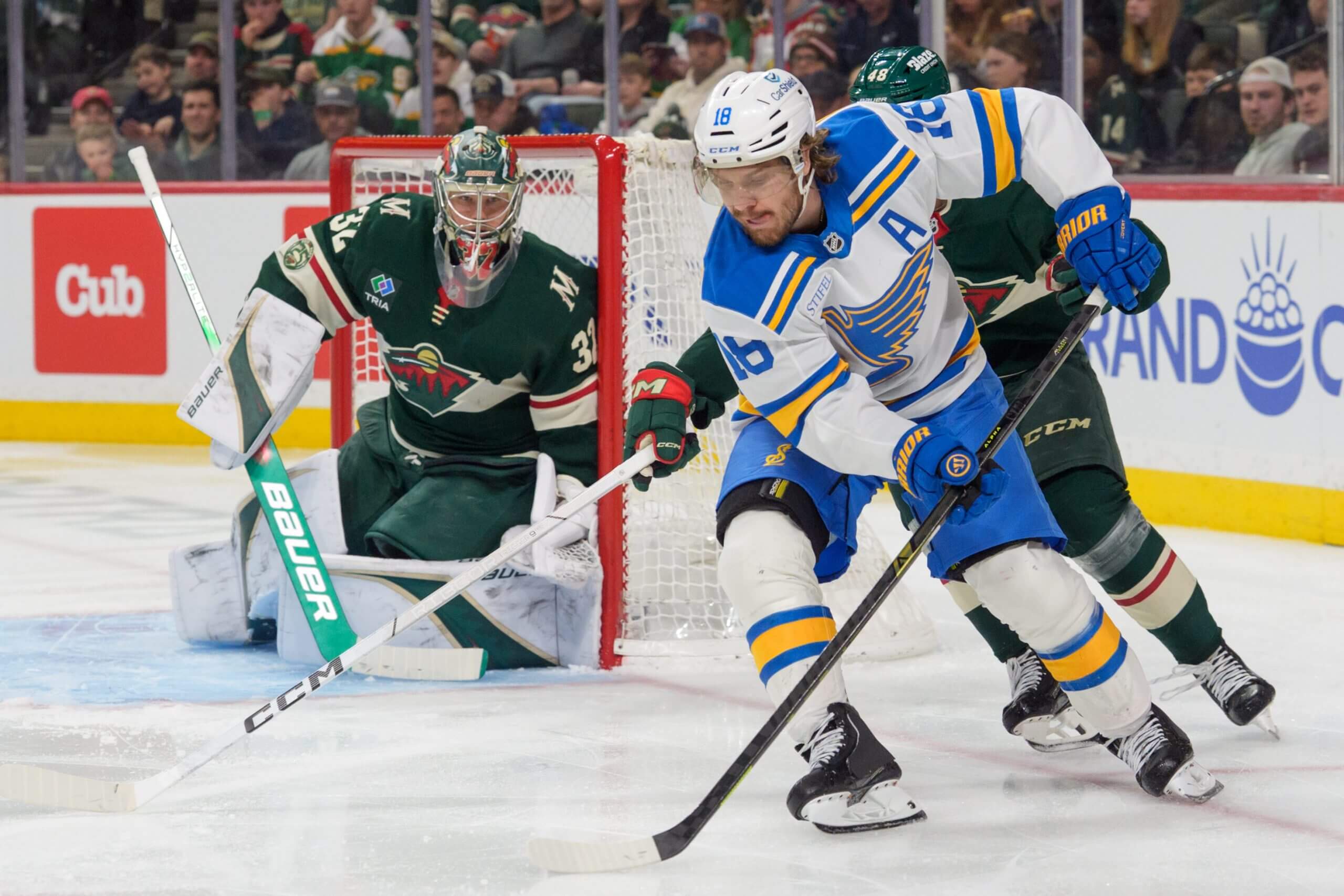
St. Louis Blues center Robert Thomas is a prime top-six center option for the Red Wings. Thomas would be pricey, but Detroit can meet it, both in picks and prospects. (Matt Blewett / Imagn Images)
2. Add a top-nine forward
Though the Red Wings’ blue line need has been clear for months, this one has become more evident as the season has gone on. Scoring at five-on-five has become a real issue for Detroit, which entered Sunday ranked 27th in the NHL with 2.06 goals per 60 at five-on-five. After the Red Wings’ 5-2 loss to the Carolina Hurricanes, coach Todd McLellan had this to say to reporters in Raleigh:
“Right now, for us, I think we have some players that are playing well, and playing hard, and then we have some guys that are just jerseys,” McLellan said. “And what I mean by that is they’re wearing jerseys, they’re skating around, they’re eating up some minutes, but we need more. We just flat-out need more. We talk about scoring five-on-five, we talk about forecheck — if you’re not forechecking and being physical, shooting, backchecking, winning faceoffs, blocking shots, then what are you doing? And we need more from some guys.
“You can’t just be on the team at this time of the year. You’ve got to be effective at this time of the year.”
Now, McLellan’s calling out his players is surely meant to light a fire and prompt some improvement from the roster. And perhaps it will. But it’s not the only way to address that problem, and there are potential needle-movers on the trade market.
The dream name would be St. Louis’ Robert Thomas, a prime-aged top-six center on a great contract ($8.125 million through 2031). Thomas hasn’t scored at quite the same rate this year as his 80-point campaigns the last two seasons, but he’s still producing like a fringe top-line center, with 35 points in 43 games, and could see those numbers tick back up in a new environment.
Thomas would be pricey — three first-half-of-the-first-round-level assets — but Detroit can meet it, both in picks and prospects, and the chance to add a center of Thomas’ caliber would be worth it. That’s even more true in a new salary-cap environment, with more teams able to extend their pending free agents, reducing the talent available July 1.
Another top-six center option would be the New York Rangers’ Vincent Trocheck, whose gritty, responsible game propelled him onto Team USA at the Olympics. Trocheck has also scored 20-plus goals in four straight seasons and between 50 and 77 points, making him a true two-way center. He’d still cost at least a first-round pick, plus more, but at 32 years old (and signed through 2029 at $5.625 million) he’d be cheaper than Thomas in asset cost and future price while being a needle-mover who can score in the playoffs.
Detroit can cast a wider net than just centers, though, as Andrew Copp’s play between Alex DeBrincat and Patrick Kane has been strong for months. And though Thomas and Trocheck, likely the two highest-impact forwards available, play center, the Red Wings could still get better by adding a gritty winger who can score such as Blake Coleman, Warren Foegele and Bobby McMann.
3. Keep the future in mind
Though the urgency of the moment is real, and Detroit should absolutely add this week to bolster its playoff chances, it bears mentioning that the Red Wings are looking to enter a contention window, not firmly within an open one.
Though spending big in a deal for someone such as Thomas is entirely justifiable, because of his age and contract, overpaying for true rentals or older players is a risk better avoided. And especially if Detroit does look to meet both needs this week, it might be more prudent to pick one of the two to really spend on and find a cheaper option for the other.
This should not be read as an excuse for them to do nothing, of course. The Red Wings have been patient long enough. But it’s still worth noting the long view remains relevant, even as Detroit shifts into a more competitive phase of the cycle.