
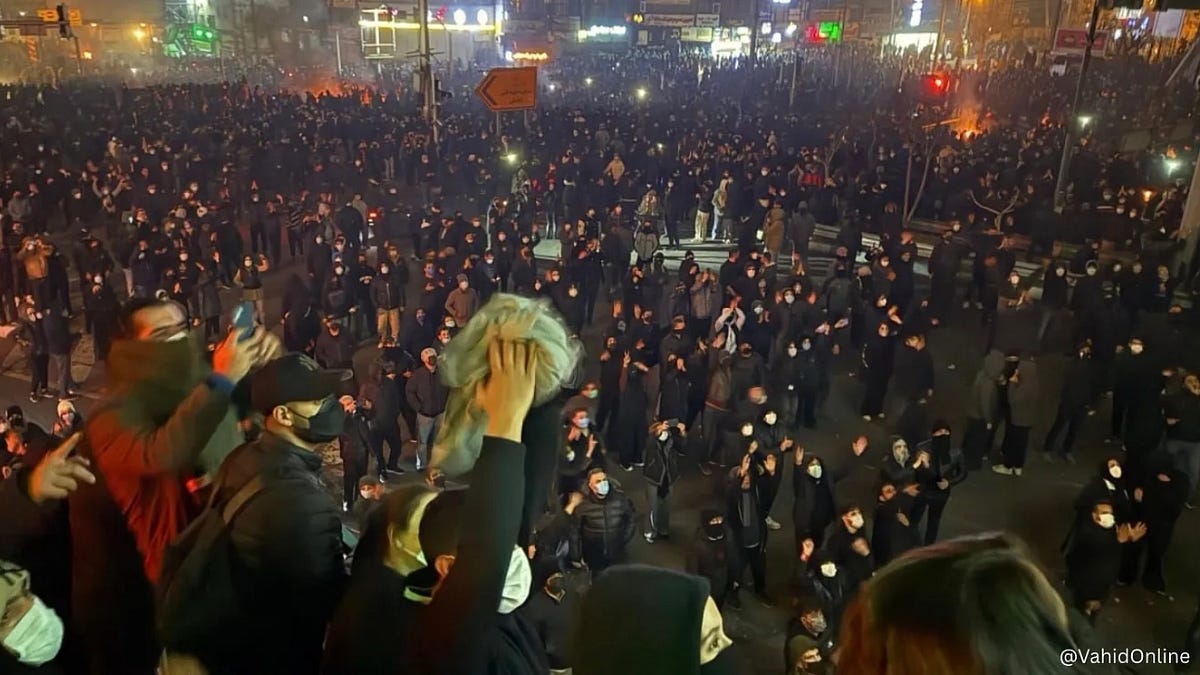
 Large crowds gather at an anti-regime protest in Tehran.
I was in the Old Executive Office Building at the White House on the day that Iraqi dictator Saddam Hussein fell in 2003. I had not supported President George Bush’s invasion of Iraq. But once the decision was made to go to war, I advocated for American support to establish a new democracy there after the autocracy collapsed. That day, the prospect of democracy in Iraq seemed closer than ever before. Bush administration officials were gleeful, watching on Fox News as exuberant Iraqis pulled down a statue of Saddam Hussein. I rejoiced too. The fall of tyrants must always be celebrated.
Years later, on February 11, 2011, I was back in the Old Executive Office Building, now working at the National Security Council, when Egyptian dictator Hosni Mubarak fell. That evening I hosted a party in my office for those involved in helping in the margins to facilitate this outcome. We watched on Al Jazeera as euphoric protesters gleefully danced and hollered in Tahrir Square. Some of them were my friends. We shared their joy that night. The fall of tyrants must always be celebrated.
This weekend, I felt a similar joy when another horrible dictator, Iranian Supreme Leader Ali Khamenei, was killed. I traded messages of “hallelujah” with Iranian-American friends. I watched on X the joyous celebrations on the streets of Tehran and other cities. I met so many people who were already exhausted with theocracy when I visited Iran in 2003, so I’ve been surprised at how long this tyrannical regime has endured. This weekend, at least for a few hours, it seemed like it might end. I did not support Trump’s decision to go to war. There was no imminent threat to the United States. War must always be a last resort. But I did rejoice at the end of Khamenei. The fall of tyrants must always be celebrated.
Now comes the harder part.
In his two speeches over the weekend, President Donald Trump called for the Iranian people to rise and take back their country. “When we are finished, take over your government. It will be yours to take. This will be probably your only chance for generations,” he said in a statement announcing that the U.S. had begun combat operations in Iran. He echoed the same call for revolution in his second statement about his war. But does Trump have a plan to foster a democratic transition in Iran? So far, the public evidence suggesting he does is thin—very thin.
The end of dictatorships rarely leads smoothly to the emergence of democracies. They take a lot of work to achieve success, often with protected engagement from international mediators and supporters. In the two cases of autocratic collapse I mentioned earlier, autocrats tragically reign again. That happens more times than not. Big revolutions against dictatorships have also historically struggled to produce democratic governance, as they often get hijacked by new autocrats. We know this from the French Revolution (1789), the Bolshevik Revolution (1917), the Chinese Revolution (1949), and the Iranian Revolution (1979) and the Soviet Revolution (1991).
Complicating matters in Iran today, US military intervention is rarely an effective instrument for fostering democratic regime change. By my count, American military intervention has produced democratic rule in only four of 17 cases; five if you count the U.S.-led invasion of Grenada in 1983. (For the details, see my book Advancing Democracy Abroad.) In three of the cases in which we succeeded—Germany, Italy, and Japan—the United States fought long wars. Then it stayed engaged in those countries for years afterwards, even governing as an occupying force, to help a new democratic regime succeed. In Panama, another successful case, the U.S. had to invade using American soldiers to produce democratic regime change. I can think of no successful case of democratic regime change in which the United States only bombed for a few weeks. Some wrongly described NATO’s 1999 bombing campaign against Serbian dictator Slobodan Milosevic as a successful case, but the military intervention was aimed at stopping the killing in Kosovo. Only a year and a half later did the Serbian people overthrow Milosevic, in October 2000, after he tried to steal an election.
In the last major war of regime change, Iraq 2003, the Bush administration drafted and then implemented a comprehensive plan for trying to impose democracy. The original war aim in Iraq was American security, albeit based on imperfect intelligence. But once Saddam Hussein’s regime fell, the goal switched to facilitating a democratic transition. That plan, despite the best intentions of Bush advisors in the country and major resources devoted to the project, failed. In 2025, Freedom House rated Iraq as unfree. (For details as to why it failed, read an account from one of those advisors on the ground, Larry Diamond. His book is called Squandered Victory: The American Occupation and the Bungled Effort to Bring Democracy to Iraq.)
To date, Trump has cheered for revolution in Iran but—in the public domain at least— we have seen no effort from his administration to craft a democratic outcome. Maybe they have a secret plan for undermining the theocracy still deeply entrenched inside Iran, despite the successful capitulation of its leadership over the weekend. Maybe the White House, CIA, and State Department are quietly communicating with potential leaders of Iranian civil society, both inside and outside the country. Successful transitions to democracy often require a “pact” between defectors from the old dictatorship and moderate forces from the democratic movement. (For instance, that’s what happened in Poland and South Africa. Read about those cases and others in this book, Transitions to Democracy: A Comparative Perspective. ).
It concerns me, however, that just days after the euphoria of Khamenei’s execution Trump administration officials have already begun walking back Trump’s own call for revolution. On March 2nd, Secretary of War Pete Hegseth declared that the goal of their war is “not about regime change.” Trump himself said he was ready to negotiate with the regime—the very same theocracy that he encouraged Iranian citizens to overthrow. As he told Atlantic reporter Michael Schere, “They want to talk, and I have agreed to talk, so I will be talking to them.”
Maybe, therefore, the reason we are not seeing any signs of a plan for the day after a dictator falls because Trump and his team do not care what happens next inside Iran. That would be a terrible tragedy. After decades of suffering under a repressive dictatorship, including the slaughter of tens of thousands of innocent protestors just several weeks ago, the Iranian people deserve better.