
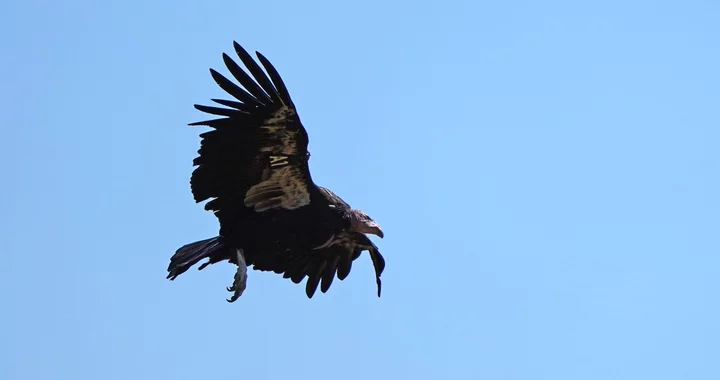
Condors A0 and A1 were close even as kids. Video: Yurok Tribe.
###
Press release from the Yurok Tribe:
A
free-flying pair of condors in the Pacific Northwest recently
established the region’s first nest in more than a century.
Based
on a series of behavioral changes and an analysis of flight data, the
Northern California Condor Restoration Program determined that
condors A0 (Ney-gem’ ‘Ne-chween-kah) and A1 (Hlow Hoo-let) may have
started tending to a newly laid egg in early February, although
actual confirmation of an egg is impossible due to the remoteness of
the nesting site. A0 would have deposited the egg within a cavity of
an old-growth redwood in the Redwood Creek drainage after months of
searching for the ideal location.
“This
is a huge moment for our Northern California flock,” said Chris
West, the Northern California Condor Restoration Program Manager and
Yurok Wildlife Department Senior Biologist. ““It is important to
remember that these are wild birds. We trap them occasionally for
health monitoring, but if they nest, and how successful they are, is
totally up to them, with as little interference from us as possible.”
NCCRP
is thrilled by this development, although much can still happen
between now and the potential hatch day. In wild populations, the
initial egg produced by a breeding pair of condors frequently
exhibits low survival, due to the adults’ lack of experience with
the incubation and care process.
“I
have been waiting for this moment since the first condors arrived in
2022,” said Yurok Wildlife Department Director Tiana
Williams-Claussen. “As a scientist, I know I shouldn’t get my
hopes up too high, but that doesn’t mean I can’t cheer for these
young parents’ success.”
Condors
A1 (studbook 969), and A0 (studbook 973) will incubate the
approximately 10‑ounce, light‑blue egg for 55 to 58 days.
These large scavengers engage in biparental incubation, with the male
and female alternating incubation duties and brooding and care of the
chick once it hatches.
NCCRP
staff are closely monitoring the breeding pair using data collected
from wing transmitters and field observations. Changes in the adult
condors’ rates and timing of feeding can be used to determine how
the nest is doing, hatching of a chick, and various stages of the
chick’s development. The NCCRP is also currently working through
the logistics for potential use of an unmanned aerial vehicle or
drone for visual confirmation of the nest.
Free
flying since 2022, A1 and A0 were among the first condors
reintroduced to the Northern California/Southern Oregon area.
Currently, 24 condors reside in the wild within Yurok ancestral
territory. With a goal of establishing a self-sustaining condor
flock, NCCRP plans to release at least one group of birds every
summer for at least 20 years.
A0
or Ney-gem’ ‘Ne-chweenkah’ which translates to “She carries
our prayers”, was the only female in the first released NCCRP
cohort. She is 6 years and 10 months old and was bred at Oregon Zoo
before being transferred to NCCRP for release in 2022.
A1,
nicknamed ‘Hlow Hoo-let’ which means “At last I (or we) fly!”,
is also 6 years and 10 months old and was bred at the World Center
for Birds of Prey.
Condors
are slow to reproduce, with females laying only one egg at a time,
and usually nesting only every other year. Young condors take months
to learn to fly and rely on their parents for more than a year. They
reach sexual maturity around 6 years old.
Most
commonly, condors stay paired with mates for successive years,
although a new partner will be sought if one dies. If condors fail to
produce a chick, they may split up, but they will typically remain as
a pair if successfully fledging chicks.
In
general, condors begin breeding between 6 and 7 years old and can
live more than 50 years. The next oldest male and female condors
under NCCRP management are 5 year and 11-month-old male A2 (studbook
1010) Nes-kwe-chokw, and 4 year and 8-month-old female A7 (studbook
1109) He-we-chek’.
Northern
California Condor Restoration Program
The
Northern California Condor Restoration Program is a partnership
between the Yurok Tribe and Redwood National and State Parks. The
program has received funding from U.S. Fish and Wildlife Service,
Bureau of Indian Affairs, Administration for Native Americans,
Pacific Gas and Electric Company, Global Conservation Fund, Redwood
National Park Foundation, and many small donations from the public.
The Yurok Tribe initiated the condor reintroduction project in 2008
as part of a long‑term effort to heal the landscape within
Yurok ancestral territory, a landscape to which the health and
well‑being of the Yurok people is inextricably connected. The
restoration of California condor, prey-go-neesh in the Yurok
language, is a vital part of this environmental and cultural
revitalization effort. Alongside condor recovery, the Tribe is also
undertaking large‑scale fish and wildlife habitat restoration
throughout the Klamath River, its tributaries, and the surrounding
region.
If
you’d like to support the Yurok Tribe’s condor restoration work,
please visit this link.