
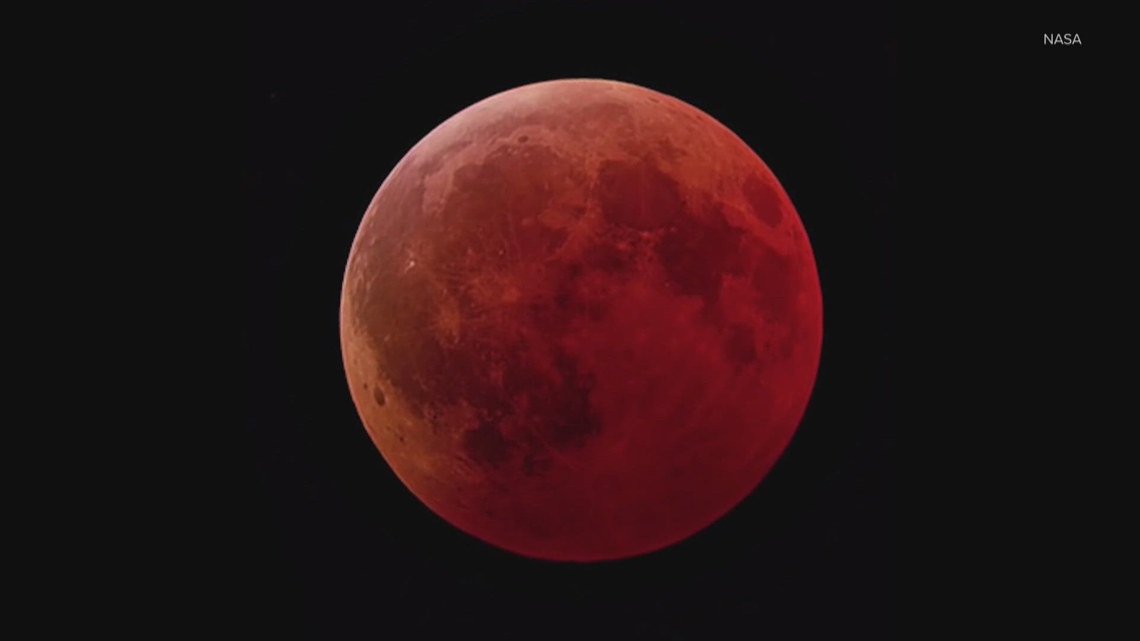
The eclipse of the March full moon, known this month as the Worm Moon, will begin around 1:50 a.m. and peak between 3:04 a.m. PST and 4:02 a.m. PST.
SEATTLE — A rare total lunar eclipse, often called a “blood moon,” will occur in the morning of Tuesday, March 3. But cloudy weather may make it difficult to observe in western Washington.
The eclipse of the March full moon, known this month as the “Worm Moon,” will begin around 1:50 a.m. and peak between 3:04 a.m. PST and 4:02 a.m. PST. Maximum eclipse will occur at 3:33 a.m., when the moon is perfectly aligned between the sun and the Earth.
High pressure over the past few days has given us plenty of clear nights and sunny afternoons. However, the system is moving slowly through western Washington and will pivot east through the night and into Tuesday morning. This will allow a front to approach the state Monday night with clouds increasing. Thicker clouds will move in after midnight into the early morning hours of Tuesday, impacting viewing of the total lunar eclipse.
The western United States in general will have the best view of the eclipse, while the East Coast may see the moon set during totality against the backdrop of the sunrise, a rare sight producing a selenelion, a phenomenon where the eclipsed moon and rising sun are visible at the same time due to refraction.
The eclipse begins in the penumbral stage, where only part of the sunlight is blocked, before the moon slides fully into Earth’s shadow.
During totality, the moon will take on a deep red color, the phenomenon that gives it the name “blood moon.” The effect is caused by sunlight filtering through Earth’s atmosphere: shorter blue wavelengths scatter away, while longer red wavelengths bend around the planet and fall on the lunar surface, similar to the way a sunset paints the horizon.
Total lunar eclipses happen every few years for any given location; the next one visible from North America is several years away.
The Worm Moon name has roots in the seasonal thaw, when earthworms begin to emerge. The Dakota people also call it the Sore Eyes Moon, a reference to the bright sunlight reflecting off late-season snow.