
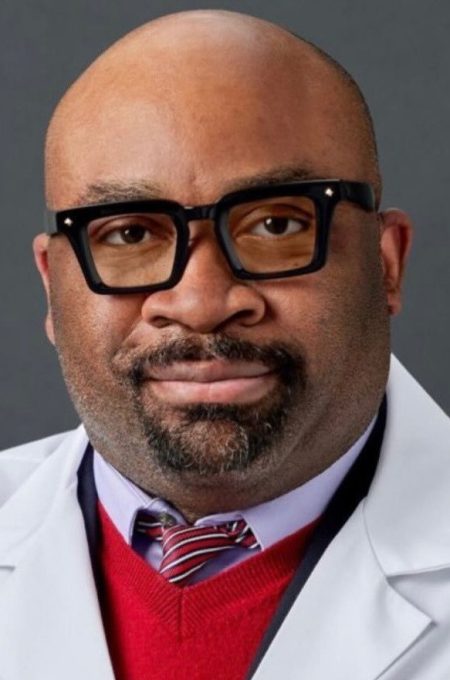
A spine surgeon who practiced in Longview is facing four malpractice lawsuits from patients who said he botched their surgeries, leaving them with long-term disabilities.
However, in a lawsuit against his now-former employer, the doctor states that he treats high-risk patients and has performed thousands of successful surgeries.
Dr. Babajide Ogunseinde is being sued in Gregg County courts by former patients Efrem Fryar, Tommy Hemphill, Arthur Perkins and Liquita Williams. The cases were filed in 2025 and 2026.
Since 2022, Ogunseinde has faced eight malpractice lawsuits in Gregg County. Four cases were settled or dismissed without further explanation, which means they could have been settled, as well.
In their lawsuits, patients complained that Ogunseinde performed medically unnecessary procedures or caused patients to have severe, permanent injuries. They’re seeking compensation for physical pain, mental anguish, medical bills and loss of wages, among other complaints.
Ogunseinde’s attorneys filed written responses to the lawsuits that generally deny the patients’ claims, but their responses do not provide specific information about the claims in each case. The News-Journal reached out to Ogunseinde and his attorneys for this story, but emails and calls requesting comment were not returned after several business days.
Meanwhile, Ogunseinde is suing his former employer, Longview Regional Medical Center, as well as its administrators for whistleblower retaliation, fraud, breach of contract and wrongful discharge, among other claims. That suit was filed in 2025 but has not progressed through the court system.
Ogunseinde is a Harvard-trained orthopedic spine surgeon who worked at Longview Regional and Orthopedics Regional Clinics. He has not been allowed to practice at the hospital since June, when he was the subject of an investigation, according to his lawsuit.
In 2024, Ogunseinde received FDA approval for a new method of treatment for lower back pain known as the PML SI Fusion Technique, a sacroiliac joint fusion. He devised the surgery while at Longview Regional. According to social media posts, Ogunseinde now trains other physicians how to perform that procedure, and they can sign up for education through his website, pmlmastery.com/.
‘Permanent injury’
Fryar’s lawsuit alleges that Ogunseinde performed a “negligent spine surgery” on Jan. 17, 2024, that left him partially paralyzed. Days before the surgery, Ogunseinde diagnosed Fryar with cervical disc disease. The lawsuit alleges that Ogunseinde injured Fryar’s spinal cord during surgery.
Hemphill underwent a thoracic spine surgery performed by Ogunseinde at Longview Regional on June 4, 2025, according to his lawsuit. During the procedure, interoperative neuromonitoring detected a possible spinal cord injury, but Ogunseinde continued with the procedure, according to the lawsuit.
After the surgery, medical imaging showed “new, severe spinal canal stenosis” consistent with surgical cement leakage and spinal cord injury, according to the lawsuit. Despite that, Hemphill wasn’t returned to surgery until the next day, a delay that eliminated “any realistic chance of neurological recovery and resulted in permanent injury.”
The lawsuit also states that postoperative care has shown that Hemphill didn’t need the surgery in the first place.
‘Nonsensical’
Between 2022 and 2024, Williams underwent three surgeries performed by Ogunseinde that left her permanently disabled, according to the lawsuit.
The lawsuit alleges that Ogunseinde placed iliac bolts in the wrong position during a surgery and performed a vertebral laminectomy without stabilization, causing Williams to have a hunchback condition known as a kyphotic deformity. (A laminectomy involves removing the back part of a vertebrae to make additional room for the spinal canal, according to the Mayo Clinic.)
Ogunseinde also obtained Williams’ consent to operate on her third and fourth vertebrae, but he actually performed the operation on her second and third, according to the lawsuit.
“It has become apparent through medical evidence and medical documentation that Ms. Williams was misdiagnosed and her treatment and surgeries were not warranted because she suffered congenital fusions, which should have been managed in a much different manner,” the lawsuit states.
Dr. Henry Barnard II, a board certified orthopedic spine surgeon in Georgia, was hired by Williams’ attorney, Todd Turner, to review the case. In a letter, Barnard opined that Ogunseinde violated the standard of care and misdiagnosed Williams, thus performing incorrect surgeries. Barnard wrote that one surgery was “honestly nonsensical because it is contradictory to her anatomy.”
‘Negligent performance”
Perkins’ suit, filed in June 2025, seeks monetary relief of more than $1 million.
On June 20, 2023, Perkins underwent a spinal surgery by Ogunseinde. During the surgery, Perkins sustained a dural tear, which is a tear in the membrane covering the spinal cord. Ogunseinde attempted to repair the tear but failed, and he did not document the injury, according to the lawsuit.
During his post-operative hospital stay, Perkins developed symptoms consistent with a spinal fluid leak, but nursing staff failed to adequately assess Perkins, notify physicians or “advocate for patient safety,” according to the lawsuit.
“The failure of the Defendants to appropriately document and treat the dural tear, and the nursing staff’s failure to recognize and respond to signs of CSF leak complications, caused further injuries and damages to Plaintiff,” the lawsuit states.
Ogunseinde performed “a much more invasive surgery than was medically necessary” for Perkins’ condition, according to the lawsuit.
Perkins suffers from left foot drop, lumbar pain, paresthesias (a tingling sensation) and gait abnormalities following the surgery, none of which he had prior to the surgery, according to the lawsuit.
“These permanent neurological complications are direct consequences of Dr. Ogunseinde’s negligent performance of an unnecessarily invasive surgery, his failure to properly manage the intraoperative dural tear, his misrepresentation to subsequent providers, and his delay in providing post-operative care,” according to the lawsuit.
Longview Regional lawsuit
In August 2025, Ogunseinde filed a lawsuit against Longview Regional and several administrators. He accuses hospital leaders of suspending him after he complained that untrained staff were being assigned to assist him during surgeries.
The suit further alleges that hospital administrators sought to harm Ogunseinde’s career. The lawsuit asks for an internal Medical Executive Committee investigation to end and for the hospital to restore Ogunseinde’s surgical, medical and staff privileges there.
Ogunseinde has been prohibited from performing surgeries at the hospital since June 11, 2025. The lawsuit alleges there was “no probable cause” for restrictions to be placed on his practice.
Ogunseinde has more than 15 years of experience, and prior to his termination from Longview Regional, he performed between 450 and 500 surgeries annually, according to the lawsuit. He frequently treated patients from across the state and nation and has received national recognition for his PML SI Fusion Technique. The lawsuit states this procedure has brought patients “outstanding medical success.”
Ogunseinde performed his orthopedic surgical residency at Harvard University from 2004 to 2009 and his orthopedic spine surgical fellowship there from 2009 to 2010. He worked at the Longview Orthopaedic Clinic Association from 2010 to 2024, and he became a physician at Longview Regional in 2024.
Ogunseinde had the support of former Longview Regional CEO Steve Gordon, according to the lawsuit. However, after Gordon left to take another job in March 2025, the hospital began using “new, inexperienced and unqualified staff” in spine surgery, according to the lawsuit. That included inexperienced and non-certified surgical technicians and nurses who had no experience “in surgically assisting the performance of a spine surgeon such as Dr. Ogunseinde,” according to the lawsuit. “This is unlawful in Texas.”
On May 14, 2025, Ogunseinde told hospital administrators he was concerned about untrained staff being selected to assist in surgeries. Two days later, a high-risk patient died in surgery, according to the lawsuit. The patient was unkempt and had severe health problems, and a hardware rod in his back had been exposed for months; the patient had covered the rod with a rag and became septic.
The patient had severe heart disease and died of a heart attack during surgery. An independent reviewer found no fault on the part of the surgical team or Ogunseinde.
In June 2025, two surgeries resulted in complications, with one patient suffering a spinal cord stroke resulting in paraplegia and another patient – an 86-year-old woman – dying. The elderly woman had severe health problems. Independent reviewers again found no fault on the part of the surgical team or Ogunseinde.
On June 11, 2025, hospital administrators met with Ogunseinde and told him his surgeries would be paused temporarily amid “anonymous reports of complications” related to surgeries. Investigative procedures ensued, but hospital leaders did not prepare a written report of the findings or recommendations. The investigative committee did not say Ogunseinde needed any adverse corrective actions before returning to work. However, the investigation was not closed, and one month later, Ogunseinde’s privileges at the hospital were suspended.
On July 10, Ogunseinde was terminated “for cause” but, but no specific reasons were given for his termination. This action violated Ogunseinde’s employment agreement, according to the lawsuit.
The lawsuit states that the hospital acted to “unfairly oust Dr. Ogunseinde from his successful surgical and medical practice at the Hospital without procedural due process” and to interfere with his physician-patient relationships.
Lawsuits not indication of malpractice
Although several lawsuits have been filed against Ogunseinde, the sheer number of lawsuits filed is not an indication of malpractice, according to a personal injury attorney.
“Because there’s multiple malpractice filings over several years, it could look like a pattern, but that volume alone doesn’t tell the full story,” said Amanda Demanda, a personal injury attorney who practices in Florida and Texas. “Spine surgery in general is a very high-risk field, and complications do occur a lot more than in other areas of medicine. So, you do see a lot more lawsuits against orthopedic surgeons and neurosurgery and anything to do with the spine.”
In malpractice lawsuits, courts rely heavily on expert opinions from independent specialists to determine whether a provider delivered a substandard level of care, Demanda said. Even if serious medical complications occur during or after a surgery, that doesn’t mean a physician delivered a substandard level of care, which is the basis for a claim in a malpractice suit, Demanda said.
Oftentimes, malpractice lawsuits become a “battle of the experts,” with an independent physician saying he would have performed a given surgery differently than the surgeon targeted by the lawsuit, she said. At that point, it’s up to a jury to decide whether a substandard level of care was delivered.
“A nerve injury, a hardware placement issue or a post-operative complication sometimes just occur because of a plethora of reasons, and not all indicate malpractice,” Demanda said. “So, each one of these cases will probably have an uphill battle to really explain how this injury was caused by substandard care and not just because there’s more than one lawsuit against this particular doctor.”
In court, Ogunseinde could argue that his patients were in worse condition than he previously thought and that, despite his attempts to deliver appropriate care, issues still arose during surgery. She also tells people not to jump to conclusions about a medical provider simply because he or she has faced malpractice lawsuits. Patients should always choose a provider they are comfortable with after talking with them and learning about them.
“It’s important that every case be analyzed on its own merits,” Demanda said.