
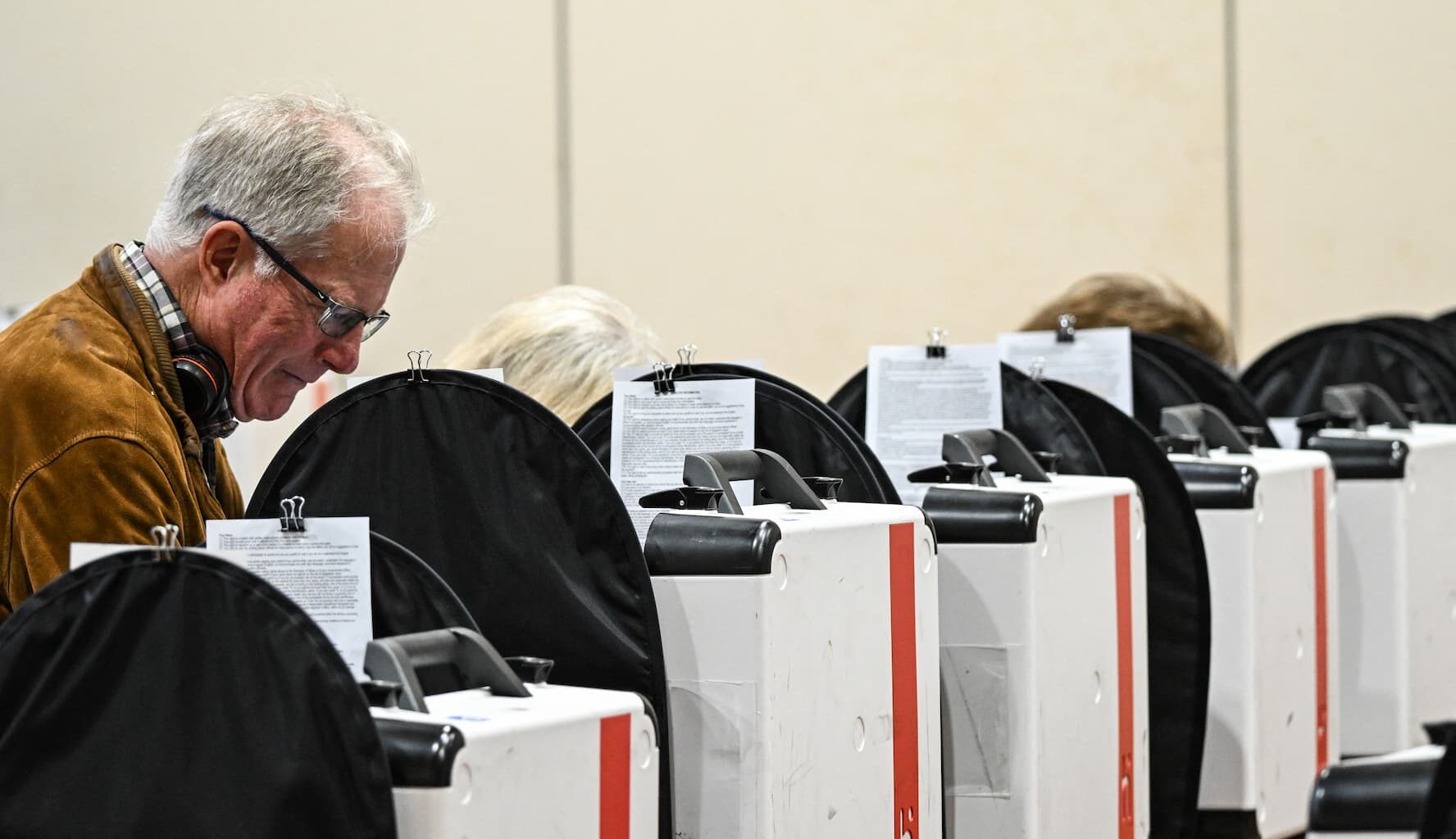
Over the next seven months, most states will hold primary elections to determine congressional candidates for their respective districts and states. There are two ways of analyzing midterm elections: the macro and the micro. The macro forces at work vary little from one midterm cycle to another. As my colleague William Galston noted in a recent analysis, the president’s party almost always loses seats in midterm elections, and the president’s approval rating historically has a significant impact on seat fluctuations.
Persistent inflation and concerns over consumer prices, alongside a voter backlash regarding immigration policy, have contributed to low approval ratings for President Trump. As of this writing, there is an 11.2 percentage-point gap between his approval and disapproval ratings. This appears to correlate with a 4.4 percentage-point advantage for Democrats when voters are asked their preference for a party in the upcoming midterm elections.
What factors, then, could alter this trajectory between now and November?
Plenty.
There is still time for the president to adjust his administration’s course. One primary objective—already underway—is to scale back Immigration and Customs Enforcement deportation efforts to prevent further fatal encounters, such as those recently seen in Minnesota. Additionally, the president could benefit from demonstrating greater empathy for Americans facing economic hardship while providing a credible narrative on his efforts to assist them. While these are achievable tasks, his recent State of the Union address suggests that such a strategic “reset” may not be in the cards.
The second factor that could alter the midterm trajectory is candidate quality. Republican and Democratic primary voters may nominate candidates who appeal to their party’s base but struggle to win a general election. Consequently, a central question leading up to November is whether the two parties nominate individuals who increase or decrease their chances of victory.
Political party leaders once controlled the nomination of candidates, a system that remains common in many democracies worldwide. In the United States, however, a wave of democratic reforms has shifted that power from party leaders to primary voters. Each method has its flaws. In many states, primary elections have very low turnout, which can result in the nomination of candidates who lose despite a favorable political environment for their party.
The 2010 midterm elections illustrate how the primary process can negatively affect a party’s electoral prospects. That year, Republican primary voters nominated several candidates whose personal or political controversies ultimately cost them the general election. This prevented Republicans from gaining control of the Senate despite a favorable political environment for the party.
A notable example occurred in Delaware, where Republican primary voters—many associated with the Tea Party—nominated Christine O’Donnell over the more experienced former Governor Mike Castle. It was generally believed that Castle would have been more competitive for the Senate seat vacated by Vice President Joe Biden and held by an interim appointee. O’Donnell was called “unhinged” by the Republican Party chairman of Delaware, and her campaign was marked by character attacks and and claims that were widely challenged as dishonest. But she is perhaps best remembered as the only candidate for the U.S. Senate to release an advertisement declaring, “I’m not a witch,” following the resurfacing of television clips where she admitted to having “dabbled in witchcraft” and described a “date with a witch… on a satanic altar.”
Thus, the results of the congressional primaries beginning this week could strengthen or weaken the projected Democratic wave, depending on which candidates prevail. For more than a decade, Brookings has published studies of every congressional primary candidate in both parties. Generally, primary candidates are white, male, married, and college-educated. In specific cycles, such as 2018, the number of female candidates increased dramatically; additionally, Black candidates primarily run in Democratic, rather than Republican, primaries.
In addition to analyzing candidate demographics, we identified candidates by their ideological positioning to understand intra-party factions and their performance in general elections. While the coding varied annually to reflect shifting political divisions, each study evaluated the relative influence of these factions compared to establishment candidates.
In 2014, for example, the “insurgent” Tea Party struggled to win primary House seats and had even less success in the Senate.
In 2016, business-oriented and establishment Republican candidates performed similarly to 2014, outperforming both Tea Party and conservative candidates. On the Democratic side that same year, candidates identified as progressives performed worse than mainstream Democrats.
In 2018, the Democratic field included an equal number of establishment and progressive candidates, with non-incumbent establishment candidates winning more frequently. On the Republican side among non-incumbents, establishment candidates outperformed their Democratic counterparts, winning 40% of their primaries compared to 24.8% for conservative candidates.
The 2022 cycle introduced a MAGA wing to the project’s coding, which showed that while these candidates lagged behind mainstream Republicans, Donald Trump’s endorsements yielded a 96.5% win rate.
The 2024 election saw MAGA candidates become the plurality of successful Republicans, while mainstream Democrats continued to have higher win rates than progressives.
Congressional primaries reveal critical insights into American politics. First, they indicate the relative popularity of factions within a political party. Over the past 12 years, the MAGA wing of the Republican Party has achieved greater electoral success than the progressive wing of the Democratic Party—an observation that aligns with the “asymmetric polarization” thesis proposed by Thomas Mann and Norman Ornstein in 2012. Factional candidates who are successful in the general election encourage more factional candidates to run in subsequent cycles.
Second, the relative strength of factional candidates serves as an effective predictor of how a party’s caucus will operate once the election is over and governing begins. For instance, the influence of Freedom Caucus and MAGA-aligned members on the House Rules Committee has frequently challenged mainstream Republicans and prevented potentially bipartisan legislation from reaching the House floor.
And, as noted at the outset, an overabundance of factional candidates on either the far right or the far left in swing districts can turn a “wave” into a trickle. The process of selecting those candidates is now underway.